

Paragon vs Unified: Choosing the Right Integration Platform
Summarise the blog with AI
Did you know that only 2% of organizations have integrated more than half of their business applications? Many companies struggle with fragmented workflows across HRIS, ATS, payroll, time, and benefits systems. This lack of integration leads to payroll errors, inconsistent employee records, delayed onboarding, and compliance risks.
When evaluating platforms like Paragon and Unified, architecture decisions directly impact reliability, scalability, and long-term maintenance. Connector-specific logic, polling-based syncs, and schema drift increase engineering effort as integrations grow across multiple vendors, making platform choice critical for long-term efficiency.
In this blog, you'll explore Paragon, Unified, and other leading integration platforms, highlighting scalable, reliable options that reduce engineering effort and support accurate, timely HR and payroll processes.
Key Takeaways
- Paragon prioritizes depth, flexibility, and full access to system-specific APIs for complex, product-grade integrations.
- Unified focuses on speed, standardization, and a consistent schema across multiple vendors for rapid integration.
- Both platforms have trade-offs: Paragon requires more upfront engineering, while Unified may limit access to advanced or custom features.
- Some teams need specialized, purpose-built unified APIs to balance flexibility, speed, and reduced maintenance across multiple HR/payroll systems.
- Many teams choose based on use case: Paragon for deep, customized integrations; Unified for standardized, fast deployments; alternatives like Bindbee, Merge, or Finch for scalable, unified solutions across multiple providers.
What Paragon and Unified Bring to Modern Integrations
Integration platforms streamline how systems communicate, reduce engineering effort, and ensure consistent, reliable data across multiple applications. Paragon and Unified take different approaches to achieve this.
Paragon: Built for Product-Grade Integrations
Paragon is an embedded integration platform (iPaaS) that enables teams to build, manage, and ship deep integrations directly within their products. It offers pre-built connectors, managed authentication, event-driven workflows, custom logic, and white-labeled experiences, making it ideal for teams that treat integrations as a core product feature rather than just a connectivity layer.
Unified: Built for Speed, Consistency, and Scale
Unified provides a single, normalized API across multiple third-party systems within a category, such as CRM, HRIS, or accounting. Key features include a consistent data model, real-time API proxying, no long-term data storage, and SDKs for faster setup, simplifying the creation of standard CRUD-based integrations.
Both approaches can simplify integrations and reduce engineering effort. They differ dramatically in depth, flexibility, and long-term scalability, which is why picking the right pattern matters for HR, payroll, and benefits integrations.
Paragon vs Unified: Key Differences
The right integration platform shapes your workflow efficiency, data reliability, and long-term scalability. Comparing Paragon and Unified helps you decide whether depth, flexibility, or speed and standardization best serve your HR and payroll operations:
With the core distinctions clear, let’s explore how each platform handles HR, payroll, and finance integrations in practice.
How Paragon vs Unified Handles HR and Payroll Integrations
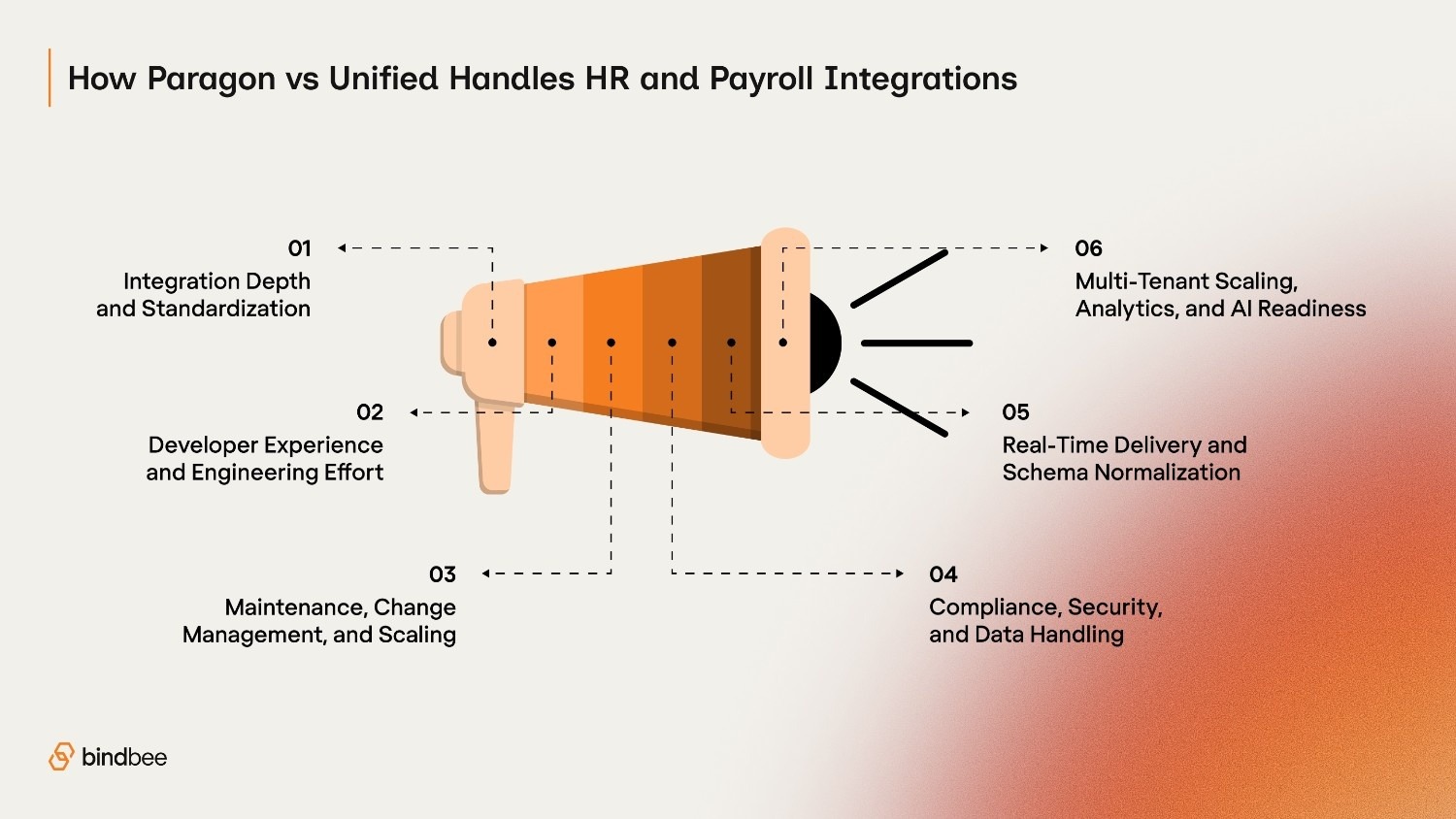
Integration strategy directly affects reliability, scalability, and engineering effort. Paragon prioritizes depth and flexibility, while Unified emphasizes standardization and speed. The choice impacts every payroll run, HR sync, and finance workflow. Below are the approaches that help teams build accurate, timely, and maintainable HR, payroll, and finance integrations:
1. Integration Depth and Standardization
HR and payroll systems vary widely, with some hiding critical fields and others exposing hundreds of endpoints. Platform choice determines how effectively you manage these differences.
Paragon:
- Full control for deep, event-driven integrations.
- Supports vendor-specific objects, conditional automation, and isolated logic per client.
- Audit trails simplify debugging and prevent cascading errors.
- Example: Automates department-specific commission calculations without affecting other workflows.
- Trade-off: Requires upfront workflow design and ongoing maintenance, but prevents costly errors as operations scale.
Unified: Prioritizes predictability and speed.
- Standardizes employees, contacts, invoices, and benefits across 20+ vendors.
- Eliminates per-vendor mapping for faster onboarding and reduced QA cycles.
- Declarative, platform-wide logic scales consistently across clients.
- Example: A mid-sized HR services firm needs to onboard 15 clients’ HRIS systems within a week. Unified allows them to pull employee and benefits data in a standardized format, populating dashboards immediately.
- Trade-off: Limited flexibility; highly customized workflows may need workarounds.
2. Developer Experience and Engineering Effort
Not all teams want the same level of control. Some treat integrations as core infrastructure, while others need quick, low-friction connections.
Paragon: Built for infrastructure-heavy teams embedding integrations directly into products.
- Supports multi-step workflows and conditional automation across vendors.
- Encourages structured data modeling, reducing the need for future refactoring.
- Integrates directly into SaaS products without external connectors.
- Example: A payroll SaaS implements client-specific leave accrual rules based on seniority, department, and local labor laws. Using Paragon, engineers can automate these rules safely per client while ensuring payroll calculations and reporting remain accurate across hundreds of accounts.
- Trade-off: Upfront engineering effort is significant. Teams must plan workflows and maintain connector logic. Once built, these integrations scale reliably and reduce future firefighting during complex updates.
Unified: Designed for rapid onboarding and minimal setup.
- Single, normalized schema works across multiple HR/payroll systems.
- Reduces per-vendor setup time and QA cycles.
- Example: A staffing agency needs to onboard 10 new clients into its HR systems in a single day. Unified lets the team pull employee records, payroll data, and benefits into dashboards immediately, enabling reporting without writing client-specific logic.
- Trade-off: While deployment is fast, unusual scenarios, such as clients with non-standard leave policies or multi-layered payroll deductions, may require manual workarounds or additional engineering later, limiting flexibility for complex workflows.
3. Maintenance, Change Management, and Scaling
As systems grow, poorly designed integrations can cause cascading failures, unexpected errors, or operational headaches.
Paragon: Isolates vendor-specific logic to reduce operational risk.
- Supports independent connector updates and complex multi-tenant workflows.
- Audit trails make troubleshooting predictable.
- Example: A global enterprise adds a new payroll provider for its regional office. Paragon allows the integration to enforce local tax and labor rules for that office without disrupting payroll workflows in other regions.
- Trade-off: Engineers must actively manage connectors and workflows. Oversight is required, but this approach ensures long-term stability, isolates failures, and allows complex, client-specific configurations to scale safely.
Unified: Uses normalized schemas to simplify maintenance.
- Updates propagate consistently across clients.
- Reduces per-vendor QA, but edge cases require special handling.
- Example: A mid-market HR platform introduces a custom benefits field for a single client. With Unified, the schema change must be applied across all clients, potentially impacting dashboards or reporting for other accounts.
- Trade-off: Maintenance and onboarding are faster, but fine-grained control is limited. Complex or unique client requirements may need workarounds, making highly customized workflows harder to implement.
4. Compliance, Security, and Data Handling
HR and payroll data are highly sensitive. Platform choice directly affects regulatory risk, operational safety, and compliance workload.
Paragon: Flexible for regulated environments.
- Supports end-to-end compliance workflows with audit trails.
- Securely handles temporary adjustments or sensitive employee data.
- Example: A multinational company faces a sudden change in tax regulations. Paragon allows the payroll team to adjust calculations for a single client’s office without affecting other clients’ payroll or reports.
- Trade-off: Teams are responsible for configuring and maintaining compliance workflows. This requires expertise, but it provides full control and ensures the platform can handle complex, client-specific regulatory scenarios.
Unified: Reduces compliance overhead.
- Proxy requests in real time and avoids storing end-customer data.
- Minimal data persistence lowers exposure and risk.
- Example: A mid-sized payroll provider updates payroll logic for 50 clients at once. Unified enforces GDPR compliance automatically without storing employee data, reducing operational burden.
- Trade-off: Offers less flexibility for unique regulatory cases. Teams gain speed and safety, but highly customized compliance adjustments may require workarounds.
5. Real-Time Delivery and Schema Normalization
Accurate and fresh data is critical for Payroll accuracy, reporting, and analytics. Platform choice determines how timely updates propagate across systems and how much engineering effort is required.
Paragon: Flexible synchronization via polling, webhooks, and workflows.
- Supports complex event-driven payroll and finance calculations.
- Exposes raw schemas for custom transformations.
- Example: A retail client runs hourly sales incentives that affect payroll deductions. Paragon ensures these adjustments propagate to payroll and accounting systems in near real-time, maintaining accuracy across multiple systems.
- Trade-off: Engineers must actively monitor syncs, manage schema drift, and maintain fallback logic. Flexibility comes at the cost of higher operational overhead.
Unified: Delivers real-time, normalized, database-ready streams.
- Native and virtual webhooks automatically propagate consistent updates.
- Pre-normalized schemas feed dashboards, BI, and AI pipelines instantly.
- Example: A staffing platform adds new hires or updates benefits across 100 client accounts. Unified automatically syncs all systems and dashboards without extra coding, reducing engineering effort.
- Trade-off: Standardization simplifies operations but constrains handling of unusual vendor-specific data transformations or custom payroll rules.
Many teams now leverage purpose-built unified APIs like Bindbee, which connect 60+ HRIS, payroll, ATS, and benefits systems through a consistent employment data model, reducing integration time and simplifying schema normalization.
6. Multi-Tenant Scaling, Analytics, and AI Readiness
Scaling across hundreds of clients while keeping data actionable is the ultimate test for HR and payroll integrations.
Paragon: Workflow-centric, client-specific scaling.
- Supports unique approval flows and conditional logic per client.
- Enables custom analytics pipelines for predictive modeling and forecasting.
- Example: A large consulting firm manages clients across multiple regions, each with different payroll rules. Paragon allows the firm to process region-specific payroll while using raw timesheet data to forecast staffing needs and attrition trends per region.
- Trade-off: Requires careful oversight; scaling is highly flexible but demands disciplined workflow management and monitoring.
Unified: Declarative, platform-wide approach.
- One integration scales seamlessly across tenants and vendors.
- Normalized data feeds BI dashboards, analytics, and AI systems instantly.
- Purpose-built unified APIs like Bindbee provide consistent workflows and normalized objects across all connected systems.
- Example: A SaaS HR platform integrates payroll, benefits, and employee records for 200+ clients. Executives can view real-time dashboards across all accounts without additional engineering or client-specific adjustments.
- Trade-off: Less flexibility for client-specific customizations, but predictable scaling, reduced engineering effort, and instant analytics make it ideal for uniform, high-volume deployments.
Also Read: Unified API v/s Workflow Automation v/s ETL
Paragon and Unified illustrate two common integration approaches: depth-first and standardized APIs. However, companies with diverse HR, payroll, and ATS systems may find that neither platform fully meets their needs.
Let’s explore alternative platforms that offer solutions optimized for specific workflows, scalability, and engineering requirements.
Top 3 Unified API Alternatives to Paragon and Unified
While Paragon and Unified offer proven approaches to integrations, many teams seek alternative platforms that balance depth, speed, flexibility, and scalability. Exploring these options helps organizations select solutions that best match their technical requirements, workflow complexity, and long-term growth.
Here are three alternatives worth considering:
1. Bindbee
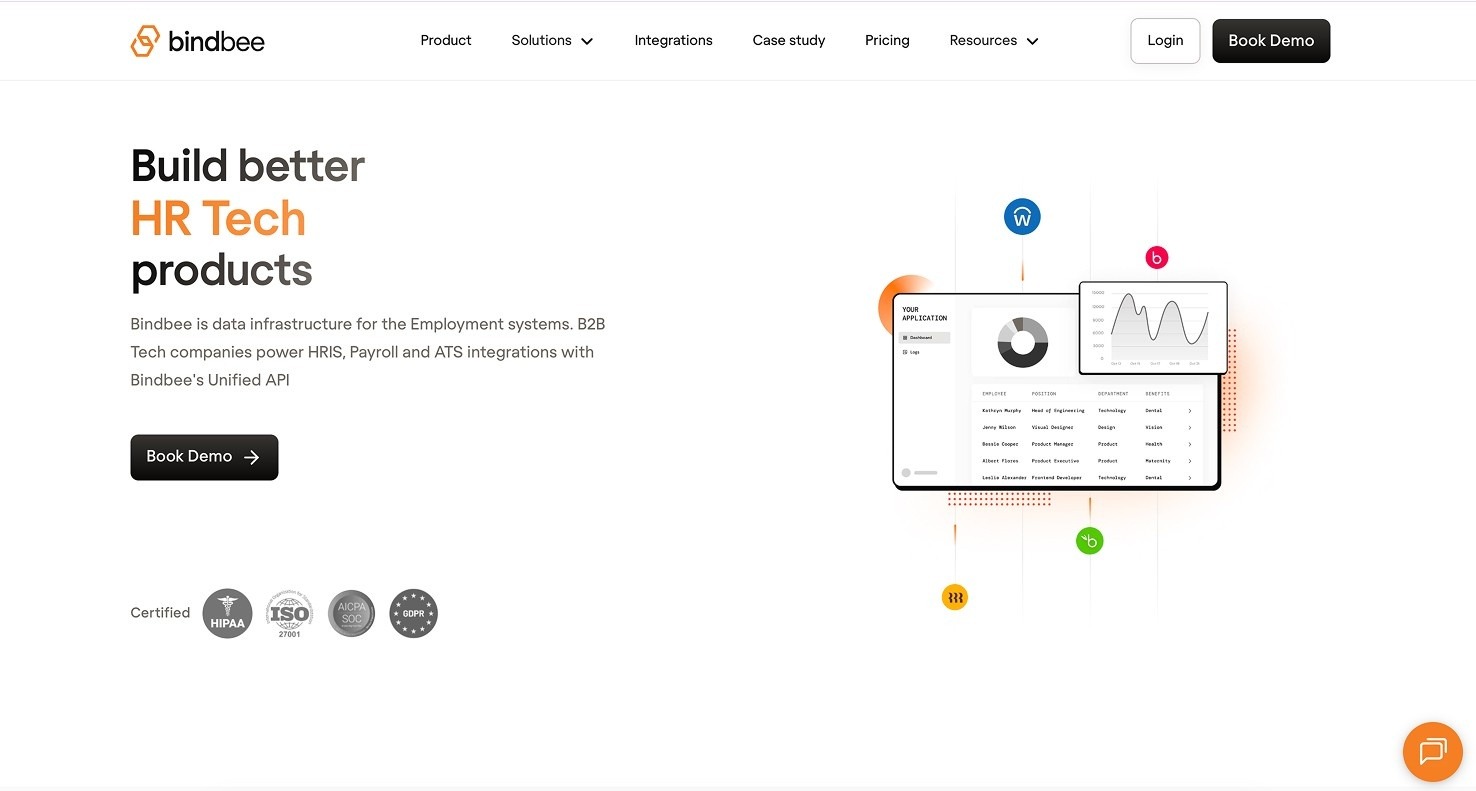
Bindbee provides unified APIs for HR, payroll, and ATS platforms, enabling SaaS products to integrate multiple employment-related systems through a single API. It simplifies authentication, data normalization, and ongoing maintenance for engineering teams.
Key Features:
- Deep Coverage Across 60+ HRIS Tools: Broad integration catalog that allows teams to support customer requests faster and win deals without engineering delays.
- Standardized Data Models: Normalizes employee and payroll data across systems to ensure consistency, accuracy, and downstream reliability.
- Enterprise-Grade Security: Built with GDPR compliance, encryption at rest and in transit, and strict access controls for sensitive employment data.
- No-Code Connection Setup: End customers can connect their HR or payroll systems in minutes, lowering onboarding time and support overhead.
- Observability Dashboard: Real-time logs and event-level visibility enable teams to diagnose and resolve integration issues without inspecting raw code.
Best Suited For: B2B SaaS companies in HR Tech, Benefits, Payroll, Fintech, Insurance, and 401(k)/TPA services that need reliable, secure, and scalable employment data integrations delivered through a Unified API without ongoing engineering maintenance.
Ratings: 4.9/5 on G2 (based on 15+ verified reviews). Users praise its ease of setup, intuitive API, and responsive support.
2. Merge
Merge provides a single, unified API that connects B2B SaaS products to multiple third-party systems, including HRIS, ATS, CRM, accounting, and payroll platforms. Its infrastructure focuses on standardizing data, reducing engineering overhead, and providing real-time observability.
Key Features:
- Unified API Access: Connect once to access hundreds of integrations across payroll, HRIS, CRM, and accounting systems.
- Data Normalization: Standardizes employee, payroll, and financial data for consistent consumption across platforms.
- Observability Tools: Real-time logs, alerts, and monitoring to detect and resolve integration issues quickly.
- Compliance & Security: SOC 2 Type II, ISO 27001, HIPAA, and GDPR compliance ensure secure handling of payroll data.
Best Suited For: B2B SaaS teams needing standardized payroll and HR data integrations while minimizing engineering maintenance and ensuring data security.
Ratings: 4.7/5 on G2 with 240+ reviews; noted for broad integration coverage and consistent reliability.
3. Finch
Finch provides a unified API for HR and payroll, connecting B2B SaaS products to over 250 payroll and HRIS providers in the U.S. The platform standardizes employment and payroll data, supports real-time updates, and manages complex payroll structures across multiple providers.
Key Features:
- Extensive Integrations: Connects with 250+ payroll and HRIS systems, including ADP, Gusto, Paychex, and Rippling.
- Payroll-Specific Data Models: Handles payroll runs, deductions, benefits, and employee paystubs.
- Compliance and Security: Enterprise-grade encryption, audit logs, and regulatory compliance ensure secure payroll data management.
- Lifecycle Data Sync: Covers onboarding, updates, and offboarding with real-time visibility into HR and payroll records.
Best Suited For: Fintech, HR, and benefits platforms that require detailed, real-time payroll and employment data while minimizing engineering maintenance.
Ratings: 4.8/5; recognized for comprehensive HR and payroll integrations and dependable real-time updates.
After reviewing the leading alternatives, the next step is to determine which platform best aligns with your team’s workflows, technical requirements, and long-term growth goals.
How to Decide Between Paragon, Unified, & Other Integration Options
Choosing the right integration platform depends on workflow complexity, engineering effort, scalability, and compliance. Beyond Paragon and Unified, alternatives like Bindbee, Merge, and Finch offer flexible, purpose-built solutions. Use the guidance below to find the best fit for your product and team.
Choose Paragon if:
- Integrations are a core part of your product and require access to vendor-specific APIs.
- Multi-step workflows or conditional automation are needed for client-specific processes.
- Long-term scalability and maintainable connector logic are priorities.
- Your team can dedicate effort upfront for engineering design and ongoing integration and maintenance.
Choose Unified if:
- Standardized access to HR, payroll, and ATS objects is sufficient for your use case.
- Rapid onboarding and predictable processes across multiple clients are important.
- Minimizing engineering effort and QA cycles is a key consideration.
- Speed-to-market takes priority over highly customized or complex workflows.
Choose Bindbee if:
- You need a unified API that integrates HRIS, payroll, ATS, and benefits systems through a single, consistent interface.
- Quick deployment, embedded onboarding flows, and reduced engineering maintenance matter without losing flexibility.
- You want near real‑time syncs with centralized logs and dashboards to monitor integration health.
- Enterprise‑grade security and compliance (SOC 2, GDPR, HIPAA, ISO) are essential for your product and customers.
Choose Merge if:
- You need unified API access to CRM, and accounting systems through a single integration.
- Standardized data and observability across multiple platforms reduce engineering maintenance.
- You want to simplify the onboarding and maintenance of dozens of third‑party system integrations.
- Security and compliance with industry standards are important.
Choose Finch if:
- You need a unified employment data API that connects to many HR and payroll systems through a consistent data model.
- Access to payroll and HR data in a common format helps automate onboarding, deductions, and pay data.
- Handling complex payroll and employment workflows through a single API reduces manual work.
- Your platform benefits from a solution that abstracts provider differences and standardizes employment data handling.
With a clearer view of what each platform offers, the decision ultimately comes down to how well the solution aligns with your product architecture, integration depth, and long-term scalability.
Also Read: Understanding API Integration Cost: Factors and Estimation
Final Thoughts
Selecting the right integration platform depends on your team’s workflow complexity, technical requirements, and long-term goals. Depth-first solutions like Paragon excel for highly customized, client-specific integrations, while standardized platforms like Unified reduce engineering overhead and accelerate deployment.
For teams evaluating alternatives, purpose-built unified APIs simplify deployment while ensuring reliability. Bindbee delivers deep, consistent integrations across HRIS, payroll, ATS, benefits, and time systems, letting B2B companies manage payroll, roster, and other employment operations without juggling multiple one-off connectors.
Want to reduce engineering effort and streamline HR and payroll workflows? See how Bindbee simplifies integrations and scales operations. Book your demo now!
FAQs
1. How does using a unified API affect onboarding new HR or payroll systems?
A unified API streamlines onboarding by providing pre-normalized objects and consistent data models, reducing setup time and minimizing errors across multiple systems.
2. Can integration platforms support custom reporting for niche HR metrics?
Yes. Platforms can either allow custom pipelines for tailored analytics or provide standardized data streams that integrate easily with reporting and BI tools.
3. What are the cost implications of depth-first versus standardized integration approaches?
Depth-first integrations may require higher upfront engineering investment but reduce long-term maintenance costs, whereas standardized platforms lower initial costs but may limit flexibility for complex workflows.
4. How do integration platforms respond to API changes from vendors?
Platforms vary: some isolate connector-specific changes to prevent cascading disruptions, while others standardize schemas, handling specific updates automatically but potentially requiring manual tweaks for advanced features.
5. Which unified API is optimized for employment systems like HRIS, payroll, and ATS?
Bindbee provides a purpose-built unified API that delivers consistent, deep integrations for employment systems, reducing engineering overhead and simplifying recurring operational tasks.