

API‑Led Integration Solutions: 7 Key Benefits and Use Cases
Summarise the blog with AI
Businesses are under increasing pressure to integrate multiple systems seamlessly, whether it's HR software, payroll platforms, or benefits data. The need for fast and efficient integration has never been more critical. However, traditional integration methods often lead to slow processes and costly errors.
A recent report found that 84% of businesses consider integrations to be "very important" or a "key requirement" for their customers, highlighting how essential seamless connectivity is for modern operations. Yet, despite this need, many still rely on outdated, point-to-point integration solutions.
This is where API‑led integration solutions come into play. They offer a more scalable, efficient, and error-free alternative to traditional methods. In this article, you'll explore the key concepts, benefits, and real-world use cases of API-led integration and how it can transform your business operations.
Key Takeaways
- API‑led integration connects systems using pre-built, reusable APIs, streamlining data flow across platforms.
- It reduces time and costs by eliminating custom integration efforts and improving scalability.
- Real-time data synchronization ensures accuracy and reduces manual errors.
- API‑led solutions are more efficient and easier to maintain than traditional integration methods.
- Bindbee offers a unified API that simplifies integrations, saving time and resources while ensuring seamless connectivity.
What are API‑Led Integration Solutions?
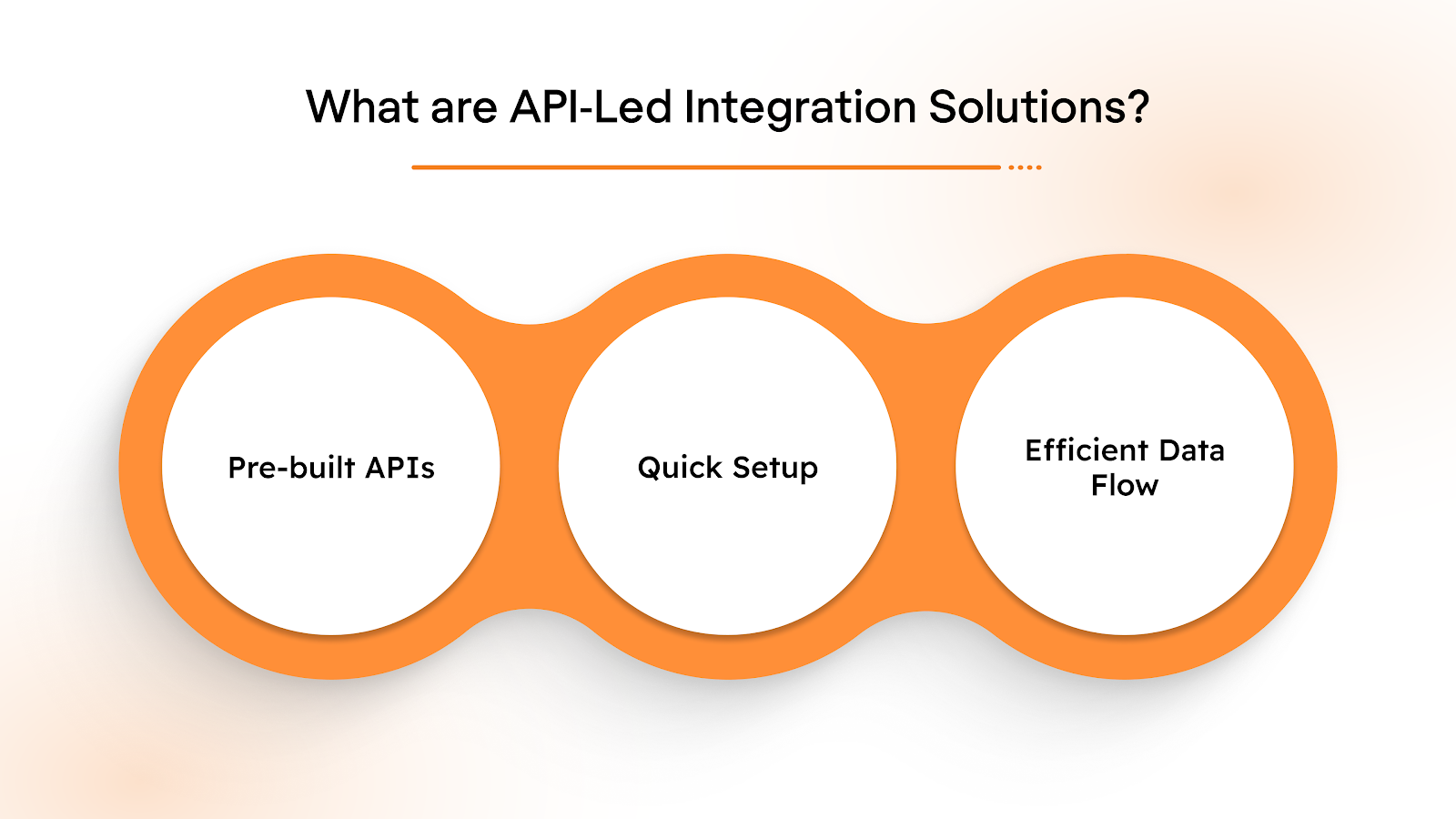
API‑led integration connects systems and applications using structured, pre-built APIs. Unlike traditional methods that require custom connections for each system, API‑led solutions simplify the process with reusable APIs.
- Pre-built APIs: Ready-to-use connectors that streamline the integration process.
- Quick Setup: Connect HR platforms, payroll systems, and other software faster than traditional methods.
- Efficient Data Flow: APIs handle different data types and workflows, ensuring seamless communication between systems.
This approach reduces the complexity of managing integrations and improves overall data consistency.
To fully understand how it works, let's compare it to traditional integration methods and see how it solves common challenges.
Comparing API‑Led Integration with Traditional Integration
Traditional integration methods often involve complex, point-to-point connections that are costly and time-consuming to maintain. In contrast, API‑led integration offers a more streamlined, scalable, and efficient approach to connecting multiple systems.
Here's a comparison of API‑led integration vs. traditional integration:
Looking for a way to simplify your integrations without lengthy development timelines? Bindbee enables integrations for customers in 5 minutes, compared to the weeks or months it would take if you built them in-house.
Now, let's explore why API‑led integration solutions matter for modern businesses.
Why API‑Led Integration Solutions Matter?
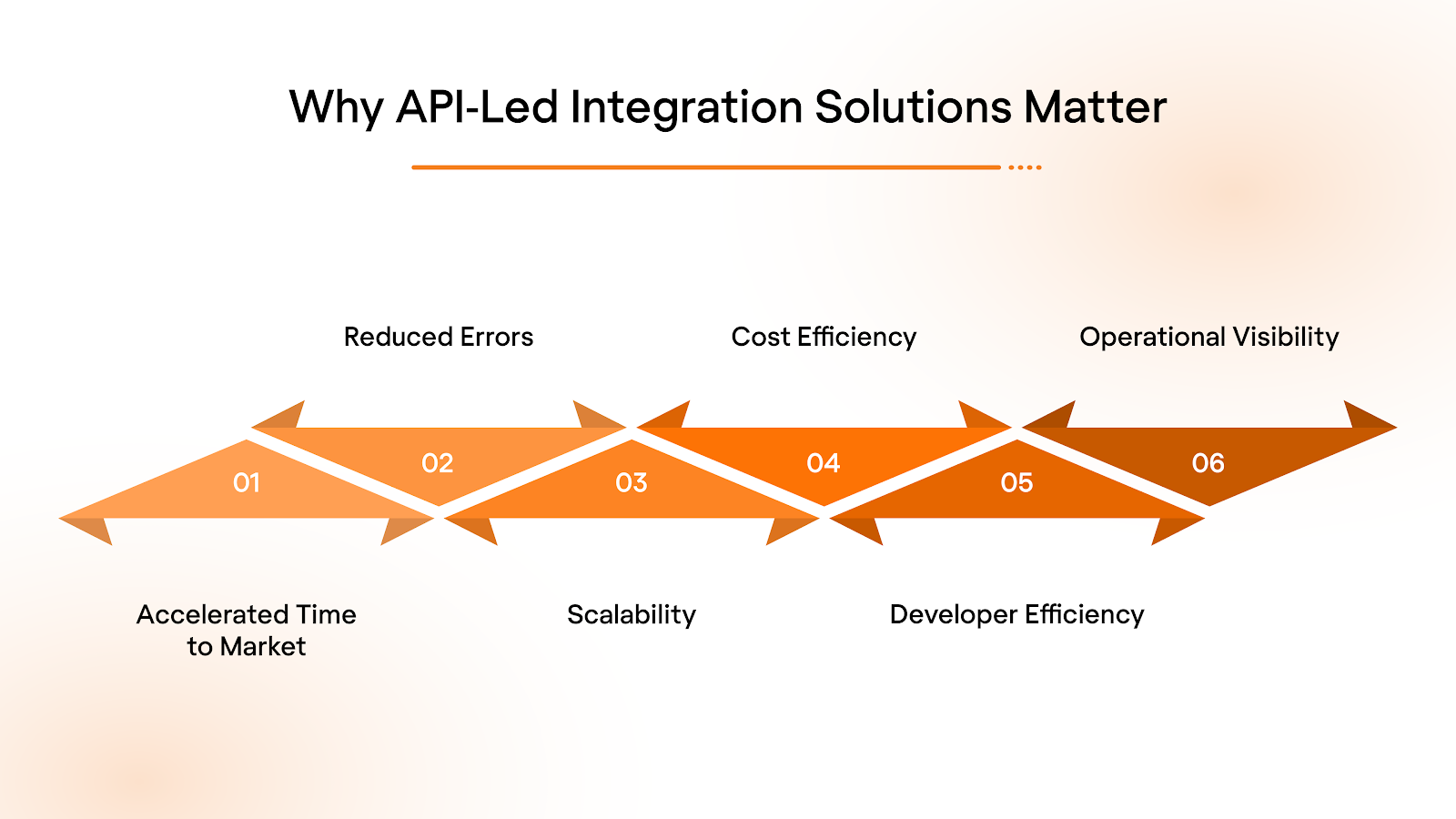
API‑led integration solutions have become essential for businesses looking to streamline their systems, reduce costs, and accelerate product time-to-market.
Here are the key reasons why API‑led integration solutions matter:
- Accelerated Time to Market: Pre-built APIs cut down integration time, enabling faster product launches and vendor onboarding.
- Reduced Errors: Automation through APIs eliminates manual data entry, reducing human error and ensuring accurate, real-time data synchronization.
- Scalability: Easily connect multiple systems, vendors, and clients with reusable APIs, allowing businesses to scale without additional complexity.
- Cost Efficiency: Avoid the high costs of custom-built integrations by leveraging pre-existing, standardized API solutions.
- Developer Efficiency: API-led integration frees up engineering teams by reducing the need for custom code and manual maintenance.
- Operational Visibility: With real-time monitoring and dashboards, businesses can gain insights into the health of their integrations and make informed decisions.
Understanding these benefits sets the stage for exploring the core concepts that drive API‑led integration solutions. Let's look into the core components of API‑Led Integration.
Also Read: Understanding the Role of APIs in Employee Benefits Administration
5 Key Components of API‑Led Integration Solutions
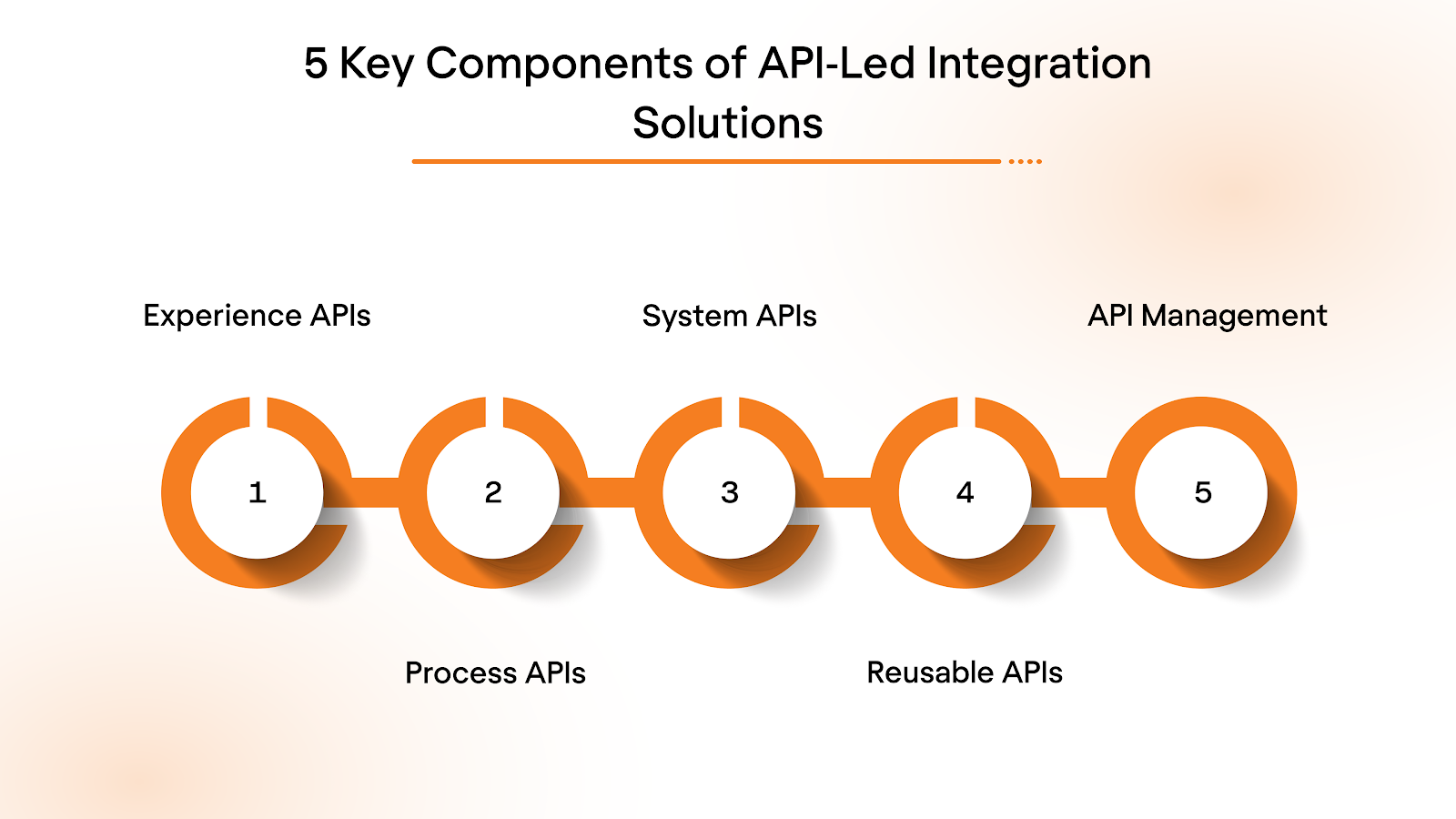
API‑led integration solutions are built around five core components that simplify and streamline system connections. These components allow businesses to integrate multiple systems efficiently, improving data flow and operational scalability.
Let’s break down each of these key components:
1. Experience APIs
Experience APIs expose data from backend systems to front-end applications like mobile apps or employee portals. They act as intermediaries to deliver personalized user experiences.
Why it matters:
- Enables seamless connection between user-facing applications and backend systems.
- Standardizes data delivery across different front-end applications.
- Reduces development time for building customer-facing interfaces.
2. Process APIs
Process APIs manage the transformation and flow of data between different systems, handling complex business logic and ensuring that data is processed in the right format.
Why it matters:
- Simplifies the integration of multiple systems by handling data transformation.
- Enables consistent workflows across different systems without redundant code.
- Streamlines complex processes like payroll data normalization across platforms
3. System APIs
System APIs provide direct access to core systems like HRIS, payroll, or CRM, allowing other APIs to interact with essential back-end data sources.
Why it matters:
- Securely connects to vital systems of record.
- Ensures smooth and efficient data flow between systems.
- Acts as the foundation for all other APIs, enabling comprehensive integrations.
4. Reusable APIs
Reusable APIs are designed to be used across multiple systems and processes, eliminating the need to build new integrations for every new system.
Why it matters:
- Saves time and resources by reducing the need for custom integration development.
- Increases efficiency by allowing businesses to leverage the same API across different applications.
- Simplifies maintenance as reusable components are easier to update and manage.
5. API Management and Monitoring
API management tools monitor the performance, security, and usage of APIs, ensuring they run efficiently and securely across the system.
Why it matters:
- Provides real-time monitoring of API health and performance.
- Detects and resolves issues quickly, ensuring minimal downtime.
- Improves security by managing access and enforcing API security policies.
With a clear understanding of the core components, it's now time to explore the key benefits that API‑led integration solutions bring to businesses, improving efficiency, scalability, and operational performance.
7 Key Benefits of API‑Led Integration Solutions
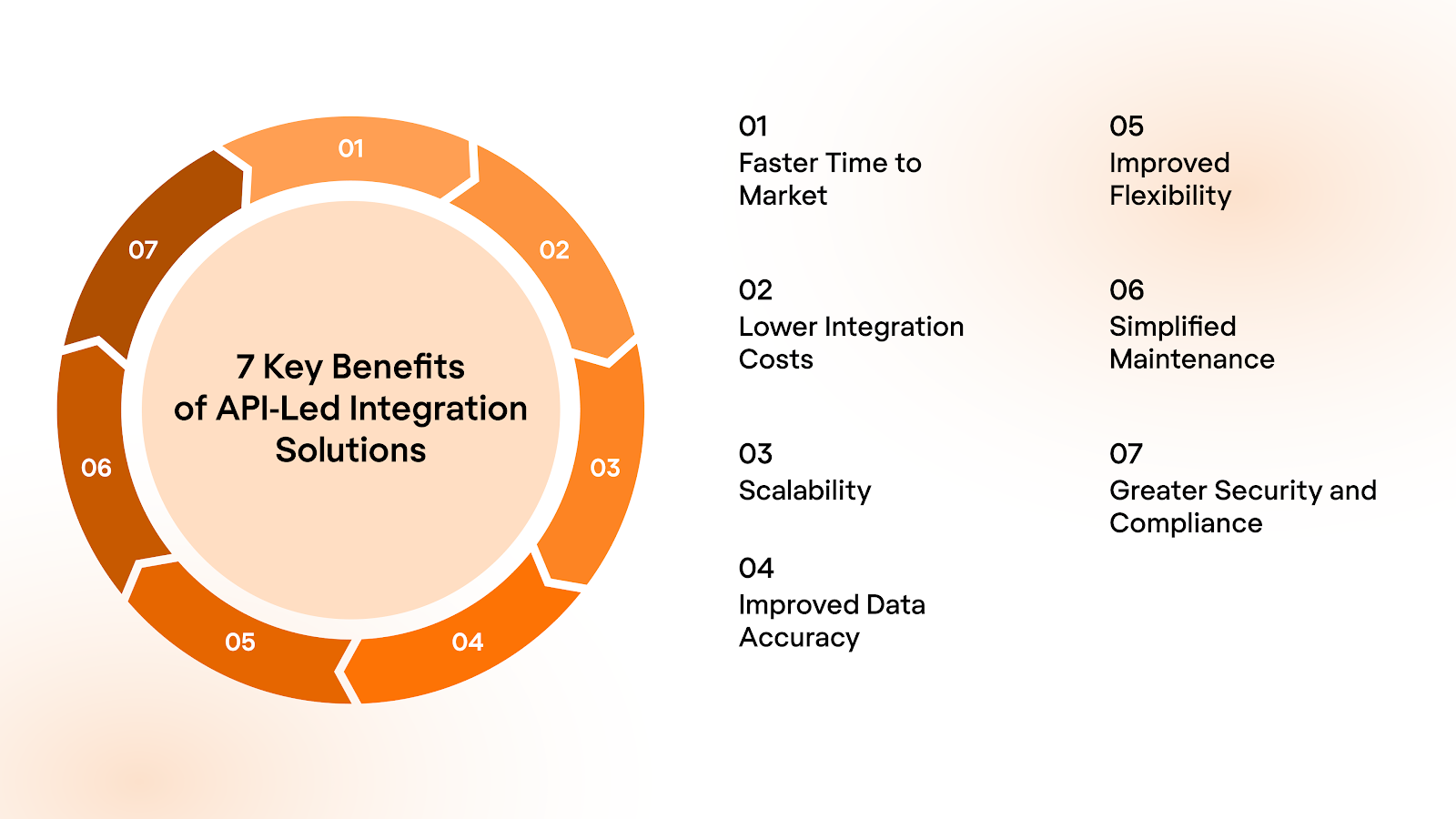
API‑led integration offers numerous advantages that can streamline operations, reduce costs, and accelerate time-to-market.
Let's break down the key benefits in a practical, easy-to-understand way:
1. Faster Time to Market
API‑led solutions enable rapid integration with pre-built APIs, reducing the time it takes to connect systems from months to days.
How it benefits:
- Accelerates product launches and customer onboarding.
- Reduces delays in bringing new features or services to market.
- Helps businesses respond faster to market changes or customer needs.
2. Lower Integration Costs
With reusable APIs, businesses avoid the high costs of custom coding and manual integrations, leading to significant cost savings.
How it benefits:
- Reduces the need for custom development, saving resources.
- Minimizes the long-term costs of maintaining point-to-point integrations.
- Enables teams to focus on core product development instead of costly integration efforts.
3. Scalability
API‑led integration solutions can easily scale to handle multiple systems, clients, and vendors, making it simpler to grow your business.
How it benefits:
- Supports rapid expansion without the need for complex new integrations.
- Easily adds new systems, clients, or data sources without disrupting operations.
- Ensures long-term sustainability as businesses scale.
4. Improved Data Accuracy
By automating data flow between systems, API‑led integration reduces manual errors and ensures consistent, real-time data synchronization.
How it benefits:
- Eliminates human error in data entry or transfers.
- Ensures accurate, up-to-date data is always available across systems.
- Reduces the risk of costly mistakes or data discrepancies.
5. Improved Flexibility
API‑led solutions allow businesses to adjust and modify integrations quickly, ensuring they can adapt to new requirements or changes in the market.
How it benefits:
- Makes it easy to add or change systems without disrupting existing workflows.
- Supports diverse use cases, from HR tech to payroll and benefits systems.
- Offers businesses the agility to innovate and meet growing demands.
6. Simplified Maintenance
With API‑led integration, businesses can reduce the need for ongoing custom development and maintenance by leveraging reusable, standardized APIs.
How it benefits:
- Minimizes the need for custom fixes or updates for each system.
- Reduces the burden on development teams, allowing them to focus on core business needs.
- Ensures smooth, long-term operations with less effort.
7. Greater Security and Compliance
API‑led integration solutions come with built-in security protocols, ensuring data is protected and compliance standards are met.
How it benefits:
- Ensures that sensitive data is handled securely throughout the integration process.
- Supports regulatory requirements such as GDPR, HIPAA, or SOC 2 compliance.
- Provides visibility into integration activity, enhancing accountability and security.
Now that you understand the key benefits, let's explore some common use cases where API‑led integration solutions are making a significant impact across various industries.
Common Use Cases for API‑Led Integration Solutions
API-led integration isn’t just about connecting systems faster. In practice, it solves very specific operational bottlenecks that show up as companies scale, slow onboarding, brittle data pipelines, and engineering teams stuck maintaining integrations instead of building product.
Below are real-world use cases that show how API-led integration works across HR, payroll, and benefits ecosystems.
1. HR Tech Platforms
For modern HR tech platforms, payroll and HRIS integrations aren't "nice to have," they're foundational. Employee demographics, time tracking, leave balances, and compensation data must stay in sync at all times. Yet many platforms still depend on batch-based file transfers or manual processes to move this information across systems.
That was the situation for Papershift, a workforce management platform serving over 250,000 users across 5,000+ companies. As their enterprise customer base expanded, so did the complexity of their integration needs.
As adoption grew, their integration model began to show cracks:
- Each new HRIS integration required custom development, often taking up to 90 days
- Third-party integration services increased the cost per integration, limiting scalability
- Manual import-export processes slowed operations and increased the risk of errors
- Engineering time was diverted from product innovation to integration and maintenance
What Changed with API-Led Integration
By partnering with Bindbee, Papershift moved to an API-led integration model built on a single unified API.
Instead of developing individual HRIS connections one by one, they integrated once and gained access to 50+ HRIS systems through standardized schemas. Real-time synchronization replaced manual transfers, and automated bidirectional data flow ensured workforce, leave, and timesheet data remained consistent across platforms.
Why This Matters
This shift turned integration from a scaling barrier into a strategic advantage:
- Integration deployment time reduced from 90 days to under 24 hours
- 85% reduction in customer onboarding time
- $200,000+ saved annually in development resources
- Real-time employee and timesheet data synchronization across systems
- Engineering teams redirected focus to core product innovation
- For HR tech platforms, API-led integration directly determines how quickly the product can expand across HRIS ecosystems, without adding operational strain.
2. Payroll & Benefits Platforms
Payroll and benefits platforms face a different problem. It’s not just connecting to HRIS systems; it’s doing so consistently, across enterprises running a mix of modern APIs and legacy exports.
Newfront ran straight into this challenge as they scaled.
Each new enterprise client meant:
- 8–12 weeks of custom HRIS integration work
- Engineers were tied up decoding API quirks instead of building core product features
- Partial data access, especially for benefits configurations locked behind legacy systems
As their customer base grew into the thousands, integration maintenance started compounding into a serious drag on velocity.
Why a Pure API Strategy Wasn’t Enough
Newfront didn’t just need more APIs; they needed complete data coverage, even when HRIS platforms relied on SFTP exports for benefits information.
Bindbee’s hybrid API-led approach solved this by:
- Using unified APIs where modern systems are allowed
- Ingesting SFTP-based exports, normalizing them into standardized schemas
- Serving all data, API or file-based, through the same API endpoints
From Newfront’s perspective, every integration looked identical.
The Outcome
What was once an integration bottleneck became a competitive moat:
- Integration timelines dropped from 12 weeks to 48 hours
- 90% reduction in engineering effort spent on integrations
- $800,000+ saved annually in development costs
- 3× faster enterprise onboarding
- 100% HRIS data coverage across clients
For payroll and benefits platforms, API-led integration isn’t about speed alone; it’s about making legacy systems invisible to your product roadmap.
3. 401(k) Providers & TPAs (Third-Party Administrators)
Early-stage platforms often start by building HR integrations in-house. It feels faster, until it isn’t.
Clever Benefits encountered similar issues as they scaled.
Each new integration meant:
- Weeks or months to build a single custom integration
- Frequent breakages requiring manual troubleshooting and oversight
- Engineering teams pulled away from core product innovation
- Delays caused by client-side permission and coordination issues
As their customer base grew, integration maintenance became a hidden operational challenge, consuming resources that could have been used for product development.
Why a Custom In-House Approach Wasn’t Enough
Clever Benefits needed a scalable, efficient solution to handle integrations across multiple payroll and HRIS systems. Relying on custom builds and manual processes created too many bottlenecks, limiting their growth potential.
Bindbee’s API-led integration provided the answer by:
- Using a single unified API to connect with 60+ payroll and HRIS systems
- Replacing SFTP-based CSV transfers with real-time data synchronization
- Streamlining data flow with standardized data models to reduce manual interventions
For Clever Benefits, the solution was clear: Bindbee’s unified approach allowed them to focus on their core product, rather than getting bogged down by integration complexity.
The Outcome
What was once a major operational bottleneck became a competitive advantage:
- 60+ integrations deployed simultaneously instead of weeks of custom work
- Real-time data synchronization replacing batch CSV transfers
- $80,000 saved annually on integration maintenance
- 100% integration uptime, leading to better customer satisfaction and faster onboarding
For 401(k) providers and TPAs, API-led integration is about efficiency and scalability, ensuring smooth operations as the business grows.
Why These Use Cases Matter
Across HR tech, payroll, benefits, and learning platforms, the pattern is clear:
- Manual and in-house integrations don’t fail immediately; they fail quietly as you scale
- API-led integration centralizes complexity instead of spreading it across teams
- The real ROI shows up in engineering focus, onboarding speed, and long-term maintainability
Now that you’ve seen how API-led integration works in real environments, the next step is understanding how to implement it without disrupting existing systems, and how to evaluate whether your current integration strategy is holding your product back.
Also Read: 180° vs 360° Payroll Integration: Benefits for 401(k) Plans in 2025
Now that you’ve seen the benefits and real-world applications, let’s explore how to get started with API‑led integration solutions and set your business up for success.
How to Get Started with API‑Led Integration Solutions
API‑led integration solutions can simplify and accelerate your business operations by enabling seamless data flow across systems. With faster, scalable, and more reliable integrations, businesses can focus on growth without the burden of complex custom solutions.
If you're tired of dealing with slow, complex integrations that hold back your growth, Bindbee offers a simple, scalable solution. With Bindbee, you can quickly integrate your systems without the need for custom-built connections.
Here's what Bindbee offers:
- Pre-built integrations with 60+ HRIS, payroll, and benefits systems.
- Real-time data synchronization for accurate, up-to-date information.
- Scalable and flexible solutions that grow with your business needs.
- Easy-to-use APIs with full developer support and documentation.
- Improved security to protect sensitive data with compliance features like HIPAA and SOC 2.
Ready to streamline your integrations? Try Bindbee and launch your first integration in under a week.
FAQs
1. How does API‑led integration improve data accuracy?
API‑led integration ensures real-time data synchronization across systems, eliminating manual errors. This reduces discrepancies and ensures your data is always up-to-date and reliable, leading to more informed business decisions.
2. Can API‑led integration solutions scale with my growing business?
Yes, API‑led integration is designed for scalability. By using reusable APIs, businesses can easily connect with multiple systems as they expand, without the need for complex new integrations or custom solutions.
3. How secure is API‑led integration for sensitive data?
API‑led integration ensures data is securely transmitted using encryption and industry-standard protocols. With built-in security features like compliance with HIPAA and SOC 2, you can trust that your data is protected.
4. What are the typical challenges businesses face with traditional integration?
Traditional integration methods often involve manual processes, custom development, and long timelines, leading to inefficiencies. This results in higher costs, delays, and data errors, which can hinder growth and scalability.
5. How can businesses start implementing API‑led integration?
Businesses can begin by identifying key systems that need integration and choosing a solution that offers pre-built APIs. From there, setting up connections between systems becomes a streamlined process with minimal effort and cost.