

Oracle HCM Cloud Integration: Optimize Payroll, HR, and Finance Processes
Summarise the blog with AI
Did you know that only 41% of employers are satisfied with the connectivity of their HR systems? Disconnected systems create errors, delays, and compliance risks, burdening HR, payroll, and finance teams with manual reconciliations and operational inefficiencies.
Accurate payroll and regulatory compliance are critical for operational integrity, financial accuracy, and employee trust. Integrated platforms eliminate redundant data entry and provide a single source of truth for HR and finance teams.
In this blog, you’ll learn how Oracle HCM Cloud integration streamlines HR-to-payroll and payroll-to-finance data, reduces maintenance, accelerates engineering, and supports SaaS and retirement partners.
Key Takeaways
- What Oracle HCM Cloud Integration is: Connects Oracle HCM Cloud with payroll, ERP, and HR systems to keep workforce data synchronized.
- Why It Matters: Eliminates manual reconciliation, reduces payroll errors, and strengthens compliance.
- Architecture Determines Scale: The right integration design ensures reliability across multi-payroll and hybrid environments.
- Impact on Payroll and Finance Operations: Validated payroll data flows into ERP systems for accurate accounting and forecasting.
- Scaling Without Overhead: Unified data layers simplify normalization and reduce long-term maintenance costs for integration.
What is Oracle HCM Cloud Integration
Oracle HCM Cloud Integration is the process of connecting Oracle’s Human Capital Management suite with payroll, finance, benefits, and third-party HR applications. It provides a centralized, synchronized system for employee master data, compensation, benefits, and employment events.
At its core, the integration ensures these datasets are updated in real time or near real time, providing HR and finance teams with a single source of truth. This foundation supports streamlined onboarding, payroll processing, statutory reporting, and stronger governance, preparing the organization for scalable HR and payroll operations.
With the integration framework defined, the next step is understanding why it is critical for efficiency, compliance, and reliability across HR, payroll, and finance processes.
Why Oracle HCM Cloud Integration is Critical
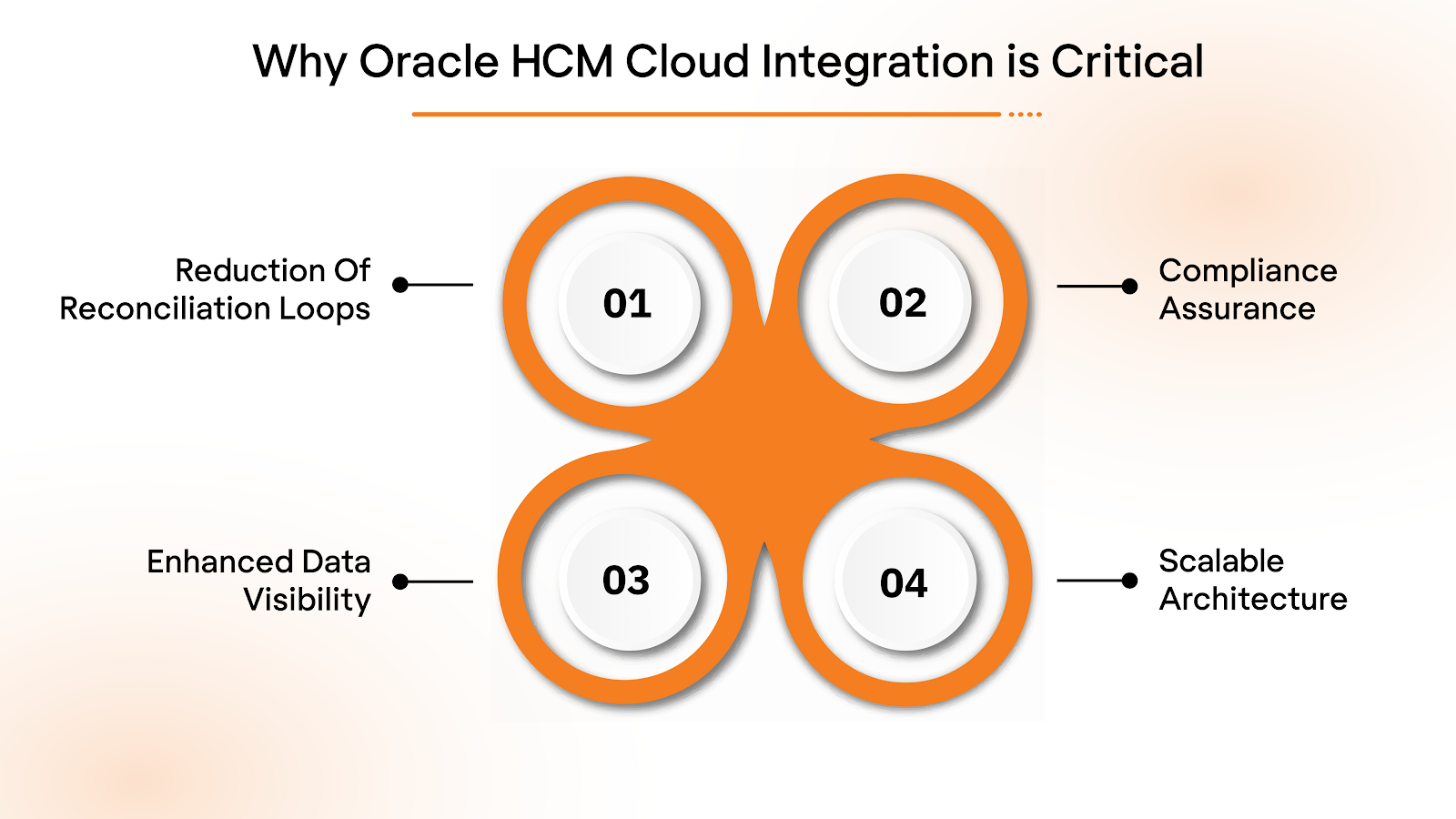
Oracle HCM Cloud integration eliminates fragmentation between HR and payroll systems, enabling consistent, automated workflows across employee, compensation, benefits, and financial data. Below are a few conceptual benefits that demonstrate why integration is essential for organizational efficiency and compliance:
- Reduction of Reconciliation Loops: Automated synchronization reduces repetitive manual checks and multi-day reconciliation cycles, allowing HR and payroll teams to focus on strategic tasks.
- Compliance Assurance: Integration aligns payroll, benefits, and statutory contributions with labor laws, ensuring that organizational processes are inherently compliant.
- Enhanced Data Visibility: Centralized data flows create a single source of truth, enabling HR and finance to consistently monitor workforce and financial information.
- Scalable Architecture for Multiple Payroll Engines: Integration supports complex environments with multiple payroll systems, ensuring uniformity and reducing governance risk as organizations grow.
By understanding these specific benefits, HR, finance, and tech leaders can evaluate how Oracle HCM Cloud integration delivers process efficiency, greater compliance reliability, and reduced administrative burden.
Next, we’ll explore Integration Architecture Options, which define how these benefits are realized technically and operationally.
Choosing the Right Oracle HCM Integration Architecture
Effective Oracle HCM Cloud integration requires selecting the right architecture based on organizational complexity, latency requirements, and ecosystem diversity. Understanding these options helps HR and tech leaders design integrations that are reliable, maintainable, and scalable.
1. Native Unified Architecture
Oracle’s cloud suite offers natively integrated modules that share a single data model between HR and payroll. This reduces the number of translation layers and enables real-time updates with minimal custom code.
2. Packaged Integrations with Middleware
In hybrid landscapes with legacy HRIS or third-party payroll engines, middleware such as Oracle Integration Cloud or SOA Suite provides connectors for REST, SOAP, file transfers, and LDAP. Prebuilt adapters reduce engineering overhead and avoid brittle point-to-point scripts.
3. Strategic Payroll Interface
In multivendor environments, interfaces like Oracle’s Fusion Payroll Interface enable structured data exchange with external payroll providers such as ADP or Ramco. This approach ensures effective dated transactions and audit logging for compliance and analytics.
With the architecture choices clarified, the next step is to examine Oracle's official integration methods and documentation, which provide authoritative frameworks for implementing these architectures reliably.
Oracle Integration Methods: Documentation and Best Practices
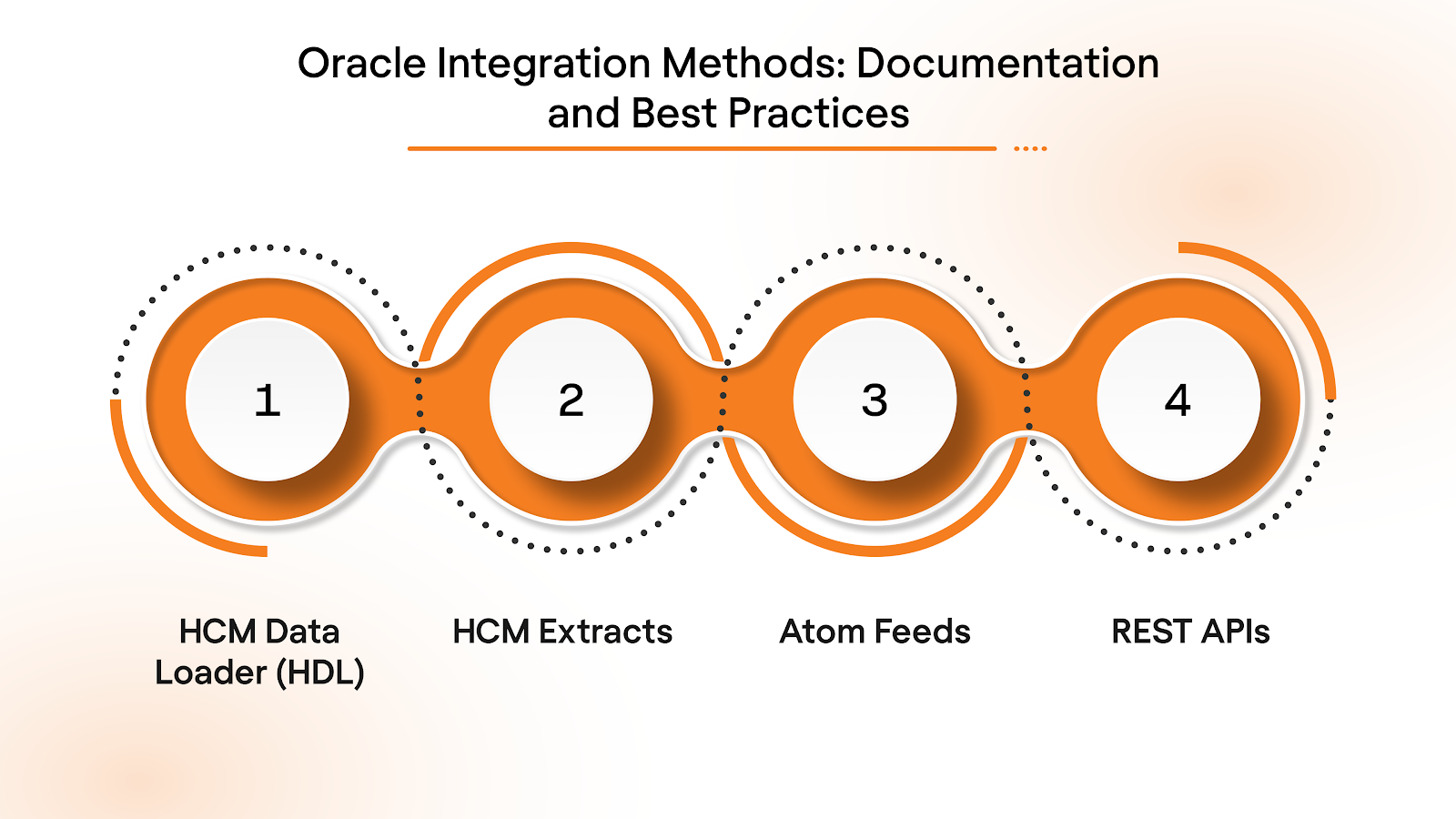
Oracle provides structured guidance for connecting external applications to HCM Cloud. Familiarity with these methods allows organizations to implement integrations that directly improve data accuracy, compliance, and workflow efficiency. Below are the primary Oracle-supported methods:
1. HCM Data Loader (HDL) - Bulk Data Management
HDL enables large-scale import and export of employee, payroll, and benefits information, making it ideal for mass updates such as compensation adjustments, terminations, or payroll corrections.
- Automation for Recurring Updates: Scripts can schedule periodic bulk uploads, eliminating repetitive manual work and ensuring data consistency across HR and payroll systems.
- Preservation of Effective-Dated Records: Maintains historical records for compliance audits, payroll reconciliation, and employee lifecycle tracking.
- Error Handling & Validation: Pre-import validation ensures data accuracy, flagging missing or inconsistent fields before committing changes.
- Scalability Across Entities: Supports multiple business units or subsidiaries, enabling uniform data updates in complex organizational structures.
2. HCM Extracts - Configurable Data Feeds
Extracts generate targeted datasets for reporting, analytics, or downstream integration, supporting tasks such as payroll reconciliation, benefits eligibility verification, or headcount reporting.
- Secure Data Transmission: Ensures only authorized information is exported to external systems, maintaining compliance with GDPR, HIPAA, or local labor regulations.
- Customizable Field Selection: Organizations can define exactly which data points to include, avoiding unnecessary data transfer and simplifying downstream processing.
- Scheduled & Event-Based Extracts: Supports both periodic extracts for regular reporting and event-triggered extracts for immediate updates.
- Integration with External Systems: Extracts feed downstream HRIS, payroll engines, or finance platforms with validated, structured datasets.
3. Atom Feeds - Event-Driven Real-Time Notifications
Atom feeds provide notifications whenever relevant changes occur, supporting real-time synchronization between HCM Cloud and external systems.
- Immediate Updates for Payroll & Benefits: Changes in employee status, compensation, or benefits automatically propagate to payroll or benefits systems, reducing delays.
- Proactive Compliance Monitoring: Real-time notifications ensure statutory contribution deadlines are met, and audit logs are maintained.
- Reduced Latency Across Workflows: External systems receive updates instantly, minimizing manual data entry and the risk of errors.
- Integration with Third-Party Applications: Atom feeds can trigger workflows in HR Tech SaaS platforms, 401(k) vendors, or TPAs for automated processing.
4. REST APIs - Programmatic HR Data Access
REST APIs enable the creation, retrieval, update, and deletion of HR records, enabling deep integration across hire-to-retire workflows.
- Robust Error Handling & Logging: Supports structured error messages, transaction logs, and retry mechanisms, ensuring reliable integration.
- Scalable Multi-System Integration: Enables HR Tech SaaS providers, TPAs, or payroll vendors to integrate across multiple subsidiaries or payroll engines without data conflicts.
- Versioning & Governance: APIs maintain version control, ensuring backward compatibility and compliance with organizational IT governance policies.
- Extensible Workflow Automation: Organizations can build automated approval chains, payroll triggers, or benefits updates that interact directly with HCM Cloud modules.
With official methods understood, HR and finance leaders can now evaluate how these integrations translate into measurable operational and compliance benefits.
Operational Gains from Oracle HCM Cloud Integration
Integrated Oracle HCM Cloud–payroll pipelines transform payroll from a manual, fragmented process into an automated, governed workflow with embedded compliance controls. The following measurable outcomes illustrate how these integrations support HR, finance, and tech teams:
- Reduction in Payroll Errors: Integrated platforms synchronize employee master data and compensation rules, eliminating manual error vectors and lowering the risk of compliance penalties and employee dissatisfaction.
- Faster Cycles and Greater Accuracy: Organizations using Oracle HCM Cloud experience speedier payroll processing, quicker reporting, and fewer human touchpoints for routine updates.
- Audit-Ready and Compliant Processes: Unified data flows with validation checks maintain comprehensive audit trails, supporting internal governance while reducing exposure to penalties and compliance failures.
- Multi-Payroll Normalization for Complex Environments: Standardized data pipelines ensure accurate contributions and reporting across multiple payroll engines and third-party vendors, including 401(k) providers, TPAs, and recordkeepers.
- Accelerated Employee Onboarding: New hires and employment status changes are automatically synced with payroll and benefits systems, reducing setup errors and administrative delays.
Beyond operational gains, enterprise teams must also ensure finance integration is seamless. Let’s explore how ERP alignment enables accurate forecasting, reporting, and compliance.
Oracle HCM Cloud Payroll Alignment with ERP Systems
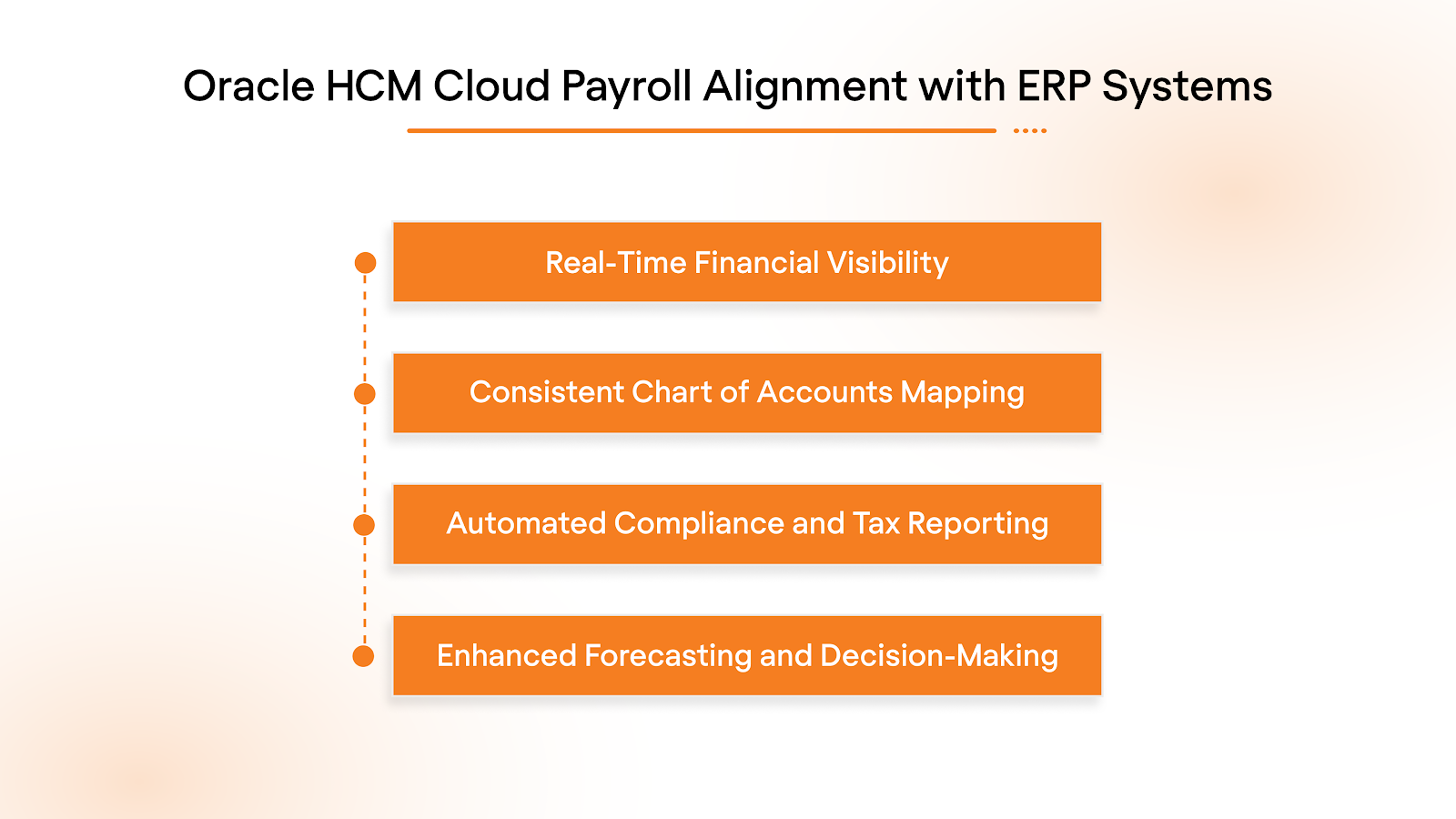
Integrating payroll from Oracle HCM Cloud with ERP systems ensures accurate, real-time financial visibility, proper accounting, and compliance. Without this alignment, organizations risk misclassified expenses, delayed forecasts, and audit inefficiencies.
- Real-Time Financial Visibility: Payroll and HR data from Oracle HCM Cloud feeds directly into ERP systems, giving CFOs and finance teams instant insight into labor costs, allocations, and expense tracking.
- Consistent Chart of Accounts Mapping: Standardized classifications from Oracle HCM Cloud automatically map to financial ledgers, reducing manual journal entries, rework, and reporting errors.
- Automated Compliance and Tax Reporting: Oracle HCM Cloud ensures payroll contributions, statutory deductions, and labor cost allocations are accurately captured in the ERP with full audit trails, lowering regulatory risk.
- Enhanced Forecasting and Decision-Making: Timely, validated payroll data from Oracle HCM Cloud enables finance teams to run reliable budgets, forecasts, and workforce cost projections.
While ERP integration strengthens financial control, HR Tech SaaS vendors and enterprise teams must also address speed, scalability, and maintenance. Next, we explore the key challenges organizations face in implementing and sustaining Oracle HCM Cloud integrations.
Key Challenges in Oracle HCM Cloud Integration
Oracle HCM Cloud offers robust integration capabilities, but organizations often face hurdles during implementation and ongoing operations. Below are key challenges that HR, payroll, finance, and tech leaders encounter:
- Complex Multi-System Integration: Integrating multiple payroll engines, legacy HR systems, and third-party benefits platforms can lead to misaligned employee records, timing mismatches, and data synchronization errors.
- Compliance and Regulatory Pressure: Payroll calculations, tax withholdings, and statutory contributions must automatically align with applicable labor laws. Maintaining audit-ready records across jurisdictions is challenging without automated workflows.
- Data Consistency and Accuracy: Disconnected systems or manual data entry can lead to inconsistencies, resulting in payroll errors, reporting delays, and increased reconciliation effort.
- Technical Maintenance and Scalability: Custom scripts and point-to-point integrations are prone to breakage. Scaling integrations for growing workforces or adding new payroll providers increases engineering overhead.
- Multi-Tenant and Retirement Ecosystem Complexity: HR Tech SaaS providers, 401(k) TPAs, and recordkeepers face additional challenges with multi-client normalization, timely contribution posting, and onboarding overhead for sponsors.
To address these integration challenges, many HR Tech and payroll platforms adopt a unified API strategy. Solutions such as Bindbee provide a single API that standardizes and normalizes HR and payroll data from multiple systems into a consistent format usable with platforms like Oracle HCM Cloud, reducing downstream reconciliation and long-term integration maintenance.
Also Read: Employee Benefits Data Integration: Key Challenges & How APIs Fix Them
Recognizing these challenges highlights the need for proven strategies to ensure smooth, scalable, and compliant Oracle HCM Cloud integrations.
Best Practices for Oracle HCM Cloud Integration
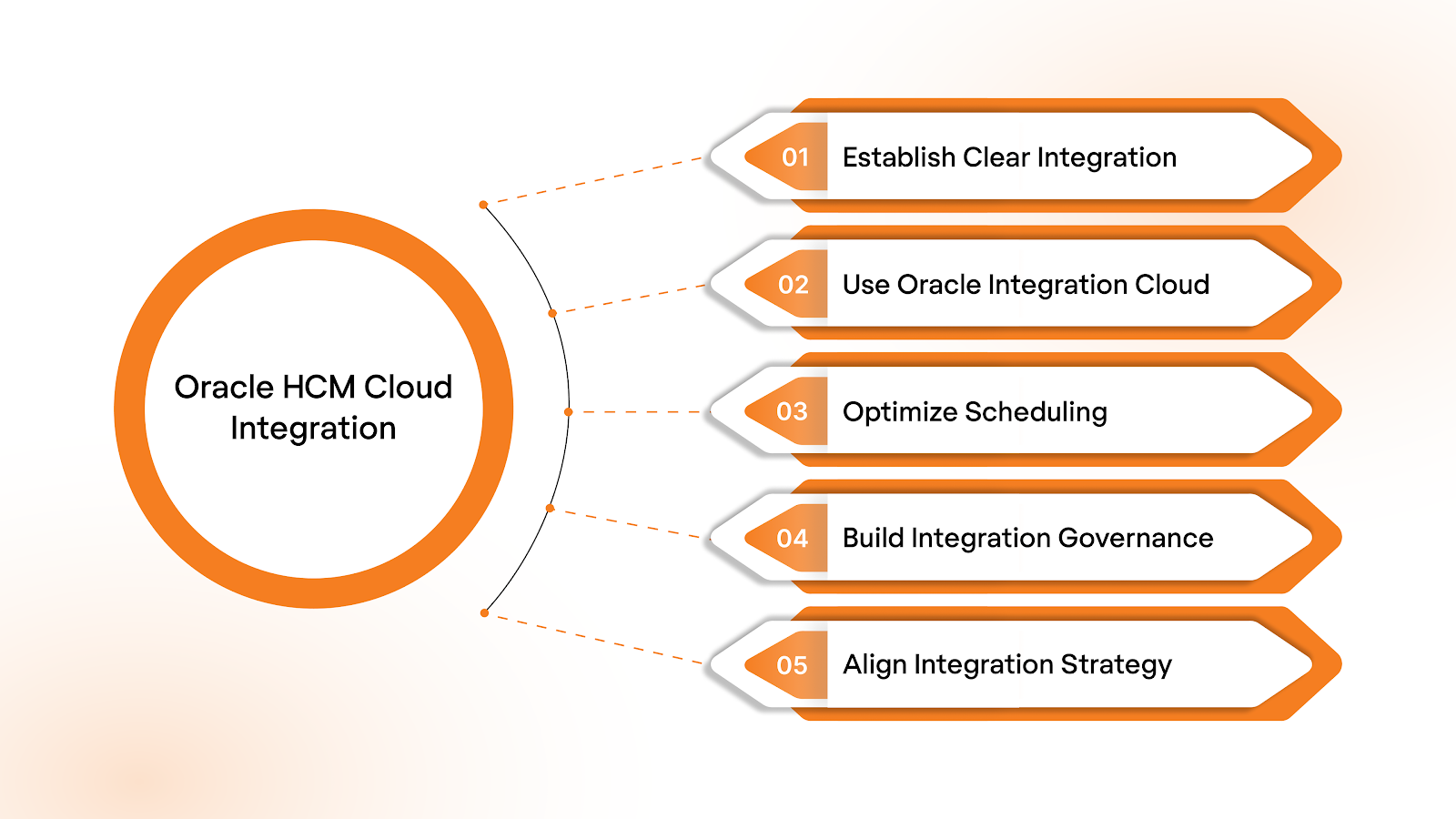
Implementing and maintaining Oracle HCM Cloud integrations requires careful planning, robust design patterns, and ongoing governance. Following best practices reduces integration risk, improves reliability, and supports scalability. These practices are essential for HR, payroll, and finance teams managing multi-system environments.
1. Establish Clear Integration Design Principles
Defining architectural standards and integration patterns upfront ensures consistency, maintainability, and scalability. Early planning prevents future rework and simplifies the onboarding of new systems. Validating data at entry points reduces reconciliation effort and improves audit readiness.
2. Use Oracle Integration Cloud and Prebuilt Adapters
Using Oracle Integration Cloud’s adapters, prebuilt recipes, and templates accelerates development while maintaining reliability. Reusable connections reduce redundancy across integration flows. Utilizing these tools aligns with Oracle-supported best practices and minimizes the need for custom coding.
3. Optimize Scheduling and Execution Patterns
Efficient scheduling and asynchronous orchestration improve system performance and prevent operational delays. Event-driven triggers enable real-time data processing, while careful monitoring of execution metrics ensures timely error detection. Optimized execution patterns maintain integration reliability across all workflows.
4. Build Integration Governance and Lifecycle Management
Ongoing governance ensures integrations remain efficient, maintainable, and compliant. Version control, periodic review of integration relevance, and structured error handling reduce risk and prevent conflicts. Lifecycle management keeps systems aligned with evolving business and compliance needs.
5. Align Integration Strategy with Organizational Change Practices
Integration success requires organizational alignment, cross-functional collaboration, and proper access control. Clear role-based privileges, stakeholder involvement, and comprehensive documentation ensure sustainable operations. Training reduces dependency on individual engineers and improves overall resilience.
Also Read: HCM–Payroll Integration Explained: Key Benefits & Implementation Steps
For HR Tech platforms and enterprises operating in complex, multi-system environments, applying these practices at scale often requires an integration abstraction layer. Let’s see how Bindbee supports scalable Oracle HCM Cloud integrations.
Scalable Oracle HCM Cloud Integration Starts With Bindbee
Bindbee provides a unified API that connects HRIS, ATS, and payroll systems through a single integration interface, normalizing employee, pay, deduction, and related data. Its pre-built connectors and real-time sync capabilities reduce engineering effort, improve data accuracy, and support reliable HR and payroll workflows for multi-vendor environments.
Here’s how Bindbee streamlines Oracle HCM Cloud integration:
- Deep, Standardized Employment Data Model: Bindbee’s unified model covers employees, jobs, time entries, benefits, deductions, contributions, payroll runs, and more. Field mismatches, missing objects, and naming inconsistencies are resolved upstream.
- Integrate With Any Employment App in Under 5 Minutes: With Magic Link and the embeddable SDK, customers can connect their HRIS or payroll system to your product in under 5 minutes. No front-end code required.
- Real-Time + Daily Sync Options for Live Payroll Operations: Bindbee syncs workforce changes as they occur and runs stable daily loads for high-volume data. New hires, comp changes, time entries, benefits updates, and termination data stay continuously aligned.
- Issue Detection and Self-Healing Integrations: Bindbee’s Logs and Issues surface integration failures without requiring code changes. Automated retries and workflow repairs prevent most problems before they reach customers.
- Webhooks for Critical Events: Create webhooks in a few clicks to track sync events, downtime, or high-impact changes. This gives engineering and payroll teams real-time visibility into upstream data.
- Enterprise-Ready Security and Deployment Options: Bindbee is SOC 2, ISO, GDPR, and HIPAA compliant, with optional on-prem deployment and multi-geo data residency.
Together, these capabilities provide a single, consistent data layer across all employer systems, enabling smoother, more scalable Oracle HCM Cloud integrations. Try Bindbee and launch your first integration in under a week.
FAQs
1. How does Oracle HCM Cloud integration improve data consistency?
Integration ensures employee, compensation, and benefits data is updated in real time across HR, payroll, and finance systems. Centralized, automated data flows reduce discrepancies, eliminate duplicate entries, and create a single source of truth, supporting accurate payroll, reporting, and regulatory compliance.
2. What are common integration challenges for multi-system organizations?
Organizations with multiple HRIS, payroll engines, and benefits platforms often face misaligned records, delayed updates, and synchronization errors. Maintaining consistent data, automated compliance, and error-free payroll processing across diverse systems requires robust architecture and structured integration practices.
3. How do REST APIs enhance Oracle HCM Cloud integration?
REST APIs allow automated creation, retrieval, update, and deletion of HR records. They provide structured error handling, logging, and version control. APIs enable real-time updates, workflow automation, and multi-system integration without manual intervention, improving reliability and compliance across HR and payroll processes.
4. Why is multi-payroll normalization essential?
Normalization standardizes employee data across multiple payroll engines, eliminating discrepancies and reducing reconciliation cycles. It ensures accurate contributions, reporting, and compliance, especially for organizations managing multiple payroll providers, TPAs, or 401(k) vendors, supporting operational efficiency and audit readiness.
5. How does integration affect finance operations?
Payroll data feeds directly into ERP systems, providing accurate, real-time financial visibility. Automated chart-of-accounts mapping, tax calculations, and statutory contributions reduce manual errors. Integration supports reliable forecasting, budgeting, and reporting while minimizing reconciliation and manual adjustments for finance teams.