Introduction
The average mid-market organization now manages 15 HR system integrations across 11 to 13 different HR technology platforms, according to Sapient Insights Group's 2024-2025 HR Systems Survey. For Benefits Tech and HR Tech companies, this sprawl creates a persistent engineering bottleneck: every new employer connection requires custom integration work that can take 4-8 weeks per system, pulling developers away from core product development.
The wrong integration approach—point-to-point API builds, generic iPaaS platforms—leads to slow employer onboarding, stale eligibility data, and engineering teams stuck in maintenance cycles rather than shipping product.
The cost makes that choice concrete: a single API integration runs between $50,000 and $150,000 annually, with 60-70% of that going to maintenance rather than the initial build. At that scale, the integration layer you choose directly affects how fast you can grow.
This article evaluates the best integration software options in 2026, covering who each tool serves best and what separates purpose-built unified APIs from general-purpose platforms.
TL;DR
- Integration software connects HRIS, payroll, and benefits systems for automatic data flow without manual effort
- Top 2026 tools split into two camps: general iPaaS platforms (MuleSoft, Boomi, Workato) and vertical unified APIs built for specific domains like HR and Benefits (Bindbee, Merge)
- For HR Tech and Benefits Tech, the three criteria that matter most: HRIS coverage depth, compliance certifications (SOC 2, HIPAA), and time-to-first-integration
- Vendor-managed integrations outperform self-hosted frameworks at scale—maintenance burden matters as much as initial setup
- Top picks: Bindbee and Merge for HR/Benefits-specific use cases; MuleSoft, Workato, and Boomi for broader enterprise automation
What Is Integration Software and Why It Matters in 2026
Integration software connects two or more applications so they can automatically share and synchronize data without manual export/import cycles. Instead of building separate API connections for every HRIS, payroll, or benefits system your product touches, integration platforms provide a standardized framework that handles each system's unique requirements for you.
The HR and Benefits Tech space has become particularly integration-intensive. Employers now run core functions across separate platforms:
- HRIS for employee records
- Payroll for compensation processing
- Benefits administration for enrollment and elections
- Carrier connections for claims
- Engagement tools for workforce communication
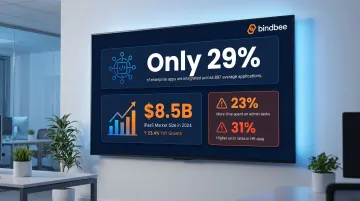
Data must flow across all of them in real time. Yet according to Gartner, only 29% of enterprise applications are currently integrated — even as the average company manages 897 applications in total.
That gap is fueling rapid market growth. The integration platform as a service (iPaaS) market grew 23.4% to $8.5 billion in 2024, driven by AI adoption and the shift to cloud infrastructure. For HR Tech companies, the cost of ignoring this infrastructure is concrete: organizations with disconnected HR platforms spend 23% more time on administrative tasks and experience 31% higher error rates in employee data management.
Best Software for Seamless Integration in 2026
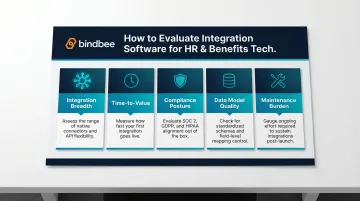
These platforms were evaluated on integration breadth, setup speed, compliance posture, data model quality, and maintenance burden—the factors that determine how quickly HR Tech and Benefits Tech teams can onboard employers and keep data current.
Bindbee
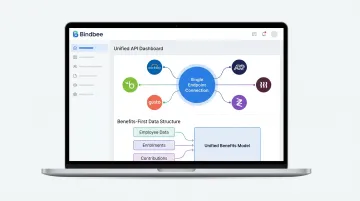
Bindbee is a unified API infrastructure platform built specifically for Benefits Tech, HR Tech, and InsurTech companies, connecting products to 60+ HRIS, payroll, benefits, and carrier systems through a single API endpoint. Customers include Newfront, Healthee, Pasito, and Clever Benefits.
What sets Bindbee apart is its Benefits-First Data Model, which treats Employee Benefits, Employer Benefits, and Dependent Benefits as distinct, normalized objects rather than flattening them into generic employee records. Setup completes in under one day versus 4-8 weeks for native API builds, and the platform carries a zero-maintenance promise: when upstream HRIS providers change their APIs, Bindbee detects and resolves breaking changes without customer involvement.
Compliance coverage includes SOC 2 Type II, ISO 27001, GDPR Ready, and HIPAA Compliant certifications. For legacy systems that only export files, the SFTP-to-API Bridge converts batch file data into API-accessible objects, eliminating the need for manual SFTP workflows.
Key Features:
- Single unified API for 60+ systems
- Benefits-first data models with distinct objects for employee, employer, and dependent benefits
- Magic Link authentication for end-user connections
- Webhooks for life events including new hires, terminations, and dependent changes
- SFTP-to-API Bridge for legacy carriers
- Custom fields support across integrations
Compliance & Security:
SOC 2 Type II, ISO 27001, GDPR Ready, HIPAA Compliant
Best For:
Benefits administration platforms, HR Tech companies, InsurTech providers, TPAs, and payroll platforms requiring benefits-layer integrations
Merge
Merge is a unified API platform covering HRIS, ATS, accounting, CRM, and file storage categories, enabling B2B software companies to embed integrations into their products without building each connector individually. It's widely adopted among HR Tech startups needing quick HRIS coverage.
Merge normalizes data across integrations per category—offering 8 to 30 data models depending on the vertical—with a developer-friendly SDK and a pre-built Link UI component for end-user authentication. Automated syncs keep data current without manual intervention.
Where it falls short for benefits-specific use cases: limited depth on benefits enrollment data, dependent relationships, and carrier-side connections. Merge's security page confirms SOC 2 Type II, ISO 27001, and HIPAA certifications, making it suitable for handling employee data across HRIS and ATS integrations.
Key Features:
- Unified HRIS/ATS/accounting API
- Pre-built Link UI component for authentication
- Automated field mapping
- Webhooks for data change notifications
Compliance & Security:
SOC 2 Type II, ISO 27001, HIPAA
Best For:
B2B SaaS companies needing broad HRIS/ATS coverage with a developer-first integration experience
MuleSoft (Salesforce)
MuleSoft, acquired by Salesforce in 2018 for $6.5 billion, is one of the most widely deployed enterprise integration platforms globally. Its Anypoint Platform handles API management, integration design, and data orchestration across cloud and on-premise systems, making it common in large enterprise IT environments with complex, multi-system architectures.
The platform delivers enterprise-grade scalability through a vast connector library and strong governance features. A 2026 Forrester Total Economic Impact study found 426% ROI over three years, with 60% acceleration in IT project delivery and 70% reduction in ongoing API management costs.
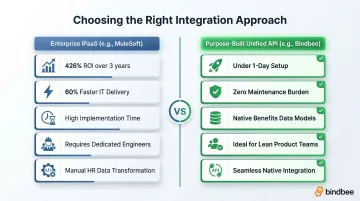
Where it creates friction for HR/Benefits use cases: significant implementation time, high licensing costs, and a requirement for dedicated integration engineering resources. MuleSoft is not purpose-built for HR or benefits data schemas, so teams must configure data transformations manually using DataWeave.
Key Features:
- Anypoint Platform for API-led connectivity
- Pre-built connectors for major enterprise systems
- DataWeave transformation language
- API governance and lifecycle management
Compliance & Security:
SOC 2, ISO 27001, PCI DSS, HIPAA (per MuleSoft Trust Center)
Best For:
Large enterprises with complex multi-cloud architectures and dedicated integration teams
Workato
Workato is a cloud-native automation and integration platform (iPaaS) combining workflow automation with application integration. It's widely used by HR, IT, and finance operations teams for automating cross-system workflows without heavy engineering involvement.
Workato's strengths include a low-code/no-code recipe builder, a library of 1,000+ pre-built connectors covering major HRIS platforms, and strong appeal for internal operations use cases like employee onboarding automation.
It also holds the broadest privacy-specific certification portfolio among iPaaS vendors, including ISO 27701 and NIST 800-171A.
Its limitation for product teams: recipes can become brittle as complexity grows, and the platform is not designed for embedding integrations inside B2B software products at scale. Workato targets internal automation rather than customer-facing integration layers.
Key Features:
- Low-code recipe builder
- 1,000+ pre-built connectors
- Real-time triggers for event-based automation
- Enterprise-grade workflow orchestration
Compliance & Security:
SOC 2 Type II, ISO 27001, ISO 27701, PCI-DSS, HIPAA, NIST 800-171A
Best For:
HR and IT operations teams automating internal workflows; companies not requiring embedded, customer-facing integrations
Boomi
Boomi is a cloud-native iPaaS platform offering data integration, API management, EDI, and master data management. Acquired from Dell Technologies by Francisco Partners and TPG in 2021 for $4 billion, Boomi operates as an independent company with strong presence in mid-market and enterprise organizations across HR, supply chain, and healthcare verticals.
Boomi brings a mature, graphical integration builder, strong HR system connector coverage including Workday and SAP SuccessFactors, and flexible deployment options. Its compliance portfolio includes FedRAMP Moderate authorization, making it the only platform in this list suitable for U.S. federal government customers or organizations handling Controlled Unclassified Information (CUI).
Like MuleSoft, Boomi requires meaningful implementation effort and integration expertise, making it better suited for organizations with IT resources rather than lean product teams shipping fast.
Key Features:
- Graphical low-code integration builder
- API management and governance
- EDI support for legacy B2B transactions
- Master data hub for data quality management
- Large pre-built connector library
Compliance & Security:
SOC 2 Type II, ISO 27001, ISO 27701, ISO 42001, HIPAA, FedRAMP Moderate, PCI DSS
Best For:
Mid-market to enterprise organizations integrating HR and ERP systems with available IT implementation resources
How We Chose the Best Integration Software
Tools were assessed across five dimensions: integration breadth (number and depth of supported systems), time-to-value (speed to first live integration), compliance posture (certifications relevant to HR and benefits data), data model quality (whether the platform understands HR and benefits objects natively), and maintenance burden (who owns keeping integrations current as APIs change).
The most common mistakes teams make when selecting integration software:
- Choosing a general-purpose iPaaS for use cases demanding domain-specific data models
- Underestimating maintenance costs after initial setup—maintenance consumes 60-70% of total integration cost, yet teams often evaluate only build speed
- Prioritizing connector count over data depth—a tool with 200 shallow HRIS integrations delivers less value than one with 60 deeply normalized connections including benefits enrollment and dependent data
For platforms handling employee benefits, payroll, and health data, compliance certifications are a hard requirement — not an afterthought. Any platform in consideration should hold:
- SOC 2 Type II — for security and availability controls
- HIPAA compliance — for protected health information
- ISO 27001 — for information security management
Teams that discover gaps post-integration face data exposure incidents averaging $4.4 million per breach, with HIPAA Tier 4 penalties reaching $2.19 million per violation.
Those compliance risks don't exist in isolation. Gartner reports that 83% of data migration projects fail or exceed budgets and timelines, and more than 70% of ERP initiatives fall short of their original goals. Evaluation criteria must weight implementation risk and maintenance burden alongside features — not treat them as secondary concerns.
Conclusion
The right integration software depends on your use case, team size, and data requirements. General-purpose iPaaS platforms like MuleSoft, Boomi, and Workato serve broad enterprise automation needs; purpose-built unified APIs like Merge and Bindbee are better suited for product teams embedding customer-facing integrations at scale.
For HR Tech and Benefits Tech specifically, benefits data model depth and compliance coverage should drive your decision — not brand recognition or connector volume. A platform that treats Employee Benefits, Employer Benefits, and Dependent Benefits as distinct objects reduces data mapping effort and improves accuracy compared to one that flattens everything into generic employee records.
If your product lives in the HR or benefits space, Bindbee connects you to HRIS, payroll, and carrier systems through a single API — without months of engineering investment. The platform handles integration maintenance automatically, with a benefits-first data model built for exactly this use case.
Explore Bindbee's documentation or request a demo to see how quickly a new employer connection can go live.
Frequently Asked Questions
What are software integrations?
Software integrations are connections between two or more applications that allow them to automatically share and synchronize data, eliminating manual data transfer and duplicate entries between systems.
What are the 4 types of system integration?
The four main types are:
- Point-to-point — direct connections between two systems
- Hub-and-spoke — a central broker routes data through adapters
- Enterprise service bus (ESB) — a decentralized messaging backbone
- Unified API — a single normalized API abstracting multiple systems in the same category
What are the top integration platforms?
Leading platforms by category include enterprise iPaaS (MuleSoft, Boomi, Workato), unified APIs for HR/benefits (Bindbee, Merge), and workflow automation tools (Zapier, Make). The best choice depends on whether the use case is internal automation or embedded product integrations.
What is an app integration?
An app integration is a configured connection between two software applications that allows data to flow between them automatically, typically through APIs or webhooks, so actions in one app trigger updates in another.
What are the leading integration tools?
Leading tools by use case: MuleSoft and Boomi handle enterprise-scale data orchestration; Workato automates HR and IT workflows; Zapier and Make connect everyday SaaS apps without code. For HR Tech and Benefits Tech teams building embedded integrations, Bindbee offers a unified API purpose-built for employment and benefits data.
What is the difference between ERP and EAI?
An ERP (Enterprise Resource Planning) system manages business functions—HR, finance, supply chain—within a unified database. EAI (Enterprise Application Integration) is a framework for connecting disparate applications so they can exchange data. In practice, EAI tools are frequently used to integrate ERP systems with other software.