
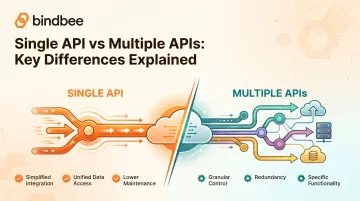
The scope of the problem is significant. Organizations now operate 26 HR technology modules on average, more than doubling from just 10 modules in 2020. Meanwhile, approximately 39% of IT team time is spent designing, building, and testing custom integrations. For HR Tech companies supporting multiple employer clients, this creates a maintenance surface area that grows exponentially with each new system.
TL;DR
- A unified API provides one normalized endpoint to access data from multiple HRIS, payroll, and benefits systems—no custom integration per vendor
- The multiple API approach means building separate native integrations for each HR system, each with unique authentication, schemas, and maintenance cycles
- Unified APIs reduce development time from weeks to hours and cut long-term maintenance costs by up to 76%
- Native APIs offer deeper system-specific control but require significant ongoing engineering investment
- For most HR Tech teams, a unified API is the faster and more scalable path; native integrations only make sense when proprietary system access is non-negotiable
Single API vs Multiple APIs: Quick Comparison
Here's how the two approaches stack up across the dimensions that matter most to engineering and product teams.
| Dimension | Single (Unified) API | Multiple Native APIs |
|---|---|---|
| Development Time | Less than 1 day per new system | 2–4 weeks per integration |
| Maintenance Burden | Zero — handled by API provider | 300+ hours/year per integration |
| Data Consistency | Normalized across all systems | Custom mapping per vendor |
| Systems Covered | 60+ HRIS platforms through one endpoint | Limited by engineering capacity |
| Authentication Complexity | Single authentication flow | OAuth, API keys, credentials per system |
| Scalability | Add new systems without code changes | Linear growth in engineering effort |
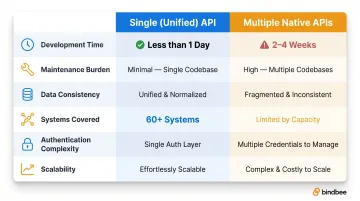
Note: "Single API" refers to a unified API layer that normalizes access to multiple HR systems through one endpoint. "Multiple APIs" means building individual native integrations per HRIS/payroll vendor.
What is a Single (Unified) API?
A unified API in the HR Tech context is a single endpoint with a standardized data model that normalizes employment, payroll, and benefits data from dozens of underlying HRIS and payroll systems — so developers learn one integration to access all of them.
How unified APIs work technically:
Unified APIs abstract vendor-specific complexity behind a single interface:
- Authenticates once through the unified layer, whether the underlying system uses OAuth, API keys, or SFTP
- Maps proprietary field names to a common data model — employee records, payroll runs, benefits enrollments, and dependents follow the same structure regardless of source
- Handles version differences and pagination logic internally, so you never interact with vendor-specific quirks
Core operational benefits:
- Faster time-to-market when adding new employer customers
- Consistent data formatting across all HR systems
- Reduced debugging cycles—one codebase instead of dozens
- Add new HR system coverage without additional engineering effort
Some unified APIs are built with domain-specific data models. Bindbee, for example, uses a benefits-first architecture that separates Employee Benefits, Employer Benefits, and Dependent Benefits as distinct objects—a structure that generic integration platforms don't provide out of the box.
Use Cases of a Single Unified API
Unified APIs deliver the most value when:
- Benefits administration platforms need to sync enrollment data across multiple employer HR systems without building custom integrations per customer
- Insurtech companies verify eligibility and dependent coverage across diverse payroll platforms
- HR Tech products onboard new employer clients quickly without waiting weeks for custom integration work
- Legacy system coverage is required — nearly 80% of employers share census and pay data via file exchange, email, or phone calls, and only 11% use API-based integrations
SFTP-to-API bridges extend unified API coverage to these file-based employers, letting you support them without requiring system upgrades on their end.
What is the Multiple API Approach?
The multiple API approach means building and maintaining a separate native integration for every HRIS or payroll vendor your customers use—each with its own codebase, authentication flow, and data transformation logic for systems like Workday, ADP, BambooHR, Rippling, and Gusto.
The compounding maintenance problem:
Each vendor updates their API independently. They deprecate fields, change authentication requirements, introduce new rate limits. Every change requires you to:
- Detect the breaking change
- Patch your integration code
- Test across affected customers
- Redeploy and monitor for errors
Workday, for example, releases updates biannually, during which features can be deprecated. Best practice is to check for newly deprecated features at least once per month. Multiply that across 15–20 vendor systems and integration maintenance becomes a full-time engineering role.
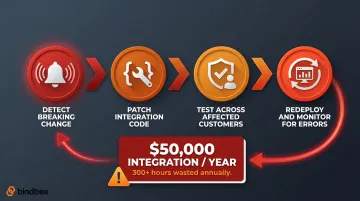
Approximately $50,000 per integration per year is a reasonable baseline—factoring in 150 hours to build, 300 hours annually to maintain, plus customer support time.
When the Multiple API Approach Makes Sense
Native integrations fit a narrow set of scenarios:
- Deep, bidirectional integrations with a single anchor system where you need control over every API call
- Enterprise clients whose IT teams require direct connectivity with no third-party intermediary for compliance or security reasons
- Niche systems with proprietary data structures that no unified API layer currently covers
- Real-time write-back requirements tied to one specific vendor
If you're supporting 3–5 systems with dedicated engineering bandwidth, native APIs can work. Past that threshold, the per-integration cost compounds quickly—$50K per system per year adds up to $500K–$1M annually before you've covered a typical mid-market customer base.
Single API vs Multiple APIs: Which Should HR Tech Teams Choose?
The right answer depends on where your product is today and where it's headed. Start with these four questions before deciding:
- How many HR systems do your customers use?
- How much engineering bandwidth can you dedicate to ongoing maintenance?
- How quickly do you need to onboard new employer customers?
- Is normalized data consistency across systems a product requirement?
Control vs. Speed
Native APIs give maximum control over data retrieval logic and system-specific features. But this depth comes at a cost: 2-4 weeks to build per integration versus less than 1 day with a unified API, plus 300+ hours per year in maintenance per native integration.
The Scalability Ceiling
As your product grows from supporting 5 employer HR systems to 30+, the maintenance surface area multiplies. 39% of IT team time is spent on integration work across enterprise IT — a burden that compounds with every new system you add.
Which Approach Fits Your Situation
- Choose a unified API if your priority is rapid employer onboarding, consistent cross-system data, low maintenance overhead, and broad HR system coverage
- Choose native integrations only when a specific system's proprietary capabilities are essential and cannot be accessed through a unified layer
The Hybrid Approach
Some HR Tech teams use a unified API to cover the long tail of HR systems while maintaining one or two deep native integrations for anchor enterprise systems. This gives broad coverage for the 90% of systems your customers use, with targeted depth for the handful where it genuinely matters.
Real-World Impact: The Cost of Building Multiple Integrations
Consider a benefits tech company supporting 20 employer clients across 15 different HRIS platforms. Building those 15 separate integrations means:
- 10-20+ weeks of initial development time (2-4 weeks per integration)
- 4,500+ hours annually in maintenance (300 hours × 15 systems)
- $750,000+ per year in combined personnel and partnership costs
Each integration requires ongoing monitoring for API changes, customer support for sync errors, and quarterly maintenance updates. The engineers who could be shipping new product features are instead maintaining integration infrastructure that generates no competitive advantage.
Phin, an employee gifting platform, reported a 76% reduction in onboarding time and 94% optimization in Time-to-Value after switching to Bindbee's unified API approach. The company saved over $115,000 annually in development costs previously allocated to manual HRIS integration work.
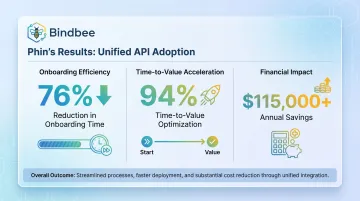
That shift in cost structure changes how teams think about integrations entirely. Companies using a unified API stop treating integrations as an engineering cost center and start treating them as a distribution advantage. Every new HR system added to the unified layer automatically expands their addressable employer market—without additional engineering effort.
Ready to eliminate integration maintenance and accelerate employer onboarding? Explore how Bindbee's unified API connects 60+ HRIS, payroll, and benefits systems through a single endpoint. Book a demo to see live integrations in action.
Frequently Asked Questions
Is it faster to have multiple API calls or one large API call for a backend?
In HR integrations, "multiple APIs" means maintaining a separate codebase per system — slower to build and slower to maintain. At the network level, parallel targeted calls can outperform one large call, but that's a different tradeoff than what most HR Tech teams face day-to-day.
What is the difference between single API and bulk API?
A single API refers to one unified endpoint abstracting multiple underlying systems. A bulk API typically refers to a single endpoint that processes multiple records (e.g., batch syncing 500 employee records) in one request.
What counts as a single API request?
A single API request is one HTTP call to one endpoint. In a unified API context, that one request can return normalized data sourced from multiple underlying HR systems, reducing round-trip overhead for the developer.
Can a service have multiple APIs?
Yes, a service can expose multiple APIs—for example, separate endpoints for payroll data, benefits data, and employee records. However, in HR Tech, managing multiple vendor-specific APIs per customer creates compounding maintenance burden compared to a unified API layer.
When should a company switch from multiple native APIs to a unified API?
The tipping point is usually one of three signals:
- Supporting more than 3-5 HR systems simultaneously
- Integration maintenance consuming more than 20% of engineering cycles
- Slow employer onboarding impacting revenue or customer churn
How does a unified API handle differences in data formats across HR systems?
Unified APIs normalize vendor-specific data schemas to a common data model—field names, data types, and relationships (e.g., employee-dependent linkages) are standardized regardless of which underlying HR system the data originates from.