
This post covers the mechanics of each integration method, where each excels in HR Tech workflows, how to decide between them, and when a hybrid approach is the right answer.
TL;DR
- APIs deliver real-time, two-way data sync; flat files transfer data in scheduled batches via CSV or XML over SFTP
- APIs excel when data freshness matters—new hire onboarding, benefits eligibility checks, and termination processing
- Flat files remain essential for legacy carriers and older HRIS platforms, especially for scheduled bulk transfers like open enrollment feeds
- 80% of employers still rely on file-based or manual data exchange, making hybrid strategies the norm rather than the exception
- Choose based on how current your data needs to be, what your systems support, and how much integration overhead your team can absorb
API vs. Flat File: Quick Comparison
| Dimension | API Integration | Flat File Integration |
|---|---|---|
| Data Transfer Method | Direct system-to-system communication via HTTP requests | Structured files (CSV, XML, TXT) exchanged via SFTP |
| Speed/Latency | Real-time or near-real-time | Batch processing (hourly, daily, weekly cycles) |
| Setup Complexity | Requires API endpoints, authentication, rate limit management | Universal compatibility; simpler initial setup |
| Error Handling | Immediate error responses enable instant retries/alerts | Errors discovered after batch processing, often days later |
| Scalability | Scales with API call volume; composable architecture | Limited by file size and batch frequency |
| System Compatibility | Requires modern systems with API support (86% of developers use REST) | Works with any system, including legacy platforms |
| Security | OAuth 2.0, token-based authentication | SSH-based encryption (SFTP) |
| Maintenance Overhead | Ongoing management of authentication, rate limits, schema changes | Manual export, validation, and format mapping per system |
| Ideal HR Tech Use Case | Real-time eligibility syncs, new hire webhooks, live enrollment data | Legacy carrier feeds, bulk enrollment exports, older on-premise HRIS |
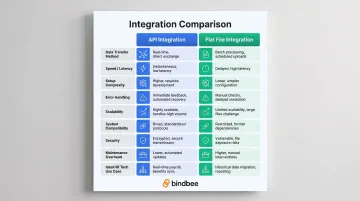
The right choice comes down to two factors: whether your target systems support APIs, and how current your data needs to be per workflow.
What is API Integration?
An API (Application Programming Interface) is a set of rules that allows two software systems to communicate directly, sending and receiving data in real time without manual file transfers. REST APIs dominate modern HR Tech—86% of developers use REST APIs compared to just 11% using older SOAP protocols. Webhooks, a subtype of APIs, push data automatically when specific events occur, such as when an employee is terminated or a dependent is added.
Core benefits for HR Tech:
- Syncs HRIS changes — new hire start dates, dependent additions, plan enrollment elections — immediately across connected systems, with no waiting for the next file drop
- Returns error responses when data fails validation (missing fields, authentication issues), enabling automated retries or instant alerts
- Triggers downstream actions the moment a qualifying life event occurs, through event-driven webhooks
According to MuleSoft's 2025 Connectivity Benchmark, the average enterprise manages 897 applications, yet only 29% are integrated. Real-time API integration directly addresses that gap.
Use Cases in HR Tech
API integration is the clear choice for:
- Keeping employee coverage status current across platforms with real-time eligibility syncs
- Triggering enrollment actions or coverage terminations automatically on new hire and termination events
- Flowing benefits enrollment data live to carriers with plan selections and effective dates
- Maintaining current family coverage across systems as dependent relationships change
Limitations to keep in mind:
- Not all HRIS platforms or legacy carriers expose the API endpoints you need
- Rate limits can throttle data volume during high-traffic periods
- Building and maintaining native integrations across dozens of systems demands significant engineering resources
For HR Tech companies connecting to a growing roster of employer systems, Bindbee offers a single normalized API covering 60+ HRIS and payroll systems. That means no per-integration builds, no ongoing maintenance overhead, and consistently fresh data.
What is Flat File Integration?
Flat file integration transfers structured data between systems using plain-text files (CSV, XML, or TXT formats). The source system exports a file, transfers it via SFTP (Secure File Transfer Protocol), and the destination system imports it on a schedule. This foundational method remains the only option when source systems don't expose APIs.
How SFTP works:
The source system drops a file into an agreed-upon directory on a secure server; the receiving system polls for new files on a schedule (hourly, nightly, per-pay-period) and processes them. Think of it as a secure shared mailbox that both systems check on schedule.
Pros for HR Tech:
- Universal compatibility — works with virtually any system, including legacy HRIS, payroll platforms, and insurance carriers
- Simpler initial setup compared to API authentication and endpoint configuration
- Handles bulk transfers well, such as annual open enrollment feeds or large demographic data exports
HIPAA mandates that all health plans and carriers accept the standard ANSI 834A Version 5010 enrollment format via SFTP, making flat file integration a regulatory requirement for carrier eligibility feeds.
Use Cases in HR Tech
Flat files are commonly used or required for:
- Legacy insurance carrier eligibility feeds where carriers only accept EDI 834 files via SFTP
- Bulk benefits enrollment data sent to carriers during open enrollment
- Periodic demographic syncs from older on-premise HRIS systems
- Payroll data exports from platforms without robust APIs
Limitations to Know
Flat file integration comes with trade-offs that compound as your employer base grows:
- Data is only as current as the last file transfer — eligibility information can be hours or days stale
- Manual steps (exporting, validating, mapping formats) introduce error risk at each stage
- Managing different file schemas per employer becomes operationally burdensome at scale
Nearly 80% of employers still share census and pay data via file exchange, email, or manual methods — with only 11% using API-based integration.
API vs. Flat File: Which is Right for HR Tech?
Frame your decision around data freshness. In HR Tech and benefits administration, stale data has real consequences — an employee whose termination isn't reflected in the benefits platform could retain coverage they're no longer eligible for, and a dependent added after a qualifying life event might not be enrolled on time.
Research shows nearly $1 million in benefits billing discrepancies per 500 employees, with enrollment errors costing approximately $400 each to resolve. The higher the cost of stale data in your use case, the stronger the case for API integration.
Key decision framework:
- Does the source system offer the API endpoints you need? Legacy carriers and older HRIS platforms often don't expose modern APIs
- How frequently does data change, and how quickly must changes propagate? Life events demand near-instant updates; annual plan catalogs can tolerate batch schedules
- What volume of data moves? Event-driven workflows (individual records triggered by changes) favor APIs; large periodic exports suit flat files
- How much engineering bandwidth can you allocate? Native API integrations require ongoing maintenance as providers update schemas and rate limits
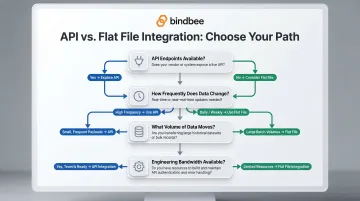
Situational recommendations:
- Choose API when building employer-connected features depending on real-time data—new hire onboarding flows, live eligibility checks, event-driven benefits enrollment
- Choose flat file when integrating with legacy carrier systems or older HRIS platforms lacking APIs, or when the use case is genuinely batch-oriented (monthly demographic reporting)
- Consider unified API platforms when connecting to a growing roster of employer systems—building and maintaining native API integrations with each HRIS individually doesn't scale
The stakes of getting this wrong are concrete: delays in termination data can trigger COBRA notification penalties averaging $110 per day per affected employee. Whichever method you choose, the architecture should match how fast your data actually needs to move.
The Hybrid Approach: Bridging Legacy and Modern Systems
While modern HRIS platforms offer robust APIs, the benefits ecosystem includes legacy carriers, older ERPs, and mid-market HR systems that rely primarily on flat file exports. A mature integration strategy accounts for both—using APIs where available for real-time data, and flat files via SFTP as the fallback for systems that haven't modernized.
According to research, 64% of organizations are affected by legacy system dependencies, with IT teams spending 16+ hours weekly patching these systems — and 51% still rely on spreadsheets somewhere in their payroll process.
The demand for middleware that bridges this gap is growing fast. The iPaaS market reached $8.5 billion in 2024 — a 23.4% increase — with Gartner forecasting it will exceed $17 billion by 2028.
The SFTP-to-API Bridge Pattern
Middleware ingests flat file exports from legacy systems, normalizes the data, and surfaces it through a standard API — so downstream applications consume all employer data through a consistent interface, regardless of whether the source uses APIs or flat files. Bindbee provides this bridge, eliminating the need for consuming applications to handle two different integration paradigms simultaneously.
To evaluate whether a hybrid approach fits your stack:
- Identify which source systems export flat files only (legacy carriers, older ERPs, mid-market HR platforms)
- Map where file-based transfers create data lag or require manual intervention
- Assess whether a unified API layer could reduce that maintenance burden and accelerate employer onboarding
Frequently Asked Questions
What is the difference between a flat file and an API?
A flat file transfers a batch of structured data (CSV, XML) between systems on a schedule via SFTP. An API enables direct, real-time communication between two systems without file transfers—the key difference being speed and automation versus scheduled batch processing.
Are flat files still used?
Yes, flat files remain widely used in healthcare, insurance, and HR Tech. Many legacy systems (older HRIS platforms, insurance carriers) do not yet support modern APIs, making flat file via SFTP the only available integration method. HIPAA mandates that carriers accept ANSI 834 files.
What is the purpose of a flat file?
A flat file serves as a transferable, system-agnostic format for moving structured data that can be exported from one system and imported into another. It's useful for bulk data transfers, historical data exports, and integrations with systems lacking API connectivity.
What are the different types of APIs?
The most common types in HR Tech are REST APIs (the dominant standard, using HTTP requests), SOAP APIs (an older standard still used by some legacy systems), and webhooks, which push data automatically when specific events fire, such as a new hire being added.
Can you use both API and flat file integration together?
Yes, a hybrid approach is common and practical—using APIs for real-time, event-driven data flows and flat files for systems that don't offer API access or for genuinely batch-oriented use cases, such as bulk enrollment exports.
Which integration method is better for HR Tech and benefits administration?
API integration is the better fit for HR Tech, given real-time requirements around eligibility, enrollment, and life events. That said, flat file integration remains necessary for legacy carrier and HRIS systems—which is why most mature implementations combine both methods rather than choosing one exclusively.