Introduction
Most HR and benefits platforms weren't built to talk to each other. HRIS systems, payroll engines, benefits administration portals, and carrier platforms each do their job well — but in isolation.
That fragmentation has real consequences: duplicated data entry, delayed benefits updates, and compliance exposure that compounds as organizations grow.
The stakes are quantifiable. Organizations now manage an average of 101 applications, yet only 29% of those applications are connected. For Benefits Tech and HR Tech companies, this integration gap is not just an inconvenience—it's a structural barrier. When eligibility data arrives late, employees enroll in incorrect plans. When dependent records don't sync, benefits administration breaks. When termination events don't propagate instantly, claims get paid to ineligible members.
This guide covers what platform integration actually means, how the underlying mechanics work, and how to evaluate the right approach — pre-built connectors, custom API builds, iPaaS platforms, or unified APIs — for connecting HR and benefits systems at scale.
TL;DR
- Platform integration connects separate software systems for automatic data exchange without manual transfers or one-off custom builds
- It works by establishing connections, normalizing data across systems, scheduling syncs, and delivering records to downstream tools automatically
- Integration approaches range from pre-built connectors and custom APIs to iPaaS platforms and unified APIs — the right fit depends on your scale and maintenance capacity
- The core payoff is consistent data across connected systems without the engineering overhead of building and maintaining each connection individually
- For Benefits Tech, integration directly affects employer onboarding speed, benefits data accuracy, and employee record synchronization
What Is Platform Integration?
Platform integration is the structured process of connecting two or more software applications so they can automatically share data and trigger actions across systems without human intermediaries or manual data transfers. For Benefits Tech and HR Tech companies, this means employee records created in an HRIS immediately appear in the benefits platform, terminations trigger coverage end dates across carriers, and dependent additions flow through to eligibility systems—all without spreadsheet exports or CSV uploads.
The operational problem becomes clear when systems run in isolation. When an HRIS, payroll tool, benefits platform, and insurance carrier each maintain separate data stores, the result is duplicated data entry and delayed updates that create compliance exposure under ERISA and ACA. Benefits administrators often discover enrollment failures only during retrospective billing reconciliation—long after the damage is done.
According to MuleSoft's 2025 Connectivity Benchmark Report, 95% of IT leaders struggle to integrate data across systems, and 90% report that data silos create significant business challenges.
What Platform Integration Is Not
Platform integration is distinct from single point-to-point API connections, which link only two specific systems without centralized coordination. It's also not the same as data migration—a one-time movement of historical records from one system to another. Platform integration establishes continuous, bidirectional or multi-directional data flows that persist as long as the systems remain connected.
Why Platform Integration Has Become Critical
The HR Tech market has expanded from $43.66 billion in 2025 toward a projected $95.95 billion by 2034, driven by specialization. No single vendor covers all HR, payroll, benefits, and carrier functions comprehensively. As organizations adopt best-of-breed tools across recruitment, onboarding, payroll, time tracking, and benefits enrollment, cross-platform data flow becomes baseline operational infrastructure—not an optional enhancement.
Main integration types:
- Pre-built connectors — Vendor-specific integrations for common pairings
- Custom API integrations — Internal engineering builds for specific system pairs
- Integration Platform as a Service (iPaaS) — Middleware that manages multiple integrations centrally
- Unified APIs — Normalized API layers that abstract dozens of underlying systems through a single endpoint
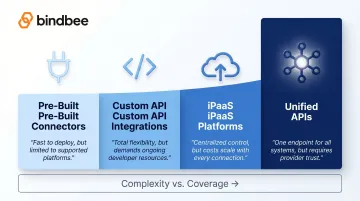
Each approach carries distinct trade-offs in speed, maintenance burden, and flexibility. For teams connecting more than a handful of systems—or shipping integrations as a product feature—the difference in build time and ongoing maintenance between these approaches is measured in months, not days.
How Does Platform Integration Work?
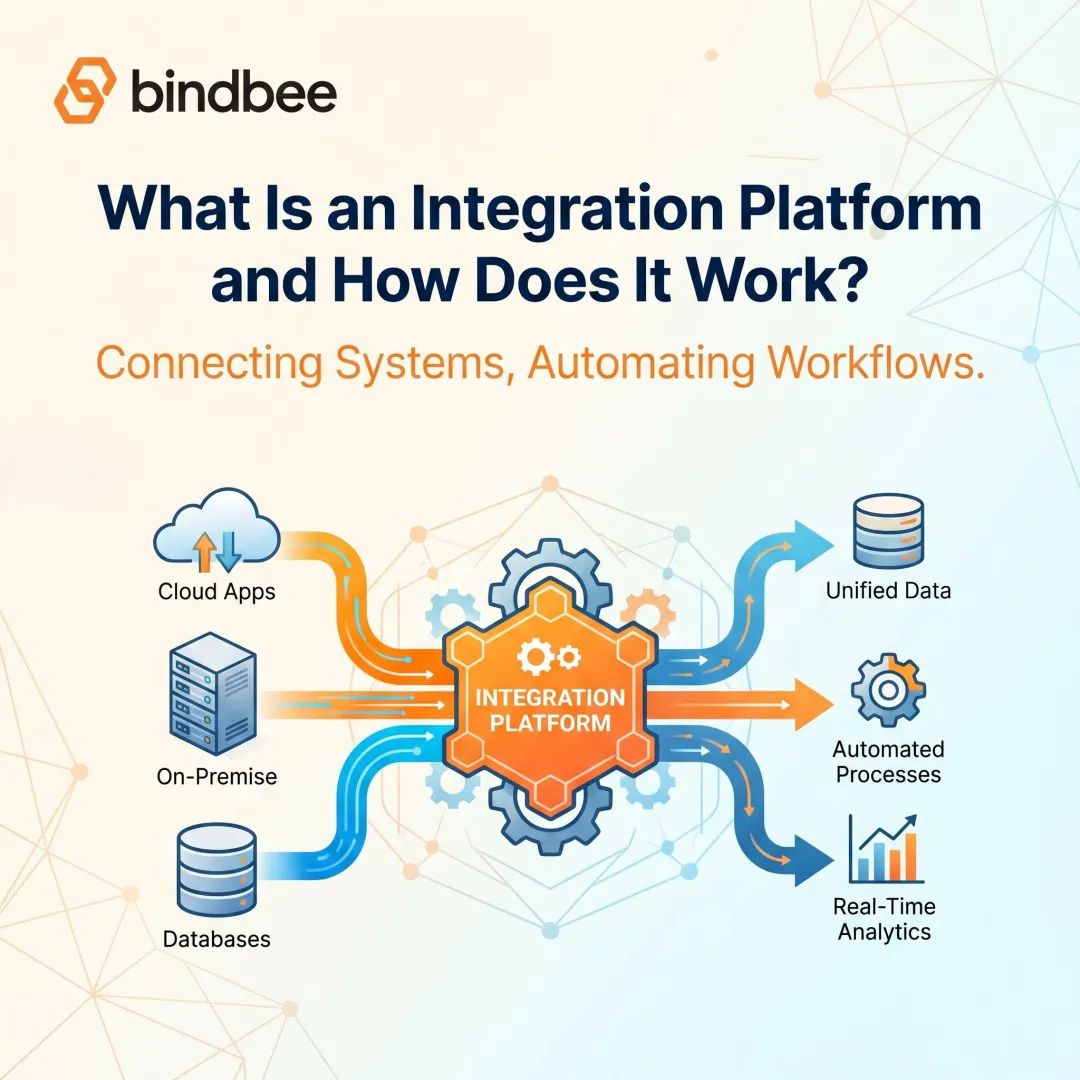
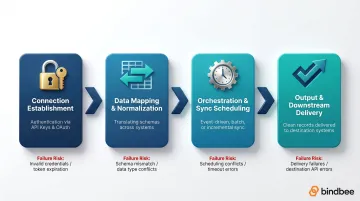
Platform integration runs as a repeatable pipeline—authentication, mapping, orchestration, and delivery—where failures at any stage corrupt data quality downstream. Each stage has distinct failure modes, and knowing where they occur explains why so many teams underestimate integration complexity.
Connection Establishment
Platform integration begins when the source and destination systems authenticate with each other. This typically occurs via API keys, OAuth tokens, or managed authentication flows—like an embedded link that guides end users through credential entry and permission granting. The authentication process verifies identity and defines what data the integration can access, which endpoints are available, and what operations (read, write, update) are permitted.
A common bottleneck emerges at this stage in HR Tech, where HRIS and payroll systems often use proprietary authentication schemes or legacy file-export formats like SFTP. Unlike modern REST APIs with OAuth 2.0 flows, these systems may require manual credential configuration, file location setup, or custom bridging logic to establish a reliable, secure connection. For benefits platforms connecting to multiple employer HRIS systems, this authentication complexity multiplies—each new employer may use a different HRIS with different credential management requirements.
Data Mapping and Normalization
Once connected, the integration must translate data from the source system's schema into a format the destination system understands—a process called data mapping. One HRIS may label an employee's last day as termination_date; another calls it end_of_employment or separation_date.
The integration layer normalizes these variations into a common model that downstream systems can rely on consistently.
Normalization is especially critical in HR and benefits contexts because employee identifiers, dependent relationships, benefit plan codes, and coverage elections rarely share naming conventions across vendors. Without it, a benefits administration platform needs custom mapping logic for every HRIS it connects to.
The stakes are concrete: when dependent relationships are labeled differently—"spouse" versus "partner" versus "domestic_partner"—enrollment systems may fail to recognize coverage eligibility entirely, breaking the benefits workflow at the source.
Bindbee addresses this challenge by normalizing all data to a unified schema across 60+ HRIS and payroll systems. Whether an employer uses ADP Workforce Now, BambooHR, or Workday, the benefits platform receives employee records, dependent relationships, and benefit enrollment data in the same standardized format, eliminating vendor-specific mapping logic.
Orchestration and Sync Scheduling
Orchestration manages when and how data flows between systems. Integrations can operate in several modes:
- Event-driven (webhook-triggered) — Data syncs immediately when a triggering event occurs, such as a new hire added to the HRIS
- Scheduled batch sync — Data transfers at fixed intervals, such as nightly or weekly batches
- Continuous incremental updates — Real-time or near-real-time syncs that detect and propagate only changed records
Each approach involves trade-offs. Event-driven syncs deliver the freshest data but require both systems to support webhooks and handle high-frequency API calls. Scheduled batch syncs reduce system load but introduce latency—employees added mid-cycle may not appear in the benefits platform until the next sync window. Continuous incremental syncs balance freshness and efficiency but require sophisticated change detection logic.
Monitoring and error handling are essential components of orchestration. Effective orchestration includes failure detection, contextual error logging, automatic retries, and administrator alerts. Without this layer, silent failures cause data drift that surfaces only during audits, open enrollment periods, or compliance checks—often too late to prevent employee impact.
Output and Downstream Delivery
The integration ultimately produces clean, normalized, current records delivered to the destination system in the format it expects. For a benefits administration platform, this might be an updated employee roster with accurate eligibility data, dependent records with relationship codes that match carrier requirements, or termination events that trigger automatic COBRA notices and coverage end dates.
Output quality directly determines operational outcomes. Stale eligibility data leads employees to enroll in incorrect benefit tiers. Missing or malformed dependent relationships cause carriers to reject enrollment files during EDI 834 transmission.
According to Tabulera's analysis, HRIS platforms typically have zero visibility into downstream carrier validation once enrollment data leaves the system. A single failed enrollment during onboarding can cause every subsequent transaction for that member to fail—creating ERISA fiduciary exposure and ACA compliance risk.
This is why the pipeline stages matter individually—a gap in any one of them doesn't just slow data down; it can invalidate the records that carriers, compliance teams, and employees depend on.
Types of Platform Integration
Pre-Built Connectors and Native Integrations
Pre-built connectors are integrations offered directly by software vendors to link their tool with specific partner platforms. These are the fastest to implement—often requiring only credential entry and basic configuration—but come with limited scope and customization. Pre-built connectors work well for standard, high-volume pairings (such as connecting Slack with Google Workspace) but frequently break when either vendor updates their API without coordinating changes.
Best for: Small-scale deployments with standard workflows, where both systems are on the vendor's supported integration list and customization requirements are minimal.
Limitations: Each connector supports only one specific pairing. If your benefits platform needs to connect with 20 different HRIS systems, you'd need 20 separate pre-built connectors—assuming they all exist. Maintenance remains the customer's responsibility, and API version changes can cause unexpected failures.
Custom API Integrations
Custom API integrations are built internally by engineering teams to connect two specific systems. This approach offers maximum control—developers can implement precisely the data flows, transformations, and business logic required—but demands significant ongoing maintenance.
That maintenance burden adds up fast. According to MuleSoft's Connectivity Benchmark Report, IT teams spend an average of 39% of their time designing, building, and testing custom integrations. For payroll specifically, IT departments estimate spending 22 hours per week, per country setting up integrations. This engineering time directly competes with product development priorities.
The cost compounds at scale. A case study from Saveday and Finch found that building a single payroll integration manually would take approximately 3 months. By contrast, using a unified API, Saveday built 40 payroll provider integrations in the same 3-month period—a 40x improvement in coverage per unit of engineering time.
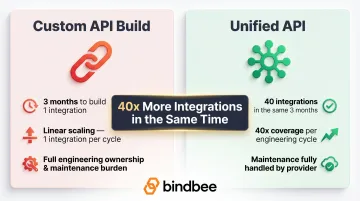
Ideal when: Organizations with substantial engineering resources, unique data transformation requirements, and a small number of integration endpoints that remain stable over time.
Scaling costs: Each new system connection requires a full rebuild cycle. Version management, authentication token refresh, rate limit handling, and error recovery all require ongoing engineering attention.
Integration Platform as a Service (iPaaS)
iPaaS solutions are cloud-based middleware platforms that provide pre-built connectors, a workflow UI, and centralized monitoring for building and managing multiple integrations.
Platforms like MuleSoft, Workato, and Boomi allow technical teams to configure integrations visually, manage data transformations through low-code interfaces, and monitor sync status across all connections from a single dashboard.
The iPaaS market grew 23.4% to $8.5 billion in 2024, making it the largest integration platform market according to Gartner. This growth reflects enterprise demand for governed, centralized integration management, particularly for internal integrations connecting ERP, CRM, finance, and HR systems within a single organization.
Works best for: Enterprises managing many internal integrations, IT teams seeking governance controls and audit trails, and organizations with technical staff who can configure workflows but prefer not to write custom code for every integration.
Limitations: iPaaS platforms typically charge per connection or per transaction volume, which can become expensive at scale. They also require ongoing configuration management and may not offer deep, benefits-specific data models tailored to HR Tech use cases.
Unified API
A unified API is a single normalized API layer that abstracts dozens or hundreds of third-party systems, allowing product teams to integrate once and reach all covered systems immediately.
Rather than connecting individually to ADP, Workday, BambooHR, Paychex, and 50+ other HRIS systems, a benefits platform integrates with one unified API provider. That single connection grants access to all supported systems immediately.
This approach is particularly effective for HR Tech and Benefits Tech companies that need to connect with many different employer HRIS, payroll, and benefits systems. Bindbee's unified API, for example, connects to 60+ HR and benefits systems through a single integration, with benefits-first data models specifically designed for employee benefits, employer benefits, and dependent benefits. The platform normalizes fields like termination dates, dependent relationships, and benefit plan identifiers across all vendors, eliminating the need for custom mapping logic.
Key advantages:
- Integrate once, support 60+ systems — no per-vendor development cycles
- The unified API provider handles version changes, authentication updates, and rate limiting across all underlying systems
- Consistent, normalized schemas reduce downstream mapping complexity
- Built-in webhooks fire automatically on new hires, terminations, and dependent changes to enable real-time benefits workflows
Unified APIs shift maintenance responsibility from the customer's engineering team to the API provider, freeing internal resources to focus on core product development rather than integration upkeep.
Key Benefits of Platform Integration
Operational Efficiency and Reduced Manual Work
Automated data flows eliminate repetitive manual entry, reduce error rates, and free operations teams to focus on higher-value work rather than administrative data transfers. HR staff spend 57% of their time on administrative tasks, and companies using HR automation tools report cutting manual tasks by 70%.
Human error rates for manual data entry range from 1-5%, and that risk compounds each time data moves between systems. Every handoff between HRIS, payroll, and benefits platforms adds another opportunity for error accumulation.
The scale of manual reliance in benefits administration makes this tangible:
- 51% of organizations still use spreadsheets to process payroll
- 19% rely on manual or paper-based processes entirely
- When these workflows feed benefits enrollment, errors create compliance exposure and employee dissatisfaction
Data Accuracy and Consistency Across Systems
When employee records update in one system and immediately propagate through the integration layer, all downstream tools reflect current state. This is especially critical for benefits eligibility, where outdated data directly affects employee coverage and compliance.
The numbers show how far most organizations are from that standard:
- Global mean payroll accuracy sits at just 78%, with 69% of organizations reporting at least one payroll data problem
- 50% of companies have been penalized for non-compliant payroll, rising to 67% for those operating across 2-5 countries
- When payroll inaccuracies cascade into benefits systems, the result is enrollment errors, incorrect contribution calculations, and carrier file rejections
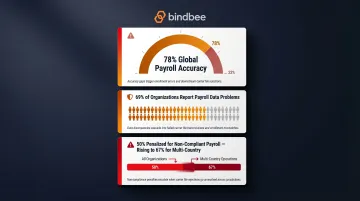
Integrated data flows cut this exposure directly. Eligibility changes, coverage elections, and dependent updates propagate immediately across all connected systems — no manual re-entry, no lag between source and downstream record.
Scalability Without Proportional Engineering Cost
A well-structured platform integration allows companies to add new system connections without rebuilding from scratch each time. This matters when expanding to new employer customers who use different HRIS or payroll vendors.
Custom API approaches scale linearly: each new system requires comparable engineering effort from scratch. A unified API works differently — the first integration covers all connected systems at once, and adding support for a new employer becomes a configuration step rather than a development project.
The demand is clear: 94% of business leaders want payroll software integrated across all HR systems, meaning integration is now table stakes for HR software buyers. For Benefits Tech companies, demonstrating immediate HRIS compatibility during the sales cycle shortens deals — while competitors still scoping custom integration projects are still negotiating scope.
Where Platform Integration Is Used in HR and Benefits Tech
HR Tech and Benefits Tech companies use platform integration to connect with the HRIS systems their employer clients already use. Rather than asking employers to manually export and upload employee census data every pay period, an integration pulls employee records, organizational structure, dependent information, and benefit elections automatically.
The onboarding impact is substantial. A documented case study from Saveday and Finch reduced employer onboarding time from 5 hours to under 15 minutes—a 95% reduction—by implementing a unified API integration layer. Organizations using SaaS management platforms with integrated onboarding report a 78% reduction in onboarding time.
Beyond onboarding, benefits administration platforms rely on integration to keep enrollment data, life event triggers, and coverage elections synchronized across carriers, TPAs, and payroll systems. Without reliable integration, benefits data becomes inconsistent between what HR believes is enrolled and what the carrier actually has on file.
According to Tabulera's analysis, enrollment data using the EDI 834 standard must be mapped between HRIS schemas and carrier-specific implementation guides. HRIS platforms typically have zero visibility into downstream carrier validation outcomes—meaning a single failed enrollment during onboarding can cause every subsequent transaction for that member to fail.
Bindbee handles this integration layer directly, giving Benefits Tech and Insurtech companies a ready-made infrastructure rather than requiring them to build and maintain individual connections to each HRIS or carrier system. The platform provides:
- Normalized data models for employee benefits, employer benefits, and dependent benefits
- Webhooks for life events including new hires, terminations, and dependent changes
- Connections to 60+ HRIS, payroll, and benefits systems through a single API endpoint
Frequently Asked Questions
What does platform integration mean?
Platform integration connects separate software systems so they exchange data automatically without manual intervention. For example, when an HR manager terminates an employee in the HRIS, that event immediately triggers benefit coverage end dates, COBRA notices, and payroll adjustments across all connected systems.
What is an integration platform?
An integration platform is the software product used to build and manage connections between systems — distinct from "platform integration," which describes the practice itself. Examples include iPaaS solutions, unified APIs, and middleware tools that handle authentication, data mapping, and orchestration.
What are the main types of platform integration?
The four main types are: pre-built connectors (fast but vendor-limited), custom API integrations (flexible but high-maintenance), iPaaS solutions (centralized management across internal systems), and unified APIs (single endpoint covering many systems). The best fit depends on your scale, maintenance capacity, and number of systems.
What is the difference between platform integration and API integration?
API integration refers to a single point-to-point connection between two systems via their APIs. Platform integration typically refers to a broader, managed approach that handles many connections, data normalization, and orchestration across multiple systems, often with centralized monitoring and error handling.
How does a unified API simplify platform integration?
A unified API normalizes data models across dozens of third-party systems and exposes them through a single endpoint. Teams build once and gain access to all covered integrations without managing each connection separately, eliminating version updates, authentication complexity, and vendor-specific schema differences.
What are common challenges in platform integration?
The three main challenges are inconsistent data schemas (requiring mapping logic), authentication complexity with legacy platforms like SFTP-only systems, and ongoing maintenance as third-party APIs change or deprecate endpoints. Platform-level solutions shift this burden away from internal engineering teams.