Introduction
You've built a benefits platform that solves a critical employer problem. The pricing is competitive, the UX is intuitive, and your early customers love it. But every sales conversation stalls at the same question: "How long will it take to connect to our HRIS?"
When the answer is "4-8 weeks of custom development work," the deal dies — or worse, the prospect chooses a competitor who can get them live faster.
This scenario plays out daily across the HR tech industry. 77% of HR and payroll professionals store data across multiple HCM databases, and 71% cannot transfer or share data across those systems. Integration capability determines whether employers adopt your product at all — not as a feature differentiator, but as a basic requirement for getting the deal done.
This article covers what seamless integration actually means in HR software, why it's so difficult to build, and how modern infrastructure approaches are changing that.
Key takeaways:
- Seamless HR integration means automatic, normalized data exchange — no manual work, no custom middleware
- Each native HRIS integration costs hundreds of developer hours and requires ongoing maintenance as APIs evolve
- A unified API cuts setup from weeks to hours across 60+ HRIS connections
- Standard HRIS exports often omit benefits-critical data: dependents, coverage elections, and life events
What "Seamless" Actually Means in HR Software Integration
Seamless HR software integration is the ability for two or more systems to automatically exchange accurate, normalized data without manual input, custom middleware, or disruptive delays from the moment a connection is established.
The difference between "seamless" and merely "connected" lies in four critical characteristics:
- Real-time or near-real-time sync: Data flows automatically as changes occur, not through nightly batch exports
- Normalized data models: Employee status codes, dependent relationships, and benefit plan structures are standardized across different source systems
- Zero maintenance burden: The integration doesn't break when upstream vendors update their APIs
- Consistent user experience: HR admins connect systems in minutes through simple authorization flows, not IT projects
Integration Depth Levels Matter
Not all integrations deliver the same value. Most HR tech platforms support three depth levels:
| Depth Level | What It Does | Best For |
|---|---|---|
| Basic data pulls | Retrieves static rosters — names, emails, departments | Directory apps, lightweight tools |
| Transactional sync | Enables bidirectional updates for enrollment changes, deductions, and coverage tiers | Benefits administration, payroll |
| Event-driven | Uses webhooks to fire immediately on new hires, terminations, or life events | Time-sensitive eligibility workflows |
For benefits platforms, all three levels are necessary — enrollment decisions need to push back to the HRIS, and eligibility checks need to trigger the day an employee starts. Employee engagement tools, by contrast, may only need basic pulls.
The right depth is what separates a genuinely seamless integration from one that's just technically connected.
Why Building HR Integrations Is Harder Than It Looks
The Fragmentation Problem
There are nearly 6,000 HR and payroll providers in the United States. An average mid-market employer uses 6-8 different HR applications simultaneously. For HR tech platforms serving diverse customer bases, this means preparing to connect to dozens of different systems just to support existing clients — before acquiring a single new customer.
The problem compounds as you grow. Every new employer potentially runs a different HRIS, expanding your integration backlog alongside your growing customer base.
The "Native Integration" Trap
Building direct, one-to-one integrations with each HRIS vendor sounds straightforward until you begin:
- Research the vendor's API documentation (often incomplete or outdated)
- Build and test authentication flows (OAuth, API keys, sometimes both)
- Write data extraction logic specific to that vendor's endpoints
- Create normalization code to map their schema to your data model
- Handle rate limiting, pagination, and error scenarios unique to that API
- Maintain the connector as the vendor updates their API (which they will, without warning)
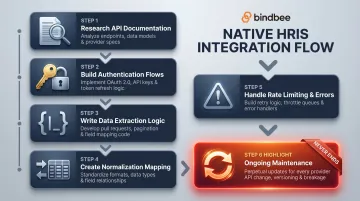
Each integration typically runs into the hundreds of developer hours to build — and the maintenance burden tends to exceed that initial cost as vendor APIs evolve.
The Data Normalization Challenge
Even when raw API connections exist, different systems structure identical data differently:
- Employee status codes: One HRIS uses "Terminated," another uses "Inactive," a third uses numeric codes (0, 1, 2)
- Dependent relationship types: Spouse vs. domestic partner vs. civil union classifications vary by system
- Benefits plan structures: Coverage tier naming, contribution calculation methods, and effective date handling differ across platforms
Each source system requires separate translation logic. When upstream vendors change their schema — which happens regularly — your normalization breaks, data sync fails, and customer support tickets spike.
The Benefits Data Gap
Unlike basic HR fields (name, start date, department), benefits-critical data is often missing or inconsistently modeled in standard HRIS exports:
- Coverage elections and enrollment status
- Dependent relationships with complete demographic details
- Plan effective dates and coverage tier selections
- Life event triggers (marriage, birth, adoption)
For benefits tech platforms, these gaps make standard HRIS integrations insufficient. You need deeper data access than most HRIS APIs expose through their standard employee endpoints.
The Scalability Constraint
Every unsupported HRIS is a direct constraint on sales velocity. If closing a deal depends on an integration that doesn't exist yet, prospects face a choice: wait months for a custom build or pick a competitor who already supports their system. That's not a technical problem — it's a revenue problem.
The Systems HR Tech Platforms Need to Connect
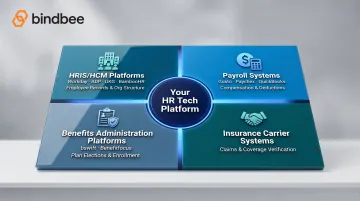
Most HR tech products need to pull from or push to four core system categories. Each one serves a distinct purpose — and missing any of them creates gaps in data your product depends on:
- HRIS/HCM platforms (Workday, ADP, UKG, BambooHR): employee records, org structure, employment status, and job details — the foundation of any accurate employee roster
- Payroll systems (Gusto, Paychex, QuickBooks Payroll): compensation data, deduction amounts, pay schedules, and earnings history — essential for benefits platforms calculating contributions or eligibility
- Benefits administration platforms (bswift, Benefitfocus): plan elections, coverage data, and enrollment details — necessary when benefits data isn't fully represented in the HRIS
- Insurance carrier systems: direct data exchange for claims processing, enrollment feeds, and coverage verification — often through specialized benefits APIs rather than HRIS connections
The Legacy System Reality
Nearly 80% of employers share census and pay data via manual methods like file exchange or email; only 11% use API-based integrations. Many mid-market and enterprise employers run systems that export data via SFTP or flat files rather than modern REST APIs.
If your integration strategy only supports API-based systems, you exclude a substantial portion of the market. Any HR tech platform that can't handle SFTP or flat-file exports will lose deals at the employer onboarding stage — not because the product failed, but because the integration couldn't reach the customer's system.
What Seamless Integration Unlocks for HR Tech Platforms
Faster Employer Onboarding
When integration setup takes hours instead of weeks, the time between contract signature and go-live collapses. One benefits tech platform reduced onboarding from 12 weeks to 48 hours by eliminating custom HRIS builds for each new employer.
Data Freshness and Accuracy
Always-current employee data means downstream workflows operate on accurate information:
- Eligibility checks reflect yesterday's new hire, not last month's export
- Benefits enrollment triggers fire the moment an employee changes status
- Dependent changes sync automatically without manual file uploads
- Support tickets from stale data drop significantly when sync runs on schedule
Complete Benefits and Dependent Data
For benefits tech specifically, seamless integration delivers the data sets standard HRIS exports often omit:
- Plan selections with coverage tiers and effective dates
- Dependent relationships with complete demographics
- Contribution amounts (employee and employer)
- Life event triggers for qualifying status changes
This data forms the foundation for accurate claims processing, carrier feeds, and compliance reporting.
Engineering Bandwidth Recovered
When the integration layer requires zero maintenance, product teams shift focus from debugging sync failures to building core product features. Fewer broken connections means fewer firefighting sprints — and more roadmap progress. Using an API hub to standardize integrations can cut integration-related IT time by 50%.
Business Impact
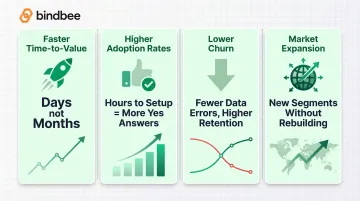
Technical benefits translate directly to commercial outcomes:
- Faster time-to-value: Customers go live in days, not months
- Higher adoption rates: Employers say "yes" when setup takes hours
- Lower churn: Data errors drop when sync is automatic and accurate
- Market expansion: Support new employer segments without rebuilding the integration layer
How HR Tech Companies Approach Seamless Integration
Approach 1: Building Native Integrations In-House
Engineering teams research each HRIS vendor's API documentation, build custom connectors, handle authentication, and write normalization logic specific to that system.
This works when you need deep customization for 2-3 high-priority integrations and have dedicated engineering resources available for ongoing maintenance.
The problem: as the integration count grows, so does the maintenance burden. API versioning, authentication changes, and schema updates pile into a perpetual backlog — pulling engineering time away from actual product development.
Approach 2: Using a Unified HR Integration API
The unified API model provides a single endpoint that abstracts connections to 65+ HRIS, payroll, and benefits systems. Data is normalized into consistent models, so the HR tech platform builds integration logic once and it works across all supported systems.
How this solves core pain points:
- Setup in hours vs. weeks: Authentication via magic link; initial sync completes in minutes
- Zero maintenance: The API provider handles upstream API changes, versioning, and authentication flows
- Normalized data models: Employee status, dependent relationships, and benefit structures use consistent schemas regardless of source system
- Legacy system support: SFTP-to-API bridges handle file-based systems alongside modern REST APIs
Bindbee takes this further with benefits-first data models that treat Employee Benefits, Employer Benefits, and Dependent Benefits as distinct entities. That structure means the data benefits platforms actually need — coverage elections, dependent relationships, plan effective dates — is consistently available across all 65+ connected systems.
Approach 3: Middleware and iPaaS Tools
General-purpose integration platforms (Zapier, Workato, MuleSoft) offer broad connectivity but weren't designed for HR and benefits data models.
They can be useful for connecting internal tools or automating simple workflows. For HR-specific use cases, though, the gaps add up:
- Still require significant per-integration configuration
- Don't provide benefits-specific data models out of the box
- May not meet compliance requirements (HIPAA, SOC 2) essential for HR and benefits data
Compliance and Security in HR Software Integrations
HR integration data carries high compliance stakes. Employee PII, benefits elections, and dependent information fall under HIPAA, GDPR, and other data privacy frameworks.
The integration layer itself must meet the same compliance standards as your core product.
What to Validate in Your Integration Infrastructure
Your infrastructure checklist should cover:
- Encrypts data using TLS 1.2+ in transit and AES-256 (or equivalent) at rest
- Enforces role-based access controls with detailed sync logging and webhook notifications for data changes
Certifications that matter:
- SOC 2 Type II: Third-party validated security controls for handling sensitive data
- ISO 27001: International standard for information security management
- GDPR readiness: Compliance with EU data privacy requirements for employee data
- HIPAA compliance: Required when handling health benefit elections and dependent data for self-insured plans
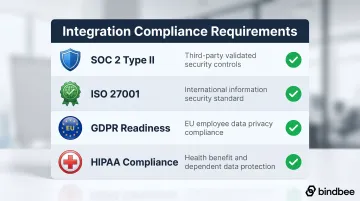
The average cost of a data breach in healthcare is $7.42 million, with employee PII breaches costing $169 per record. When evaluating any integration vendor, these certifications and controls should be non-negotiable items on your checklist — not afterthoughts.
Frequently Asked Questions
What does "seamless integration" mean in HR software?
Seamless integration means two or more HR systems automatically exchange accurate, normalized data in real time without manual input or custom middleware. HR workflows, eligibility checks, and benefits processing reflect up-to-date information without delays or errors.
What is the difference between native HR integrations and a unified API?
A native integration is a direct, custom-built connection to one specific HRIS vendor. A unified API abstracts connections to many systems behind a single endpoint, eliminating the need to build and maintain separate connectors for each platform.
How long does it take to build a seamless HR software integration?
Building a single native HRIS integration typically requires weeks of engineering effort and ongoing maintenance as APIs evolve. A unified API approach reduces setup to hours, with zero ongoing maintenance burden for the customer.
What HR systems should an HR tech platform integrate with?
Priority systems depend on your use case, but most HR tech platforms need connections to:
Priority systems depend on your use case, but most HR tech platforms need connections to:
- HRIS/HCM platforms for employee records
- Payroll systems for compensation data
- Benefits administration tools for plan elections
- Carrier systems for coverage processing
The broader your customer base, the more system coverage you'll need.
How do HR software integrations handle data security and compliance?
Secure integrations encrypt data in transit (TLS 1.2+) and at rest, enforce access controls with audit logging, and maintain certifications such as SOC 2 Type II, ISO 27001, and HIPAA compliance. These requirements apply to the integration infrastructure layer, not just the end application.
What is the biggest challenge in maintaining HR system integrations?
Ongoing maintenance — keeping connectors functional as HRIS vendors update APIs, change data schemas, or modify authentication flows — is the largest hidden cost of native integrations. This maintenance burden is the primary reason HR tech teams adopt unified API solutions over time.