Introduction
The average enterprise today manages 897 applications, yet only 29% are integrated. For SaaS products, this gap is a real bottleneck: every employer expects your platform to connect with their HRIS, payroll provider, and benefits carriers. Building those connections manually ties up months of engineering time per integration.
iPaaS (Integration Platform as a Service) gives teams the infrastructure to ship integrations faster and cut ongoing maintenance. The cost of skipping it adds up fast: each native integration takes roughly 150 hours to build and 300 hours per year to maintain—$50,000–$150,000 per integration annually.
This guide breaks down what you need to know:
- What iPaaS is and how it works
- Why it matters for SaaS teams in 2026
- Top iPaaS solutions by use case, technical fit, and integration category
TL;DR
- iPaaS platforms let SaaS companies connect their products to third-party systems without custom-building each integration
- The right iPaaS choice depends on your team's technical resources, target systems, security requirements, and speed-to-market needs
- General-purpose tools like MuleSoft, Boomi, and Workato offer wide connector libraries — but come with heavy setup and engineering overhead
- Specialized unified APIs (Bindbee for HR/Benefits, Merge for HRIS/ATS) cut integration time through pre-normalized, domain-specific data models
- HR Tech and Benefits SaaS teams gain the most from iPaaS built specifically for employment data — faster onboarding, cleaner data, no maintenance burden
What Is iPaaS and Why SaaS Teams Need It in 2026
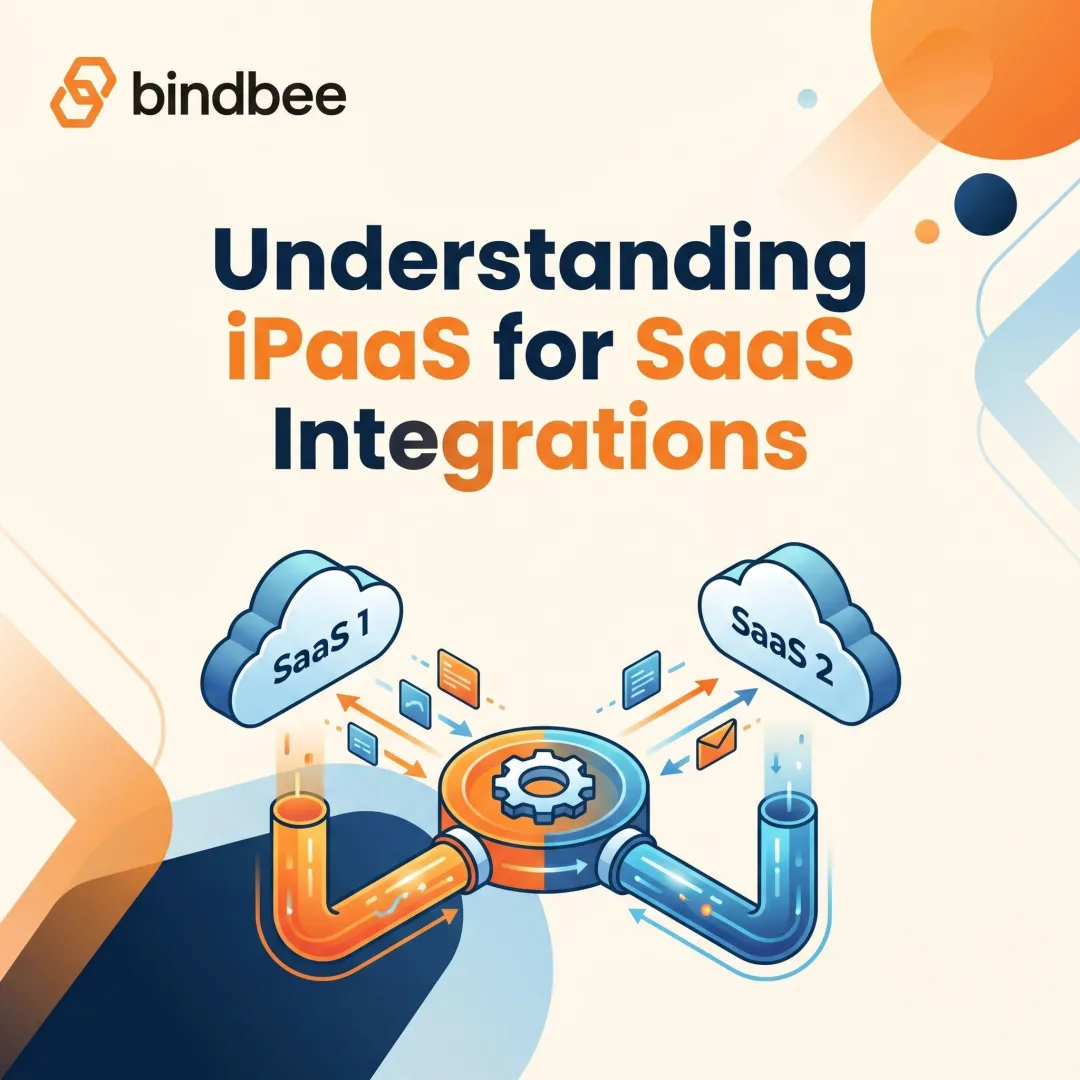
iPaaS is a cloud-based platform that provides the infrastructure for SaaS companies to connect their product to external apps and data systems via APIs, without building or maintaining each connection manually. Gartner defines iPaaS as a vendor-managed cloud service that enables end users to implement integrations, automate processes, and compose services.
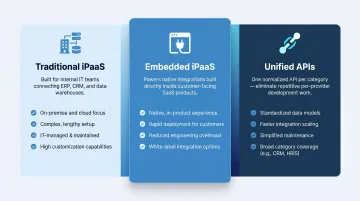
Three types of iPaaS exist:
- Traditional iPaaS – Built for internal IT teams connecting enterprise back-office systems like ERP, CRM, and data warehouses
- Embedded iPaaS – Powers native integrations inside your SaaS product, so customers connect their tools without leaving your platform
- Unified APIs – One normalized API that covers an entire category (HRIS, ATS, CRM), eliminating per-provider integration work
Why This Matters for SaaS Teams
As SaaS products are evaluated on integration depth, every week spent building a native connector is a week not spent on core product development. IT teams spend 39% of their time creating custom integrations, and 90% of organizations report that data silos create business obstacles.
The iPaaS market grew 23.4% to $8.5B in 2024, driven by SaaS companies seeking faster time-to-value and reduced engineering overhead. Building and maintaining a single API integration costs $50,000–$150,000 annually when accounting for development, maintenance, and opportunity cost.
The profiles below cover enterprise platforms, embedded solutions, and specialized unified APIs — matched to different team sizes, technical profiles, and integration categories — so you can identify which approach fits your product's needs.
Top iPaaS Solutions for Best SaaS Connections in 2026
These platforms were selected based on connector breadth, ease of implementation, security and compliance standards, pricing transparency, and real-world relevance for SaaS teams building product integrations.
Bindbee
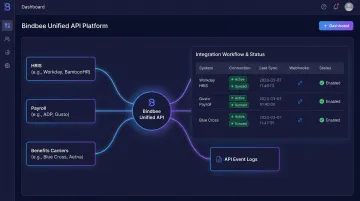
Bindbee is a unified API platform built specifically for HR Tech, Benefits Tech, and Insurtech SaaS. It normalizes data across 60+ HRIS, payroll, benefits administration, and carrier systems through a single API. Unlike general-purpose iPaaS platforms, Bindbee treats employee benefits, employer benefits, and dependent benefits as distinct data objects rather than generic HR data passthrough.
Key capabilities:
- Setup time of less than one day, versus 4-8 weeks for native APIs
- Zero integration maintenance — automatic incremental syncs keep data current without manual intervention
- SFTP-to-API bridge for legacy systems that only export files
- Built-in webhooks for life events: new hires, terminations, and dependent changes
- Magic Link authentication component for seamless employer connections
- Healthee reduced HRIS integration time from 12 weeks to 48 hours and saved $150,000+ in development costs
| Key Features | Unified API for 60+ HRIS, payroll, benefits, and carrier systems; benefits-first data models; SFTP-to-API bridge; webhooks for life events; Magic Link auth component |
|---|---|
| Best For | HR Tech, Benefits Administration Platforms, TPAs, Insurtech, and Employee Engagement SaaS teams needing normalized employment and benefits data fast |
| Compliance | SOC 2 Type II, ISO 27001, GDPR Ready, HIPAA Compliant |
MuleSoft Anypoint Platform
For teams at the opposite end of the complexity spectrum, MuleSoft (owned by Salesforce) is one of the most established enterprise iPaaS platforms. It offers full API lifecycle management across cloud, on-premise, and hybrid environments, built for large organizations that treat APIs as a governance and infrastructure problem rather than a product integration challenge.
Where it excels:
- Covers the full API lifecycle: design, deployment, governance, and monitoring
- Hybrid deployment supporting cloud, on-prem, and multi-cloud environments
- Policy-based security with role controls and audit trails
- Handles batch and event-driven processing for complex enterprise workflows
Tradeoffs: Implementation typically takes weeks to months, requires dedicated engineers, and pricing is enterprise-tier (often six figures annually). Best suited for complex, multi-system enterprise environments rather than lean SaaS product teams.
| Key Features | Full API lifecycle management; hybrid deployment; extensive connector library; governance and policy enforcement |
|---|---|
| Best For | Large enterprises with complex multi-cloud or on-prem environments requiring deep API governance |
| Pricing | Custom enterprise pricing; sales-led model with no public pricing |
Workato
Workato is an enterprise-grade automation iPaaS that combines low-code workflow building ("recipes") with embedded integration capabilities. It serves both internal automation use cases and customer-facing product integrations, giving it a dual-purpose footprint most platforms don't match.
Why teams choose it:
- 1,200+ connectors spanning business applications, databases, and APIs
- Low-code recipe builder that lets non-developers create workflows without engineering support
- On-premise agents for hybrid environments with legacy systems
- Embedded integration portal for SaaS vendors to surface integrations directly to customers
- Enterprise governance with role controls and audit trails
Limitations: Pricing starts high (enterprise-tier), and the platform's complexity can be overkill for SaaS teams that only need product integration—not internal workflow automation.
| Key Features | 1,200+ connectors; low-code recipe builder; on-prem agents; embedded integration portal; audit trails |
|---|---|
| Best For | Enterprise SaaS teams that need both internal automation and customer-facing integrations in one platform |
| Pricing | Sales-led model; enterprise plans scale significantly with usage |
Boomi
Boomi is a mature, cloud-native iPaaS platform known for broad connector coverage and strong support for hybrid environments (both cloud and on-premise systems). It is a common choice for mid-market to enterprise organizations with complex, multi-system connectivity needs.
Differentiators:
- Drag-and-drop integration designer that reduces reliance on hand-coded workflows
- Reusable components and a template marketplace for faster deployment
- 1,000+ pre-built connectors including ERP and EDI standards
- Hybrid Atom runtime supporting cloud and on-prem deployments
- API management and data hub capabilities for complex data routing
Tradeoffs: Requires technical oversight and is priced for mid-market to enterprise budgets—less accessible for lean SaaS product teams needing fast time-to-value. Boomi offers a 30-day free trial to de-risk evaluation.
| Key Features | Drag-and-drop designer; hybrid Atom runtime (cloud and on-prem); 1,000+ connectors; API management; data hub capabilities |
|---|---|
| Best For | IT teams managing hybrid cloud and legacy system integrations at mid-to-enterprise scale |
| Pricing | Custom pricing; 30-day free trial available |
Merge
Merge is a unified API platform providing a single normalized API across HRIS, ATS, CRM, accounting, file storage, and ticketing categories. It is designed for B2B SaaS teams that need to ship a large number of integrations quickly without deep customization, handling authentication, data normalization, and ongoing maintenance.
Differentiators:
- 220+ integrations maintained by Merge across 7+ categories
- Pre-built Merge Link component handles end-user authentication out of the box
- SOC 2 Type II, ISO 27001, HIPAA, and GDPR certifications
- Free developer tier — first 3 production linked accounts included at no cost
Limitation: Unified APIs trade customization for simplicity—complex data transformations and custom fields outside the normalized model require workarounds. The HRIS data model is generalized rather than benefits-first, which can create challenges for benefits administration use cases.
| Key Features | Unified API across 7+ categories; 220+ integrations; Merge Link auth component; normalized data models |
|---|---|
| Best For | B2B SaaS teams needing broad, standardized integrations across HRIS, ATS, and CRM categories with minimal engineering lift |
| Pricing | Free developer tier; $650/month for up to 10 production linked accounts; $65 per additional linked account |
How We Chose the Best iPaaS Platforms
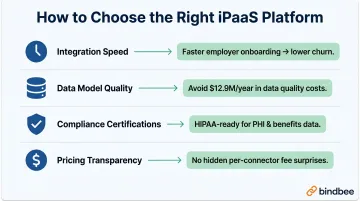
This list was built by assessing platforms across four dimensions: integration speed and time-to-value, connector depth and data model quality, security and compliance certifications, and pricing transparency.
The common mistake SaaS teams make is choosing a platform based on raw connector count rather than whether the platform's data models match their domain. A benefits SaaS team needs benefits-first data models (employee benefits, employer benefits, dependent benefits as distinct objects)—not just a generic "employee" object that requires extensive transformation work.
Why This Matters for Business Outcomes
Each dimension connects to a real business outcome:
- Integration speed: When employers connect their HRIS in hours instead of weeks, your product delivers value faster and churn risk drops. IT teams spend 39% of their time creating custom integrations—every week saved on integration is a week recovered for core product work.
- Data model quality: Poor data quality costs organizations at least $12.9M per year on average, often traced back to manual mapping and transformation errors. Domain-specific models eliminate that overhead at the source.
- Compliance certifications: HIPAA compliance is required for any SaaS platform handling protected health information (PHI) on behalf of covered entities—benefits enrollment data included. Not all general-purpose iPaaS platforms meet this requirement out of the box.
- Pricing transparency: Hidden per-connector or per-call fees compound quickly at scale. Understanding the full cost structure before committing prevents painful renegotiations later.
The Right iPaaS Is Rarely the Most Feature-Rich
Match the platform to your team's technical resources, your customers' systems, and your integration category. General-purpose enterprise platforms offer breadth, but for vertical SaaS products—especially in HR and benefits—a specialized unified API typically means shipping working integrations weeks faster than a DIY approach on a generic platform.
Conclusion
The iPaaS landscape in 2026 offers solutions across a wide spectrum—from enterprise-grade platforms like MuleSoft and Workato for complex internal integration needs, to specialized unified APIs like Bindbee for HR and benefits data. Choosing based on brand recognition alone leads to mismatched tools, delayed launches, and engineering debt.
Evaluate platforms against:
- Integration category fit — does the platform's data model match what your product actually needs?
- Total cost of ownership — setup time, ongoing maintenance burden, and compliance readiness
- Compliance coverage — a platform with 1,200+ connectors delivers little value if it lacks HIPAA support or requires 8 weeks of custom mapping just to handle enrollment data
The connector count is rarely the bottleneck. Data model alignment and compliance readiness usually are.
If you're building in HR Tech, Benefits Administration, or Insurtech, Bindbee's unified API is built specifically for this category. Setup takes less than a day, with no ongoing maintenance overhead on your team's plate.
Frequently Asked Questions
What is the difference between iPaaS and a unified API?
iPaaS is a broader platform category for building and managing integrations, often through visual builders and workflow logic. A unified API is a specific approach where one normalized API abstracts multiple third-party systems in a category—simpler to implement but trading deep customization for speed and standardization.
What should SaaS companies look for in an iPaaS for HR and benefits integrations?
Prioritize these four criteria:
- Domain-specific data models — benefits-first vs. generic employee objects
- Compliance certifications — HIPAA and SOC 2 Type II at minimum
- Connector coverage — across HRIS and carrier systems
- Setup time — including ongoing maintenance, not just initial deployment
General-purpose iPaaS platforms often require heavy custom transformation work to handle benefits enrollment or dependent data correctly.
How long does it typically take to implement an iPaaS solution?
Implementation time varies widely: enterprise platforms like MuleSoft and Boomi can take weeks to months, while specialized unified APIs like Bindbee are designed for sub-day setup. Assess both initial setup time and ongoing maintenance when calculating total implementation cost.
What is an embedded iPaaS and when should SaaS companies use it?
An embedded iPaaS lets SaaS vendors offer native integrations inside their product—handling auth, configuration, and UX for their end customers. It's best suited for SaaS teams treating integrations as a product feature, rather than just connecting their own internal systems.
How do iPaaS platforms handle data security and compliance?
Reputable platforms offer encryption in transit and at rest, role-based access controls, audit logs, and certifications including SOC 2 Type II, ISO 27001, GDPR readiness, and HIPAA compliance. For HR and benefits data, HIPAA compliance is critical — and not all general-purpose iPaaS platforms meet this requirement out of the box.
What is the difference between a traditional iPaaS and a specialized HR integration API?
Traditional iPaaS platforms offer broad connector coverage but use generic data models that HR Tech teams must transform to fit benefits and payroll use cases. Specialized HR integration APIs provide pre-normalized, domain-specific models — covering employee benefits, dependent benefits, and enrollment data — that cut custom development and data mapping overhead considerably.