Introduction
HR Tech and Benefits Tech product teams face a recurring tension: building software capabilities in-house promises control and customization, while buying often delivers faster deployment and lower long-term costs. Choosing wrong has tangible consequences—wasted engineering bandwidth, delayed time-to-market, and weakened competitive positioning.
The build vs buy decision is harder than it appears. Every build-or-buy choice reflects what your team does best, what truly differentiates your product, and how quickly the market is evolving.
The stakes are concrete: 90% of engineering leaders admit to delaying product launches due to late-stage changes, and midsize companies routinely underestimate custom build timelines by 50-100%.
Those cost overruns and delays are avoidable with the right framework. This guide walks you through a structured decision process for HR Tech teams weighing whether to build native HRIS and payroll integrations or connect through a unified API platform like Bindbee.
TL;DR
- The build vs buy decision comes down to one question: does building this capability create a competitive advantage that justifies full ownership costs?
- A structured framework evaluates strategic alignment, total cost of ownership, time-to-value, maintenance burden, and compliance requirements
- Build when the capability is core IP, unique to your product, or requires proprietary data control
- Buy when it's a commodity, compliance-heavy, or a problem the market has already solved well
- Teams commonly underestimate maintenance costs (typically 20% of initial build cost annually) and treat decisions as permanent instead of revisiting them as markets evolve
- For HR Tech integrations, buying almost always wins—integration infrastructure is commodity, not differentiator
What Is the Build vs Buy Decision Framework?
A build vs buy decision framework is a structured evaluation process for determining whether to develop a software capability in-house or acquire it through a third-party vendor, API, or licensed solution. It's not a binary choice—the spectrum includes building from scratch, buying and customizing, extending existing tools, or partnering with specialized providers.
The foundational distinction is between two types of capabilities:
| Type | Characteristics | Best Approach |
|---|---|---|
| Commodity capabilities | Widely available, low competitive impact | Buy |
| Differentiator capabilities | Unique to your business, drives market advantage | Build |
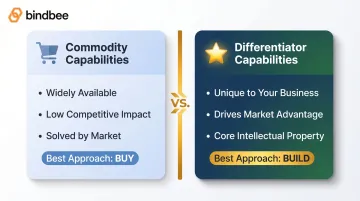
According to Thoughtworks, capabilities naturally evolve from novel differentiators to commodities over time. What required custom development five years ago may now be offered as a mature vendor solution.
Teams frequently get this decision wrong because they treat it as a cost question or a technical question, when it's ultimately a strategy question about where the company creates unique value and where it should leverage others' investments.
Key Factors in the Build vs Buy Decision Framework
Five primary levers shift the build vs buy decision. Each must be evaluated honestly and in context, not as a checklist.
Strategic Alignment: Core vs. Commodity
The first question: does this capability directly drive competitive advantage and customer value, or is it infrastructure that every competitor also needs?
If a top-tier competitor announced tomorrow they were buying the same capability, would you still want to build it? If the answer is no, buying is likely the right path.
Example distinction:
- Differentiator capability: A proprietary algorithm that personalizes benefits recommendations based on employee health data and family structure—something unique to your product's value proposition
- Commodity capability: Authentication, payment processing, or HRIS data ingestion—essential but undifferentiating infrastructure
Total Cost of Ownership
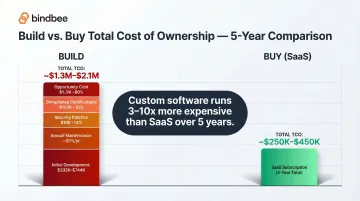
The biggest mistake teams make is comparing vendor license fees against initial development time. The true cost of building includes:
- Ongoing maintenance (research estimates 20% of initial development cost annually)
- Security updates and patches
- Documentation and training
- Compliance certifications
- Opportunity cost of engineers not working on core product features
If building a feature takes four engineers six months, that's two engineer-years of work. At a median fully-loaded cost of $166,000-$186,000 per developer (base BLS wage plus benefits and overhead), that initial build costs $332,000-$744,000—before any maintenance.
HBR research shows custom software runs 3-10x more expensive than a SaaS subscription over five years.
Time-to-Value
Speed to market shapes competitive positioning. Buying a mature solution can compress timelines from months to days or weeks. In fast-moving markets, being late can mean losing the window entirely.
The trade-off: buying gives speed but sometimes poor fit; building takes longer but creates tighter product alignment. Ask what the cost of a six-month delay actually is in terms of customer acquisition, renewals, or competitive positioning.
90% of engineering leaders admit to delaying product launches due to late-stage changes, and midsize companies underestimate custom build timelines by 50-100%.
Maintenance Burden and Long-Term Ownership
Every line of custom code is code your team owns forever. Maintenance includes:
- Bug fixes and performance tuning
- API version updates
- Security patches
- Documentation updates
- Training new team members
Peer-reviewed research finds approximately 90% of total software lifecycle cost goes to maintenance. Stripe's Developer Coefficient reports that developers spend 17.3 hours per week on maintenance and 13.5 hours on technical debt—yielding only 68.4% overall productivity.
The trade-off with buying, however, is vendor lock-in: it reduces maintenance burden but ties you to someone else's roadmap, pricing changes, and deprecation cycles. Evaluate contractual flexibility and exit options before signing.
Security, Compliance, and Data Governance
For HR Tech, Benefits Tech, and Insurtech companies, data security and compliance (SOC 2 Type II, ISO 27001, HIPAA, GDPR) are non-negotiable. Building to meet these standards requires significant investment.
Certification costs add up quickly:
- SOC 2 Type II: $30,000–$150,000+ in year one, plus 200–500 hours of internal staff time over 6–12 months
- ISO 27001: Can reach $50,000–$70,000+ for larger organizations
- HIPAA compliance: Can exceed $78,000 for large organizations
Mature vendors spread these compliance costs across their entire customer base. That makes buying especially attractive for capabilities touching regulated employee and benefits data—where a single audit gap can carry legal exposure.
When to Build and When to Buy
Once you've assessed your strategic position, team capacity, and total cost, the signals tend to cluster. Here's how to read them.
Build When: Clear Signals to Invest In-House
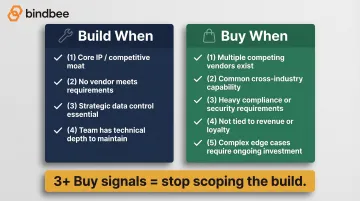
Build when:
- The capability is core IP - A proprietary algorithm or decision logic that defines your competitive moat
- No vendor meets your workflow requirements - Validate that the need is genuinely unique before assuming it; most "unique" requirements have off-the-shelf solutions
- Strategic control over data or models is essential - You cannot safely delegate this to a third party
- Your team has technical depth to maintain long-term - Without degrading bandwidth for core product work
Ask: "Would sharing this capability with competitors fundamentally damage our market position?" If yes, build it. If not, look harder at buying.
Buy When: Clear Signals to Work With a Vendor
Buy when:
- Multiple competing vendors already exist - A crowded market means edge cases are solved
- The capability is common across industries - Standard expectations, no differentiation upside
- Compliance or security requirements are heavy - Vendors spread certification costs across all customers
- The feature isn't directly tied to revenue or loyalty - Infrastructure that enables the product but doesn't differentiate it
- Complex edge cases would require ongoing investment - International requirements, legacy system compatibility, regulatory variations
Three or more buy signals is a strong indicator: stop scoping the build and start evaluating vendors. The exception is a genuine strategic moat — and those are rarer than most teams assume.
Common Build vs Buy Mistakes to Avoid
Three mistakes account for most failed build-or-buy decisions. Recognizing them early can save months of engineering time.
"Not Invented Here" Syndrome: Engineering teams instinctively prefer to build—it feels like control and craft. But MIT research studying 350 engineers found that long-tenured teams tend to dismiss external solutions, reducing communication with outside information sources over time. Building a worse version of a mature vendor solution is a costly way to learn what the market already knows.
That instinct compounds into a second mistake: the false economy trap. Teams believe they're saving money by building, when they're actually tying up expensive engineering resources and delaying time-to-market. Developers already spend 33% of their time on technical debt, and 52% report too much time lost to legacy systems.
The opportunity cost of engineers not shipping core features is the most underreported line item in any build vs. buy analysis.
Treating Decisions as Permanent: Both mistakes above get worse when teams lock in their initial choice and stop questioning it. The build vs. buy decision is not a one-time call. Capabilities that were differentiators two years ago may now be commodity services. Market conditions, vendor quality, and company strategy all shift. Leading teams revisit these decisions on a regular cadence — not because they got it wrong the first time, but because the landscape keeps moving.
How Bindbee Helps HR Tech Teams Resolve the Integration Build vs Buy Decision
For HR Tech, Benefits Tech, and Insurtech companies, one of the most common—and costly—build vs buy decisions involves HRIS, payroll, and benefits integrations. Building native connections to even a handful of systems consumes months of engineering time, requires constant maintenance as vendor APIs change, and grows exponentially with each new system added.
The scale of the problem makes this a clear-cut case:
- The HR Tech market tracks 160+ vendors and is projected to reach $95.95 billion by 2034
- A single native integration takes 2-4 weeks; five integrations totals 10-20+ weeks of engineering time
- Maintenance alone accounts for 30-40% of total integration engineering effort
Integrations are a commodity capability. Building them from scratch pulls engineering resources away from the product work that actually sets you apart.
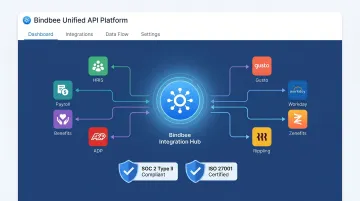
Bindbee resolves this decision by providing a single unified API that connects to 60+ HRIS, payroll, benefits, and carrier systems:
- Setup in less than one day via Magic Link authentication component versus 4-8 weeks for native APIs
- Zero maintenance as Bindbee handles all upstream API changes, rate limiting, and versioning
- SOC 2 Type II and ISO 27001 compliance built in, eliminating $30,000-$150,000+ in certification costs
- Benefits-first data models with Employee Benefits, Employer Benefits, and Dependent Benefits as distinct models—enabling sophisticated benefits administration features that generic HRIS APIs cannot support
- SFTP-to-API Bridge for legacy systems that only export files, eliminating manual CSV workflows
Customers like Newfront, Healthee, and Alma have cut onboarding time by 76% and recovered engineering capacity for core product development.
For integrations specifically, the buy case is almost always clear. The teams that reach this conclusion early redirect engineering capacity toward the work that differentiates their product — and ship faster because of it.
Frequently Asked Questions
Is it better to buy or build software?
Neither is universally better. Buying is typically faster and lower-risk for commodity capabilities, while building is justified when the capability is core to competitive advantage. The right choice depends on strategic alignment, total cost of ownership, and whether your team can realistically maintain what it builds.
What is McKinsey's build vs buy framework?
McKinsey's framework evaluates whether a capability is a strategic differentiator or a commodity, weighs total cost of ownership across the full asset lifecycle, and assesses the organization's realistic ability to build and sustain it. Decisions should be anchored in business outcomes, not technology preferences.
What is the difference between buy and build?
"Build" means developing software capabilities in-house using internal engineering resources, giving full control but requiring ongoing investment. "Buy" means licensing or using a third-party solution that trades customization for speed, lower upfront cost, and vendor-managed maintenance.
What are the four types of decision frameworks?
Common types include cost-benefit analysis, decision matrices, heuristic frameworks (such as "buy commodities, build differentiators"), and scenario-based frameworks. Build vs buy decisions often draw on elements from all four.
What is the total cost of ownership in a build vs buy decision?
TCO covers initial development, ongoing maintenance (typically 20% of build cost per year), security, compliance, documentation, training, and engineering opportunity costs. In practice, building almost always runs more expensive than initial estimates suggest.
When should a company build software instead of buying it?
Building makes sense when the capability is core intellectual property that drives competitive advantage, when no vendor solution can meet specific workflow or data requirements, or when strategic control over proprietary data and decision logic is essential. The decision to build should be validated against whether the team can sustain and evolve the capability long-term.