

Despite this reality, SaaS API integration is often treated as a backend engineering concern rather than a product capability that directly impacts customer time-to-value, engineering velocity, and compliance readiness. The companies that recognize integration as infrastructure for growth — rather than a technical afterthought — capture measurable operational advantages that compound over time.
This article examines why SaaS API integration matters in practice, focusing on the specific operational advantages HR Tech and Benefits Tech companies gain when integration is executed well.
TL;DR
- SaaS API integration enables automatic, real-time data exchange between your product and customers' HRIS, payroll, or benefits systems — without manual intervention
- Faster onboarding cuts time-to-value by up to 76%, recovering 30%+ of engineering capacity for core product work
- Real-time data accuracy reduces compliance exposure — stale employee records are a direct regulatory liability
- Skip native integrations and you inherit slower sales cycles, higher maintenance costs, and compounding technical debt
- Top-tier integrations normalize data across 60+ systems, bridge legacy infrastructure, and treat sync reliability as a product metric
What Is SaaS API Integration?
SaaS API integration is the mechanism that allows your product to automatically exchange data with another cloud application — without manual file transfers or IT tickets. In the HR Tech and Benefits Tech context, that means your platform can:
- Pull employee records directly from an HRIS as new hires are added
- Sync benefit enrollment decisions to carrier systems in real time
- Trigger payroll updates automatically based on lifecycle events
Rather than asking employers to export CSV files, email spreadsheets, or manually re-enter employee rosters, API integration pulls data automatically from their source of truth into your product.
Done right, integration isn't an infrastructure project — it's a customer experience decision. Your product needs to stay synchronized as workforce data changes: new hires start, employees terminate, dependents are added, benefit elections are updated. API integration turns those ongoing operational realities into automated data flows, so your team isn't coordinating them manually.
Key Advantages of SaaS API Integration
The advantages below are operational and measurable, tied to metrics that product, revenue, and engineering leaders actively track.
Advantage 1: Faster Customer Onboarding and Time-to-Value
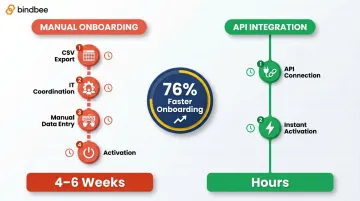
When your product integrates via API with a customer's HRIS or payroll system, that customer can activate in hours rather than weeks. The alternative — waiting for file exports, manual imports, and IT coordination — delays activation and extends the window where customers question the purchase decision.
How API integration accelerates onboarding:
Automated data retrieval at connection setup means employee rosters, dependent records, and benefit elections are available immediately. No IT tickets, no file formatting, no waiting for the customer's HR team to manually extract and send data. In practice, this can reduce onboarding timelines by 76% and cut time-to-value by 94% compared to manual or native integration approaches.
What's at stake:
Onboarding speed directly affects revenue recognition and retention. Research shows 48% of customers abandon onboarding if they don't see value quickly, and 57% of companies that cut onboarding investment saw churn increase within six months.
The first 90 days determine whether revenue momentum is established or lost — and integration setup is often the longest single component of that window.
KPIs impacted:
- Time-to-first-value
- Customer onboarding cycle time
- Activation rate
- Sales cycle length (integration complexity often surfaces as a procurement blocker)
When this advantage matters most:
- High-volume employer onboarding (benefits platforms, TPAs serving hundreds of small-to-midsize employers)
- Rapid sales cycles where integration readiness is evaluated during procurement
- Mid-market and enterprise expansion, where customers have entrenched HRIS infrastructure that cannot be replaced
Advantage 2: Reduced Engineering Burden and Long-Term Maintenance Costs
Every native integration your team builds creates ongoing maintenance liability. HRIS vendors update APIs, deprecate endpoints, change authentication flows — and your engineers must respond. Each update pulls focus from core product development.
How unified API integration eliminates maintenance cycles:
Instead of building and maintaining individual connectors for each HRIS or payroll system, a well-architected integration approach normalizes data across providers and handles upstream API changes behind the scenes. Your team integrates once and gains access to hundreds of systems without per-vendor maintenance.
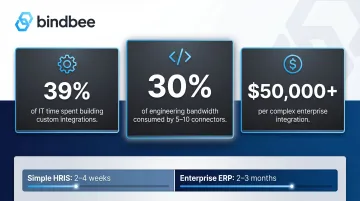
IT teams spend 39% of their time building custom integrations, and maintaining just 5-10 custom connectors can consume 30% of engineering bandwidth. Building a single HRIS integration typically requires 2-4 weeks of developer effort; complex enterprise ERPs can take 2-3 months and cost over $50,000 per integration.
Why this matters:
Every sprint spent maintaining third-party integrations is a sprint not spent differentiating your product. The cost compounds over time — maintaining 10 native integrations over three years consumes hundreds of developer weeks that could have built revenue-generating features instead.
KPIs impacted:
- Engineering velocity (features shipped per sprint)
- Integration maintenance cost as a percentage of engineering budget
- Time-to-market for new integrations
- Integration-related incidents per quarter
When this advantage matters most:
- Fragmented markets like HR, where hundreds of HRIS and payroll systems exist, each with proprietary APIs
- Scaling customer bases across employer sizes and tech stacks
- Startups where engineering bandwidth is the scarcest resource
Advantage 3: Real-Time Data Accuracy and Fewer Compliance Violations
In benefits administration and HR Tech, stale data is not just an inconvenience — it creates compliance exposure. API integration that delivers real-time or near-real-time synchronization ensures your platform always reflects the current employee population: new hires, terminations, dependent changes, and benefit elections.
How API integration maintains data freshness:
Event-driven architectures and webhooks push updates to your platform the moment a change occurs in the source HRIS — rather than waiting for nightly batch processing or relying on customers to notify you manually. Benefit eligibility decisions and carrier submissions reflect reality, not last week's roster.
The cost of getting this wrong:
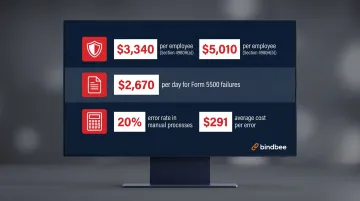
For benefits platforms, incorrect dependent data or delayed termination notices trigger compliance violations, incorrect carrier billing, and reporting errors. ACA penalties for 2026 reach $3,340 per full-time employee under Section 4980H(a), and up to $5,010 per employee under Section 4980H(b) for coverage failures. ERISA penalties can reach $2,670 per day for Form 5500 filing failures.
Beyond penalties, data accuracy directly affects retention. Platforms that display current, reliable data retain customers longer and see higher feature adoption.
Manual processes compound that risk: EY research shows non-automated payroll processes carry approximately a 20% error rate, with each error costing an average of $291 to correct. For a 1,000-employee organization, payroll errors alone can cost up to $922,131 annually.
KPIs impacted:
- Data sync latency
- Enrollment accuracy rate
- Carrier discrepancy rate
- Compliance incident rate
- Customer retention
When this advantage matters most:
- Benefits administration platforms where enrollment windows and life events create time-sensitive data dependencies
- Payroll platforms where employee status changes affect pay runs
- Any platform serving enterprise employers with high workforce turnover
What Happens When SaaS API Integration Is Missing or Ignored
Without robust API integration, customers resort to manual file exports, spreadsheet uploads, and IT-managed data transfers. What starts as a workaround becomes an embedded operational cost for both vendor and customer.
Specific failure modes in HR and Benefits Tech:
- Delayed termination data leads to continued benefit coverage for ineligible employees, creating financial exposure and potential compliance liability
- Inconsistent rosters cause enrollment errors, duplicate records, and carrier billing disputes that erode customer trust
- Reactive firefighting consumes engineering capacity — teams spend disproportionate time troubleshooting broken data pipelines instead of building product improvements
These operational failures compound directly into unit economics. Onboarding a 500-employee customer requires the same manual effort as onboarding a 50-employee one — growth doesn't create leverage, it multiplies the work.
Research shows 71% of organizations cannot transfer or share data across the databases created by their disparate HCM technology. With only 29% of enterprise applications currently integrated despite the average organization running 897 apps, the integration gap is wide, and the cost of ignoring it keeps growing.
How to Get the Most Value from SaaS API Integration
The fastest way to lose a deal — or a customer — is incomplete HRIS coverage. Supporting only the top five platforms means a predictable slice of your market hits a dead end at onboarding, driving churn and blocking expansion into mid-market or enterprise segments.
Modern unified API platforms solve this by normalizing data across HRIS, payroll, benefits, and carrier systems through a single connection. Bindbee connects to 60+ employment systems through one API, removing the need to build or maintain individual connectors.
That coverage extends to legacy systems too — including SFTP-to-API bridging for enterprise customers running older HRIS configurations that only export flat files.
Two practices separate teams that extract full value from API integration from those that treat it as a checkbox:
- Match your integration coverage to your market's technical reality. Enterprise buyers routinely run legacy payroll systems alongside modern cloud HRIS platforms. An integration strategy limited to REST APIs means lost deals or expensive one-off exceptions.
- Track integration reliability as a product metric. Sync latency, error rates, and onboarding time belong on the same dashboard as uptime and performance. Monitor sync success rates, data validation errors, and customer-reported discrepancies — these are leading indicators of product experience, not just IT housekeeping.
Conclusion
SaaS API integration compounds in value when applied consistently, monitored actively, and treated as a core product capability rather than a backend task.
Well-executed API integration produces three compounding outcomes:
- Customers onboard faster, shortening sales cycles
- Engineering teams recover capacity for core product development
- Accurate, reliable data reduces compliance risk and builds customer trust over time
Each advantage reinforces the others as the platform scales. Reliable data turns your platform into customers' source of truth — dependency that's hard to displace.
Companies that treat integration as revenue infrastructure build platforms that scale profitably, onboard customers quickly, and meet the compliance expectations enterprise buyers bring to every procurement decision.
Frequently Asked Questions
What is an API in SaaS?
An API (Application Programming Interface) in SaaS is a set of protocols that allows one software product to communicate with another — for example, enabling a benefits platform to pull employee records directly from a customer's HRIS in real time, without manual data exports.
What is the difference between SaaS API integration and a native integration?
A native integration is built and maintained directly by your engineering team for a single third-party platform. SaaS API integration, particularly through a unified API layer, normalizes data from hundreds of platforms through one connection, reducing build time from weeks to hours and eliminating ongoing per-vendor maintenance.
How does SaaS API integration reduce engineering costs?
Instead of building and maintaining separate connectors for each HRIS or payroll system, a unified API handles upstream API changes, authentication flows, and data normalization centrally. This frees engineering bandwidth for core product development rather than ongoing maintenance overhead.
How long does it typically take to set up a SaaS API integration?
Setup time depends on approach: building a native integration takes 4-8 weeks per system. Unified API platforms reduce this to less than one day, often under 10 minutes for initial authentication and first sync, by providing pre-built connectors and standardized data models.
How do SaaS API integrations handle data security and compliance?
Production-ready API integrations include encryption in transit and at rest, role-based access controls, and compliance certifications like SOC 2 Type II, ISO 27001, and HIPAA readiness. These standards are particularly important in HR and benefits contexts where employee data is sensitive and regulated. For HIPAA-covered data, platforms typically execute Business Associate Agreements (BAAs) as required by HHS guidance.