"Software integration" often gets discussed at an architectural level, but its real value shows up in daily outcomes: faster onboarding, cleaner data, fewer compliance risks, and products customers trust. When integration is absent, the consequences compound—rising error rates, slower processes, and maintenance debt that drains engineering resources.
This article explains what software integration is, why it matters operationally, and what the real cost of skipping it looks like—with a focus on measurable impact, not theory.
TLDR
- Software integration connects applications to share data and trigger actions automatically, eliminating manual handoffs
- Key advantages: automated data flow, consistent data accuracy across systems, and engineering capacity that scales without adding headcount
- Without integration, error rates climb, compliance exposure grows, and maintenance debt accumulates faster than teams can address it
- Integration delivers highest impact where multiple systems must stay synchronized—HRIS, payroll, benefits, and carrier platforms
- Treating integration as an ongoing practice, not a one-time project, separates organizations that scale smoothly from those stuck firefighting
What Is Software Integration?
Software integration connects two or more applications so they can exchange data and trigger actions automatically—without manual steps in between. Rather than copying employee records from an HRIS into payroll by hand, integration creates a direct pipeline where data flows automatically when changes occur.
Integration applies in two contexts: internal systems talking to each other (such as HRIS syncing with payroll), and products connecting to tools customers already use (like a benefits platform syncing with an employer's HRIS).
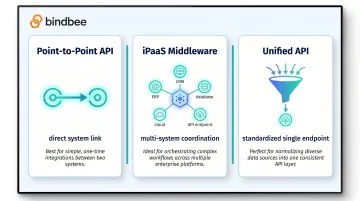
The technical approaches vary depending on complexity:
- Point-to-point API connections link two systems directly
- iPaaS middleware platforms coordinate data flows across multiple systems
- Unified APIs normalize data across many platforms into a single endpoint
Regardless of the approach, the goal is the same: faster processes, cleaner data, and fewer manual handoffs. Integration exists to eliminate delays and free teams to focus on higher-value work.
Key Advantages of Software Integration
The advantages below focus on measurable, operational impact—not abstract efficiency gains. Each ties directly to outcomes businesses track: cost reduction, error rate, time-to-value, and scalability.
Advantage 1: Operational Efficiency Through Automated Data Flow
Instead of copy-paste workflows, spreadsheet handoffs, and manual re-keying, integration creates automated, real-time data syncs across every connected system.
When an employee joins a company and is added to the HRIS, that record automatically flows to payroll, benefits, and identity management — no human trigger required.
Manual data transfer is a significant productivity drain. HR professionals spend up to 57% of their time on administrative tasks, with manual benefits enrollment costing $89 per employee. Each additional system multiplies that effort; with integration, the cost per additional system drops to near zero.
The financial impact is direct. Organizations with integrated HR technology spend 26% less on HR costs and operate with 32% fewer staff. Faster data flow also means downstream processes — payroll runs, benefits enrollment, onboarding sequences — start sooner.
KPIs this affects:
- Time-to-process (onboarding cycle time, payroll run speed)
- Staff hours saved on data entry
- Error rate on manually entered records
- Process completion rate
This advantage is most pronounced for organizations managing large employee populations, benefits platforms onboarding new employer groups at scale, or any product where the same data must be current across multiple systems simultaneously.
Advantage 2: Data Accuracy and a Reliable Single Source of Truth
Without integration, every system holds its own version of employee records — and those versions diverge. Integration creates flows where an update in one system syncs accurately to all others, eliminating data staleness at the source.
Poor data quality costs organizations an average of $12.9M per year. In HR and benefits contexts specifically, incorrect dependent data or stale enrollment records lead to claim denials, audit failures, and regulatory penalties.
The risk isn't hypothetical. Unity Technologies reported $110M in lost revenue in early 2022 after inaccurate data ingestion corrupted its machine learning models — a direct consequence of integration infrastructure failing to maintain data quality.
When data is consistent across systems, the downstream effects are clear: audit trails are clean, eligibility is verifiable, and leadership can make decisions faster because they trust what the dashboard shows.
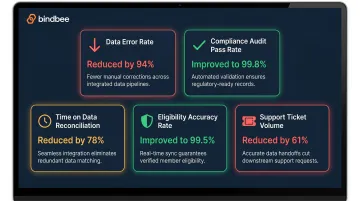
KPIs this affects:
- Data error rate
- Compliance audit pass rate
- Time spent on data reconciliation
- Eligibility accuracy rate
- Support ticket volume related to data discrepancies
This advantage matters most in compliance-heavy industries — benefits administration, insurance, healthcare HR — and in any multi-system environment where no single platform owns all the data.
Advantage 3: Scalability Without Proportional Engineering Cost
Point-to-point integrations scale badly. Each new connection adds maintenance debt — broken API connections, schema updates, version drift — that accumulates until engineering teams are spending more time keeping integrations alive than building product.
Approximately 30% of a SaaS company's total engineering resources are diverted to integration work, with teams spending 10-20% of their time on maintenance alone.
Well-designed integration infrastructure changes that math. When a unified API or managed integration layer handles the standardization, onboarding the 10th HRIS takes a fraction of the time of the first — because it follows the same pattern, not a new custom build.
The business case for this is strong on two fronts:
- Retention: Customers with 4+ integrations are 35% less likely to churn, and willingness to pay is 30%+ higher for products with 11+ integrations
- Speed: The average custom integration takes 3 to 6 weeks of dedicated engineering time; unified API platforms reduce that by 7-10x
KPIs this affects:
- Time to integrate a new system
- Engineering hours per integration
- Integration maintenance cost as a percentage of engineering budget
- Customer onboarding time
- Number of supported integrations per engineer
This advantage is most critical for HR Tech and Benefits Tech vendors managing dozens of HRIS and payroll connections, and for any platform where customer retention depends on how well the product fits into the customer's existing stack.
What Happens When Software Integration Is Missing or Ignored
The cost of not integrating rarely appears as a single visible failure. It accumulates gradually through inefficiency, error, and missed growth, surfacing at the worst possible moments—compliance audits, scaling pushes, customer churn spikes.
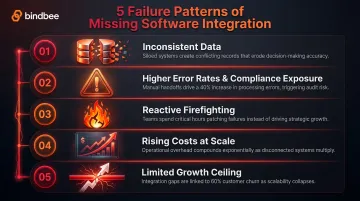
Here's what that accumulation looks like across five recurring failure patterns:
Inconsistent and contradictory data: When systems aren't integrated, each holds its own version of the truth. Over time these versions diverge, and teams spend hours every week reconciling spreadsheets and manually validating records. Decisions made on conflicting information become slower—and less reliable.
Higher error rates and compliance exposure: Manual data transfer introduces human error at every step. The commonly accepted error rate for manual data entry is approximately 1%, but when data is recorded on paper and re-keyed into a system, the probability of a faulty record rises to 40% per event. In regulated environments like payroll or benefits administration, those errors translate into compliance violations. 53% of companies have faced penalties for payroll errors, with IRS failure-to-deposit penalties escalating from 2% to 15% based on delay length.
Reactive firefighting instead of proactive management: Without integration, problems in one system don't surface elsewhere until someone notices something is wrong. By then, the issue has often cascaded—late payroll runs, incorrect benefit elections, stale dependent records. Teams get locked into a permanent reactive posture, debugging problems that connected systems would have caught automatically.
Rising costs as the business scales: Point-to-point integrations and manual handoffs don't scale linearly. As system count grows, the cost and complexity of keeping data synchronized grow exponentially. Five systems require 10 unique integrations; 20 systems require 190. Engineering bandwidth gets consumed by maintenance rather than product development.
Difficulty scaling the product or customer base: For SaaS companies, a fragmented integration story limits how quickly customers can be onboarded and how many systems the product can support. Over 60% of companies cite missing integrations as a top 3 reason for churn. When customers need connections you don't offer, they choose a competitor—integration gaps become a hard ceiling on revenue growth.
How to Get the Most Value from Software Integration
Most integration efforts fall short not because the technology fails, but because organizations treat integration as a one-time project rather than ongoing infrastructure. Getting sustained value requires consistent habits around coverage, monitoring, and roadmap planning.
Cover all critical data flows, not just the obvious ones. Audit which systems still require manual handoffs and close those gaps systematically, prioritizing by frequency of data movement and error sensitivity.
Treat integration performance as an operational metric. Establish regular monitoring: sync health checks, error rate reviews, data freshness audits. Connect those metrics to business outcomes like customer onboarding speed or compliance audit readiness.
Build integration into the product roadmap, not onto it. Organizations that treat integration as a first-class feature — with dedicated ownership, defined SLAs for data freshness, and a clear expansion plan — consistently outperform those that add integrations reactively in response to customer requests.
For HR Tech and Benefits Administration platforms managing connections across 60+ HRIS, payroll, and benefits systems, this operational burden adds up fast. Bindbee addresses it with a unified API that includes built-in sync notifications, webhooks for life events, and zero-maintenance integrations, so engineering teams can stay focused on core product development rather than integration upkeep.
Conclusion
Software integration delivers value across three operational dimensions that reinforce each other over time:
- Removes manual data drag — freeing teams from error-prone, repetitive work
- Creates a reliable data foundation — one that decisions, audits, and compliance can actually depend on
- Enables scalable growth — without proportional increases in engineering complexity or cost
These advantages build on each other. Each new connected system multiplies the value of the existing ones. The cost of staying siloed compounds just as fast — manual processes, recurring errors, and maintenance debt don't stay flat; they grow.
Treating integration as an ongoing operational practice — not a one-time project — is what separates teams that extract lasting value from it and those that don't. Consistent monitoring and deliberate expansion of connected systems are what keep that value compounding.
Frequently Asked Questions
What is an integrated software solution?
An integrated software solution is a set of connected applications that exchange data automatically, functioning as a unified system rather than isolated tools. Common examples include an HRIS integrated with payroll and benefits platforms, where employee data flows seamlessly across systems.
What is an example of software integration?
An HR platform automatically syncing a new employee record to payroll, benefits administration, and identity management systems the moment onboarding is complete, eliminating manual re-entry across each system.
What are the main types of software integration?
The four primary approaches are point-to-point API integrations, middleware/iPaaS platforms, unified APIs, and native built-in integrations. The right choice depends on your scale, the number of systems involved, and how much ongoing maintenance your engineering team can absorb.
What is the difference between software integration and an API?
An API is the technical interface that allows two systems to communicate, while software integration refers to the broader practice of connecting systems using APIs (and other methods) to create automated, reliable data flows. APIs are the mechanism; integration is the outcome.
What are the biggest challenges of software integration?
The most common challenges are inconsistent data formats, API changes from third-party vendors, and the engineering overhead of maintaining point-to-point connections at scale. Security and compliance requirements — particularly in HR and benefits contexts — add another layer of complexity.
How does software integration affect data security and compliance?
Integration introduces new data flows that must be secured — covering encryption in transit, access controls, and compliance with standards like SOC 2, ISO 27001, HIPAA, or GDPR depending on the industry. Solutions built with these requirements in mind from the start are significantly easier to audit and maintain than those where compliance is retrofitted later.