

Top 11 Application Integration Solutions to Watch in 2026
Summarise the blog with AI
Did you know that 46% of respondents cite lack of integration within and between HR systems as a top technology challenge, directly linking fragmented systems to day-to-day operational bottlenecks. Disconnected platforms create errors, duplicate work, and slow down key HR and payroll processes.
Application integration solutions address this pain by connecting disparate systems, automating workflows, and ensuring accurate, real-time data across platforms. By eliminating manual reconciliations and reducing errors, these solutions free HR and payroll teams to focus on strategic initiatives rather than firefighting system gaps.
In this blog, you'll explore 11 application integration solutions in 2026 that save time, reduce errors, and help HR and payroll teams work strategically.
Key Takeaways
- Close Data Gaps and Reduce Errors: Integration removes inconsistencies and ensures accurate HR, payroll, and benefits operations.
- Automate and Standardize Workflows: Pre-built connectors and standardized data models streamline processes and improve efficiency.
- Assess Platform Suitability: Evaluate integration coverage, scalability, usability, support, and total cost before choosing a solution.
- Enable Non-Technical Teams: Low-code and embedded tools let HR and payroll teams manage integrations without relying on IT.
- Ensure Reliable Implementation: Continuous monitoring, testing, and training maximize ROI and maintain smooth, error-free workflows.
What Are Application Integration Solutions
Application integration solutions are tools or platforms that connect multiple software applications and systems, enabling them to communicate, share data, and work together seamlessly. These solutions can integrate HR, payroll, benefits, ATS, CRM, and other enterprise systems, so data flows smoothly without manual intervention.
Why Application Integration Matters?
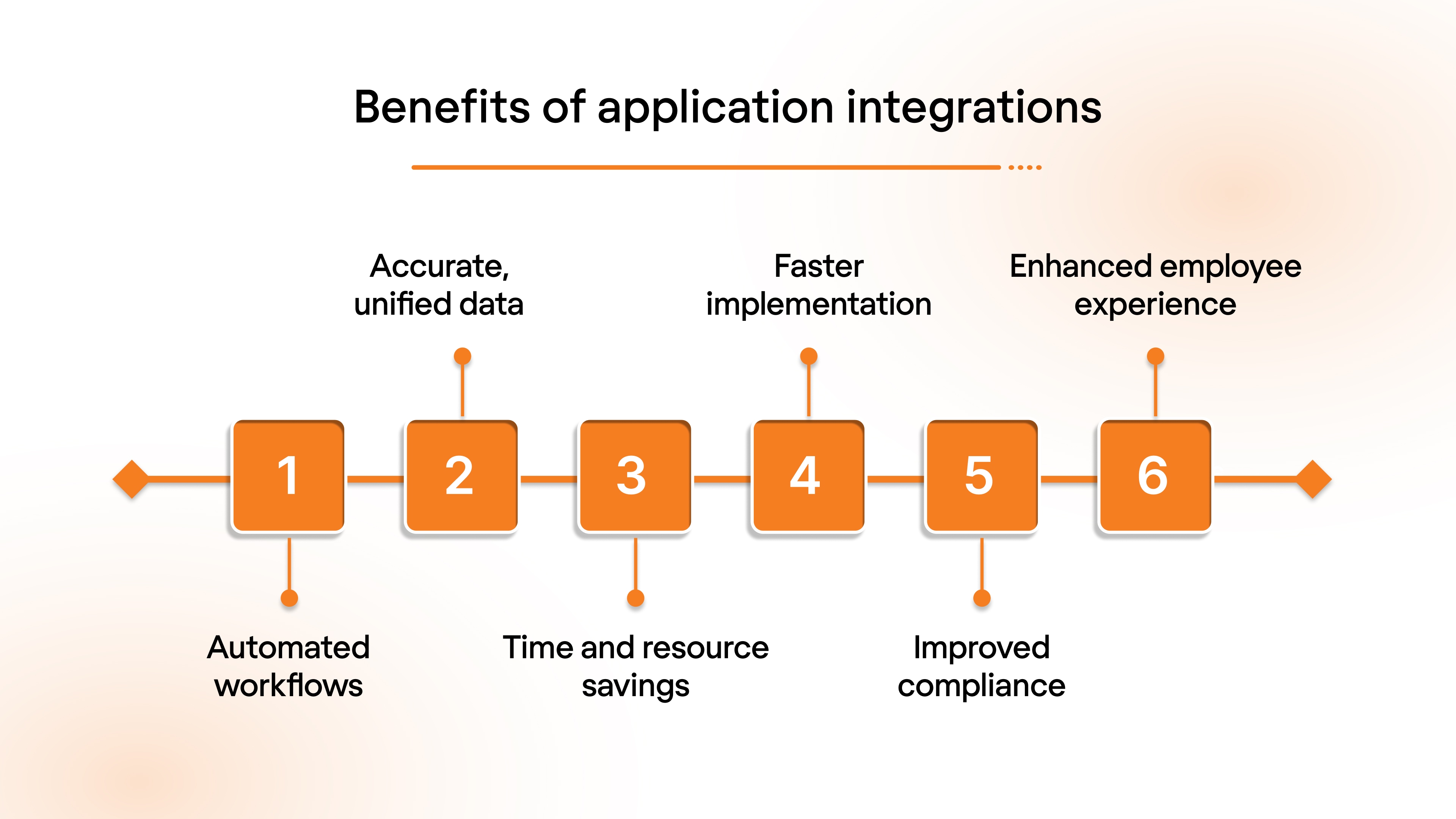
Disconnected systems create data silos, inefficiencies, and errors. Manual reconciliations, duplicate entries, and inconsistent employee records waste time and can lead to compliance issues. Application integration solutions solve these challenges by:
- Automated workflows: Integration reduces repetitive tasks across HR, payroll, and benefits systems, allowing processes to run smoothly without constant manual intervention.
- Accurate, unified data: Synchronizing information across systems ensures consistency, eliminates errors and duplicate entries, and provides reliable insights for decision-making.
- Time and resource savings: Eliminating manual reconciliations and reducing IT maintenance requirements frees HR and technical teams to focus on strategic priorities.
- Faster implementation and scalability: Pre-built connectors and low-code workflows accelerate deployment and allow systems to grow with organizational needs without added complexity.
- Improved compliance and governance: Integration maintains consistent, auditable records across platforms, reducing regulatory and internal compliance risks.
- Enhanced employee experience: Accurate payroll, seamless onboarding, and smooth benefits enrollment create a frictionless experience that boosts engagement and satisfaction.
Now that we understand why integration is critical, let’s explore the key features that make these solutions indispensable for 2026.
Key Features of Leading Application Integration Solutions
Modern application integration solutions offer capabilities that go beyond simple data transfer. HR and payroll teams should look for tools that provide:
- Pre-built Connectors: Ready-made integrations with popular HRIS, ATS, payroll, and benefits platforms make it easy to connect systems without custom development.
- Workflow Automation: These tools automate repetitive tasks such as employee onboarding, payroll processing, and benefits enrollment, saving time and reducing errors.
- Data Transformation and Mapping: They ensure consistent formatting, validation, and information accuracy across all integrated systems.
- Scalability: Leading solutions can handle growing employee bases and complex organizational structures without additional engineering effort.
- Monitoring and Error Handling: Real-time alerts notify teams of failed syncs or discrepancies, allowing issues to be resolved quickly.
Features alone do not determine value. What matters is how platforms perform in real-world environments across scale, reliability, and ease of integration. Let’s explore the top application integration solutions defining the market in 2026.
Top Application Integration Solutions to Watch in 2026
Application integration is advancing quickly, with new platforms enabling faster, more reliable connections across HR, payroll, and business systems. These solutions help organizations streamline operations and reduce errors.
Here are a few platforms making an impact:
1. Bindbee
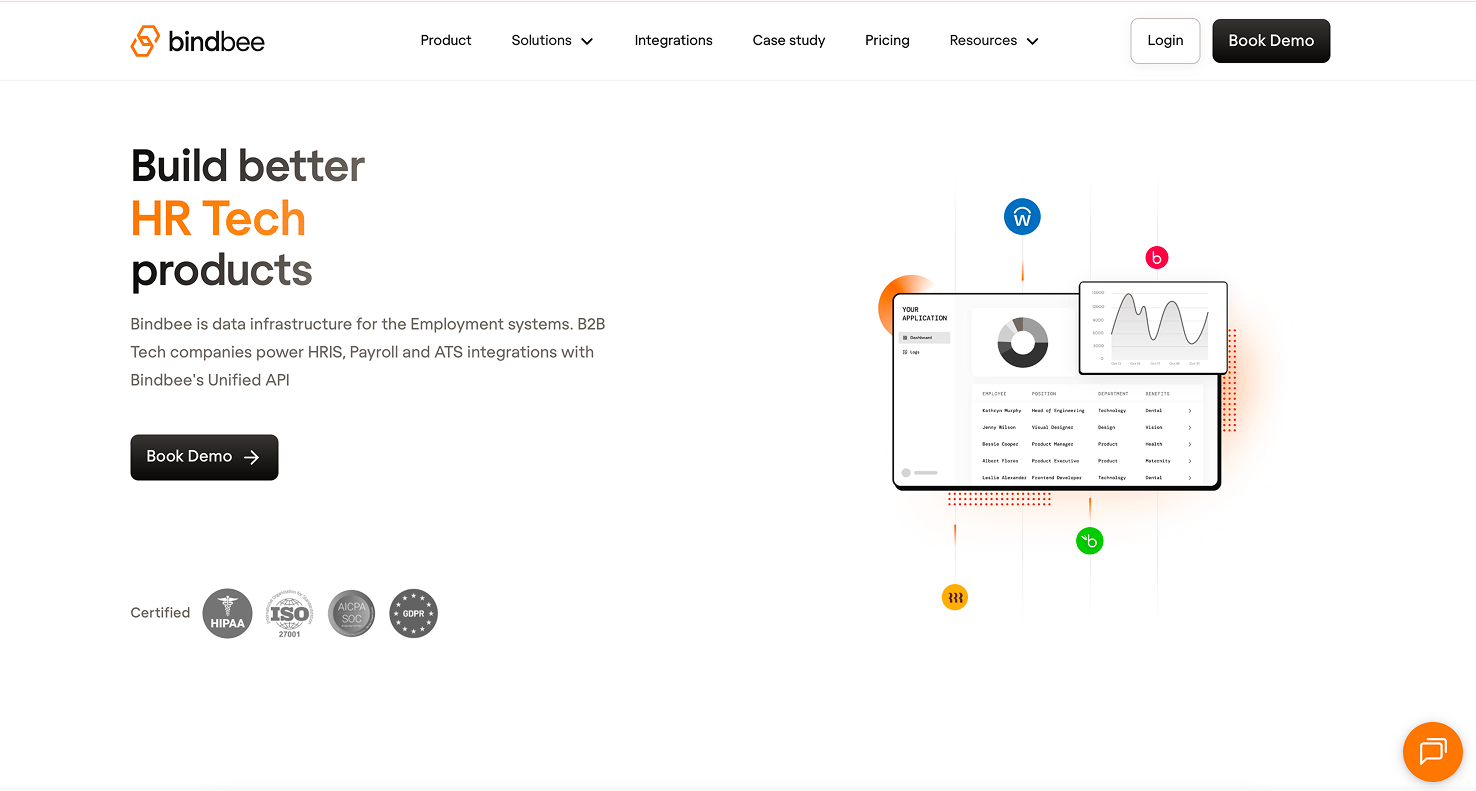
Bindbee provides unified APIs for HR, payroll, and ATS platforms, enabling SaaS products to integrate multiple employment‑related systems using a single API. It simplifies authentication, data normalization, and ongoing maintenance for engineering teams by abstracting disparate APIs into a consistent, developer‑friendly layer.
Key Features:
- Deep Coverage Across 60+ HRIS Tools: Broad integration catalog that allows teams to support customer requests faster and win deals without engineering delays.
- Standardized Data Models: Normalizes employee and payroll data across systems to ensure consistency, accuracy, and downstream reliability.
- Enterprise‑Grade Security: Built with GDPR compliance, encryption at rest and in transit, and strict access controls for sensitive employment data.
- No-Code Connection Setup: End customers can connect HR or payroll systems in minutes, lowering onboarding time and support overhead.
- Observability Dashboard: Real-time logs and event‑level visibility enable teams to diagnose and resolve integration issues without inspecting raw code.
Best Suited For: B2B SaaS companies in HR Tech, Benefits, Payroll, Fintech, Insurance, and 401(k)/TPA services that need reliable, secure, and scalable employment data integrations delivered through a Unified API without ongoing engineering maintenance.
Ratings: 4.9/5 (15+ reviews). Users highlight ease of implementation, clear documentation, and responsive technical support.
2. Boomi
Boomi is a unified integration platform as a service (iPaaS) that connects applications, data sources, and business processes across cloud and on‑premises environments. It enables organizations to design, deploy, and manage integrations using visual workflows and pre‑built connectors, reducing complexity and engineering overhead.
Key Features:
- Visual Integration Builder: Low‑code, drag‑and‑drop interface for creating complex integration flows quickly.
- Extensive Connector Library: Hundreds of connectors for ERP, CRM, HR, finance, and other enterprise systems.
- API Lifecycle Management: Full support for building, testing, deploying, and managing APIs with governance and security.
- Master Data Hub: Centralized synchronization and management of core business data to ensure consistency across systems.
- Operational Monitoring: Dashboards and alerts for tracking integration performance and resolving issues proactively.
Best Suited For: Large enterprises and midsize organizations that require robust data and application integration across diverse systems, hybrid IT environments, and complex business processes.
Ratings: 4.4/5 (600+ reviews). Commonly rated for its large connector ecosystem, visual workflow builder, and enterprise-grade integration capabilities.
3. Workato
Workato is an enterprise automation and integration platform that combines integration, workflow automation, and AI‑assisted suggestions. It enables technical and non‑technical teams to build integrations and automations using intuitive recipes, reducing time-to-value and operational friction.
Key Features:
- Pre‑built Recipes: Ready‑to‑use integration templates for HR, finance, sales, and support systems to accelerate deployment.
- Low‑Code/No‑Code Interface: Visual builder enables cross‑functional teams to design workflows without deep engineering.
- Intelligent Automation: AI‑driven recommendations and error handling to improve workflow resilience.
- Event‑Driven Architecture: Real‑time triggers and conditional logic for responsive integrations.
- Enterprise‑grade Security: Role‑based access control, encryption, and audit logs for compliance.
Best Suited For: Organizations seeking to automate business processes across departments with minimal engineering effort, especially where integrations span HR, CRM, ITSM, and ERP systems.
Ratings: 4.7/5 (400+ reviews). Frequently cited for automation depth, recipe library, and ease of building cross-system workflows.
4. SnapLogic
SnapLogic is a cloud‑native iPaaS platform that enables organizations to integrate applications and data at scale using an AI‑assisted, visual development environment. Its snap library of connectors enables rapid connections between SaaS and legacy systems.
Key Features:
- AI‑Powered Integration: SnapLogic’s AI Assistant accelerates workflow creation and error resolution.
- Comprehensive Snap Library: Connectors (“Snaps”) for cloud services, databases, messaging platforms, and more.
- Elastic Scalability: Built for handling large data volumes in hybrid environments.
- Real‑Time and Batch Integration: Support for streaming and scheduled data flows.
- Pipeline Monitoring: Centralized visibility into performance and execution metrics.
Best Suited For: Enterprises with complex integration needs, significant data movement requirements, and hybrid cloud landscapes where scalability and performance matter.
Ratings: 4.4/5 (100+ reviews). Known for scalability, performance in hybrid environments, and its AI-assisted integration tooling.
5. Paragon
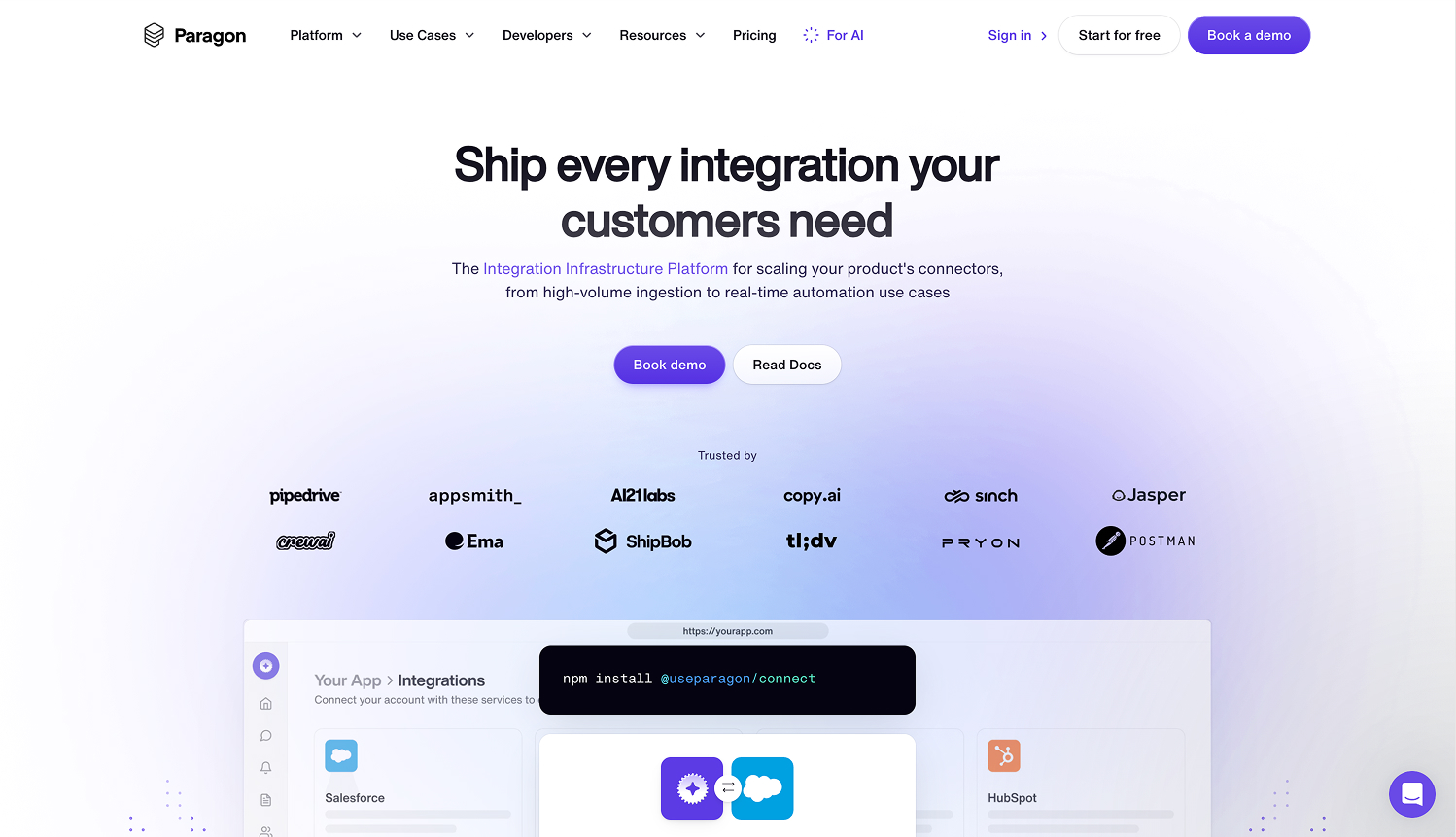
Paragon is an embedded integration platform built specifically for SaaS companies that want to ship native integrations without building and maintaining custom pipelines. It allows product teams to embed integrations directly into their application while retaining control over data flows, permissions, and customer configuration.
Key Features:
- Embedded Integration Infrastructure: Enables SaaS products to offer native, in-app integrations without exposing backend logic to customers.
- Pre-built Connector Library: Supports common SaaS tools across CRM, marketing, analytics, HR, and support systems.
- Workflow Builder: Visual interface to design data syncs, triggers, and transformations with minimal engineering effort.
- Customer-Scoped Authentication: Each customer manages their own connections securely within the product UI.
- Monitoring and Error Handling: Centralised logs, retries, and alerts to track integration health and failures.
Best Suited For: B2B SaaS companies that want to embed integrations as a core product feature, reduce internal maintenance work, and give customers self-serve control over app connections.
Ratings: 4.6/5 - Users often mention fast time to launch integrations, clean developer experience, and strong support for embedded SaaS use cases.
6. TIBCO (TIBCO Cloud Integration)
TIBCO’s integration suite, including TIBCO Cloud Integration, enables organizations to connect applications, APIs, and data streams in real time. It supports both application and event‑driven integration patterns, making it suitable for digital transformation efforts.
Key Features:
- Real‑Time Integration: Support for event‑driven architectures and streaming data flows.
- API Management: Tools to design, secure, and manage APIs across environments.
- Hybrid Integration Support: Connectivity for cloud and on‑premises systems.
- Pre‑built Connectors: Access to common enterprise systems and protocols.
- Centralized Monitoring: Dashboards for visibility into integrations and performance.
Best Suited For: Enterprises requiring robust real‑time integration and API management across diverse systems, with hybrid architecture considerations.
Ratings: 4.2/5 (250+ reviews across TIBCO integration products). Rated for real-time integration, API management, and hybrid system connectivity.
7. Jitterbit
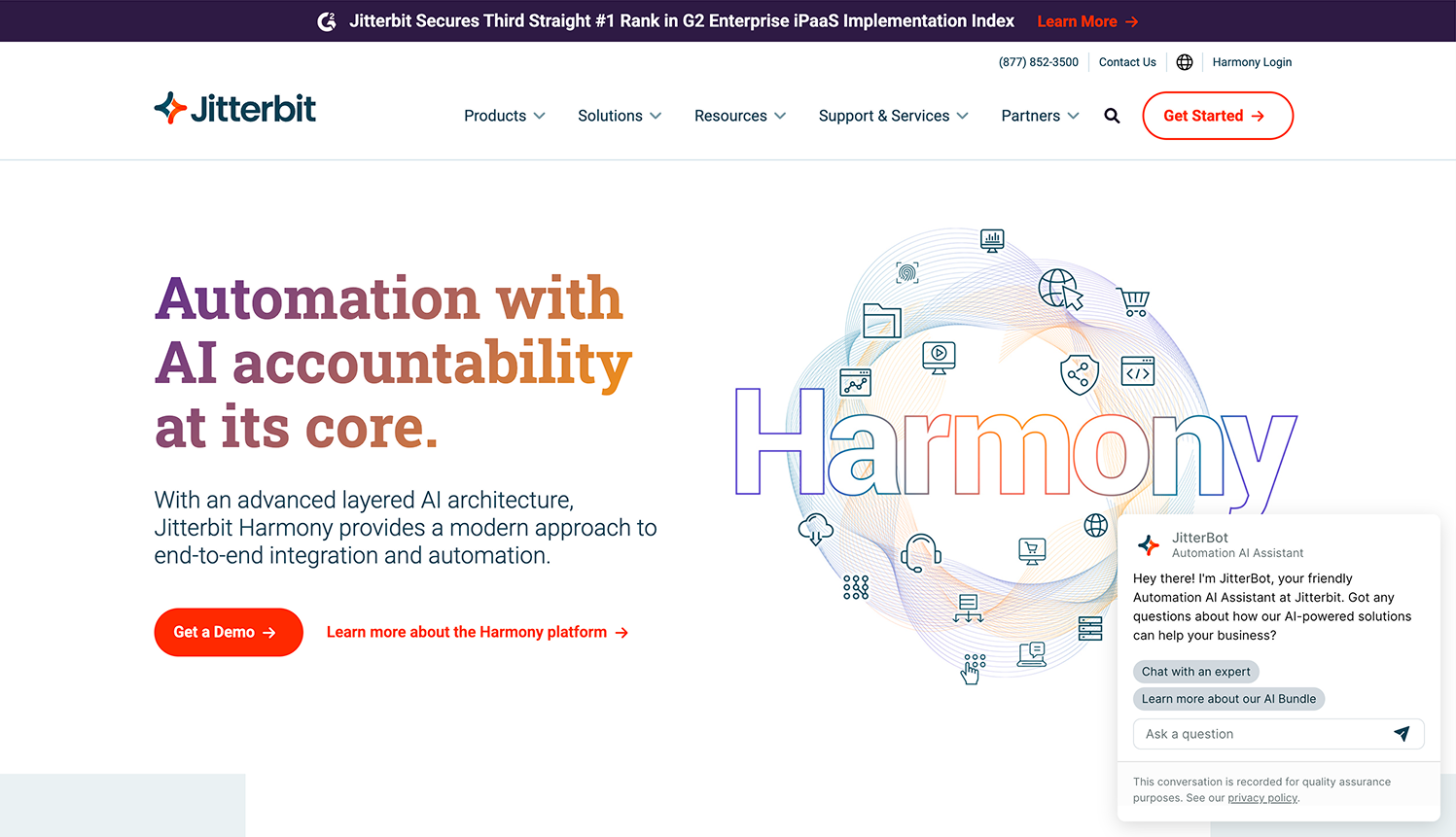
Jitterbit provides an API integration platform that connects SaaS, on-premises, and legacy systems via a visual development interface and pre-built templates. It emphasizes rapid deployment and seamless data orchestration.
Key Features:
- Visual Workflow Designer: Intuitive tools for building integrations without deep coding.
- Pre‑built Templates: Accelerate integration with common enterprise workflows.
- API Creation and Management: Design and publish APIs to expose services securely.
- Data Transformation: Map and transform data across formats and systems.
- Error Handling Tools: Alerts and central logs for quickly troubleshooting issues.
Best Suited For: Organizations needing straightforward applications and data integration with support for custom API development and rapid deployment.
Ratings: 4.4/5 (350+ reviews). Users highlight fast deployment, strong API tooling, and flexible data transformation.
8. Talend
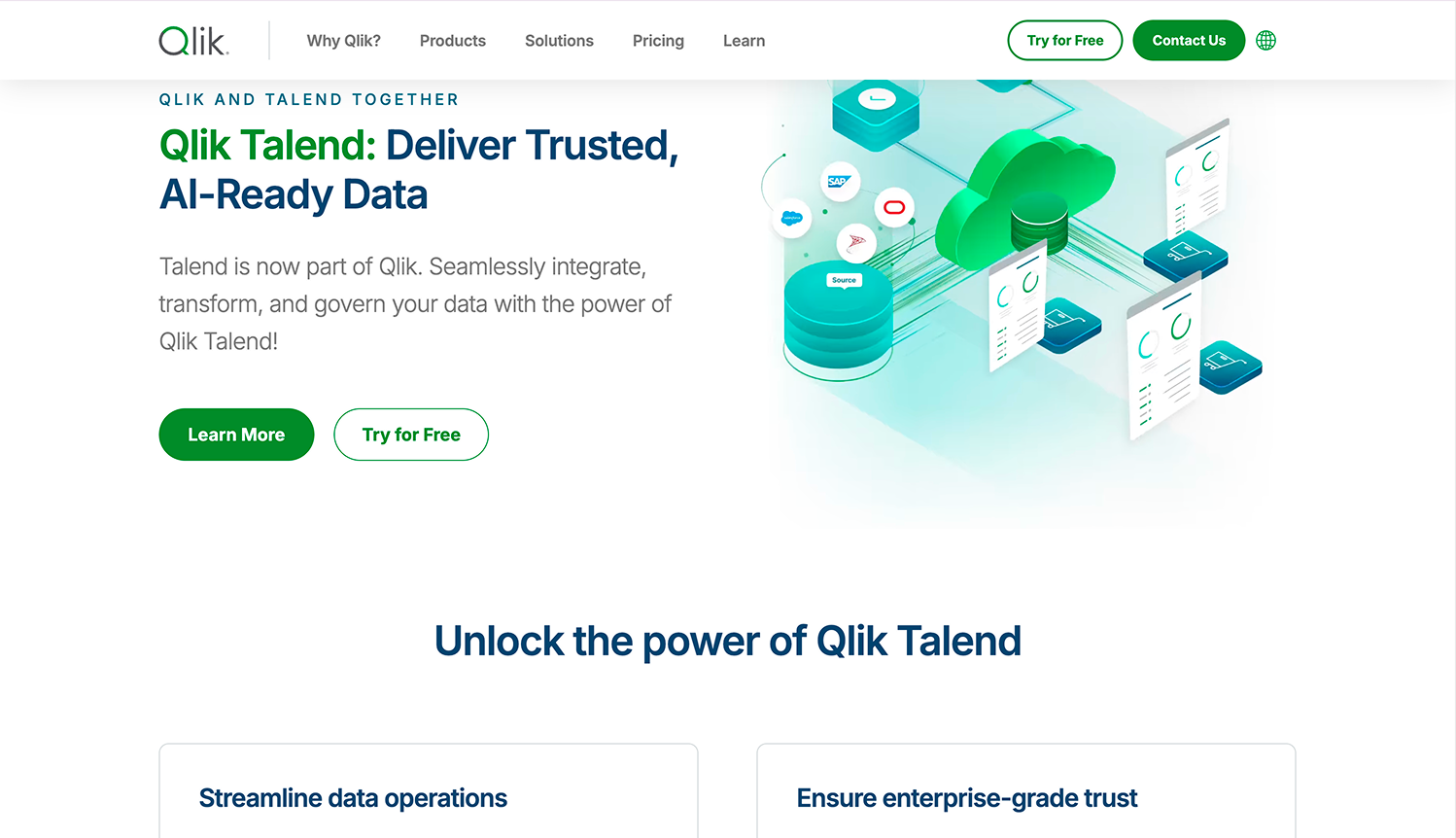
Talend provides a broad suite of data integration and data quality tools designed to connect applications, databases, and analytics platforms. Its unified platform supports ETL, ELT, API integration, and governance capabilities.
Key Features:
- Unified Data Platform: Combine integration, quality, and governance in one solution.
- Data Quality Tools: Standardise, cleanse, and validate data across pipelines.
- Connector Ecosystem: Broad support for cloud and on‑premises data sources.
- Governance and Lineage: Track data origin and transformations for compliance.
- Scalable Architecture: Suitable for enterprise data workloads.
Best Suited For: Enterprises that need deep data integration and governance alongside application connectivity, especially where analytics and data quality matter.
Ratings: 4.2/5 (600+ reviews). Well-reviewed for data integration, governance, and enterprise data quality tooling.
9. Apideck
Apideck offers a unified API and developer platform that aggregates multiple SaaS APIs (e.g., accounting, CRM, payments) into a single interface. This approach simplifies integration for product teams building cross‑system connectivity.
Key Features:
- Unified API Layer: Abstracts multiple vendor APIs into consistent endpoints.
- SDKs and Tools: Developer resources for faster implementation.
- Connector Marketplace: Expandable library of supported services.
- Authentication Handling: Standardizes security across different provider APIs.
- Versioning Support: Backward compatibility and API version controls.
Best Suited For: SaaS companies and B2B platforms needing a consistent way to integrate multiple third‑party APIs without custom development for each vendor.
Ratings: 4.8/5 - Rated highly in the Unified API category for simplifying SaaS API aggregation and developer experience.
10. Pandium
Pandium is an embedded integration platform (embedded iPaaS) designed for SaaS companies to build, deploy, and monetise integrations within their own products. It provides tools for managing connectors, workflows, and customer contexts without significant engineering overhead.
Key Features:
- Embedded Integration SDK: Tools to surface integrations inside your product UI.
- Customer‑Scoped Connectors: Personalized connection contexts per customer.
- Usage Analytics: Track integration adoption and performance.
- Low‑Code Designer: Build and test workflows without deep coding.
- Access Controls: Manage who can configure and use integrations.
Best Suited For: B2B SaaS platforms that want to embed integration capabilities directly in their product and provide self‑service connectivity to end customers.
Ratings: 4.6/5 - Reviewed positively for embedded integrations, connector management, and SaaS-focused workflows.
11. Tray Embedded
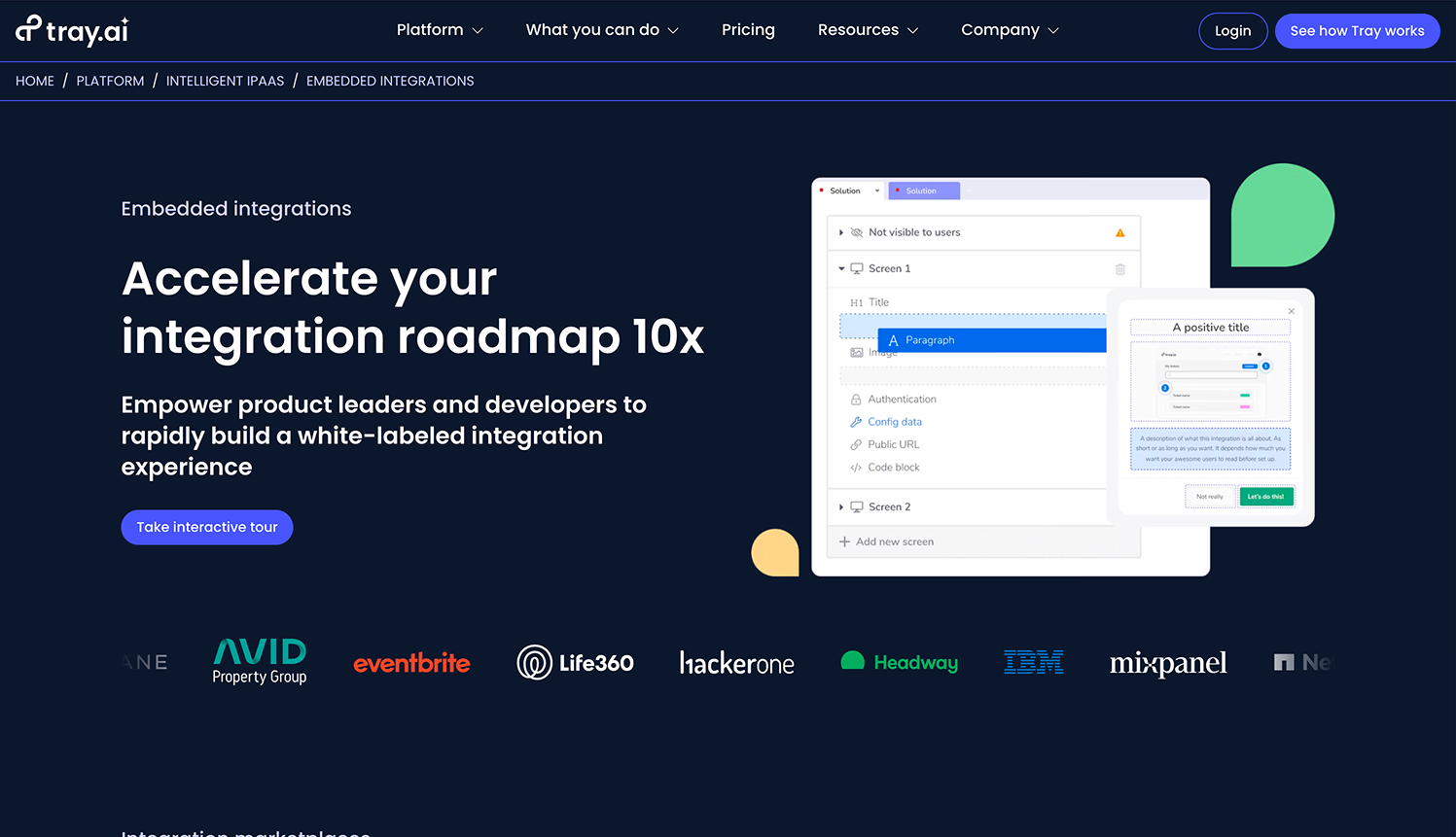
Tray Embedded, part of the Tray.io platform, enables SaaS companies to embed integration experiences inside their products. It combines the power of Tray.io’s workflow automation with tools tailored for white‑label, customer‑facing integrations.
Key Features:
- Embedded Integration UI: Build branded experiences for customers to connect systems.
- Low‑Code Workflow Engine: Design complex orchestration logic without heavy coding.
- Pre‑built Connectors: Access common SaaS systems out of the box.
- Multi‑tenant Support: Manage customer instances and contexts securely.
- Real‑Time Monitoring: Visibility into integration health and activity.
Best Suited For: SaaS companies that want to deliver integrated experiences within their own products and allow customers to self‑configure connections.
Ratings: 4.6/5 (250+ reviews). Noted for workflow automation, embedded integration tooling, and customer-facing integration experiences.
Now that you know the top solutions, let’s explore practical considerations before choosing the right integration platform for your organization.
How to Choose the Right Application Integration Solution
Selecting the right integration solution depends on your organization’s size, system complexity, and HR, payroll, and benefits requirements. Here’s what to consider:
- Integration depth: Evaluate whether the platform can connect all the HR, payroll, benefits, and ATS systems your organization relies on. Comprehensive coverage reduces the need for custom coding, prevents data silos, and ensures seamless workflows across multiple systems.
- Ease of use: Look for solutions with low-code or no-code workflow builders that allow HR and payroll teams to manage integrations independently. A user-friendly interface minimizes IT dependency, accelerates onboarding, and empowers non-technical teams to handle day-to-day operations efficiently.
- Scalability: The solution should scale with your organization as employee numbers grow and processes become more complex. It should handle increasing data volumes, multiple locations, and diverse system integrations without slowing performance or requiring significant additional engineering resources.
- Support and reliability: Ensure the vendor provides robust support, proactive monitoring, and automated error handling. Reliable platforms reduce downtime, quickly resolve failed syncs, and give your teams confidence that critical payroll and HR processes are accurate and on time.
- Cost versus value: Consider the total cost of ownership, including initial implementation, ongoing maintenance, and the potential productivity gains from automation. A higher upfront investment may be justified if the platform reduces errors, manual work, and operational risks over time.
Once you’ve selected the right integration solution, the next step is implementing it effectively. Let’s explore best practices to ensure a smooth deployment and maximize operational benefits.
Best Practices for Implementing Application Integration
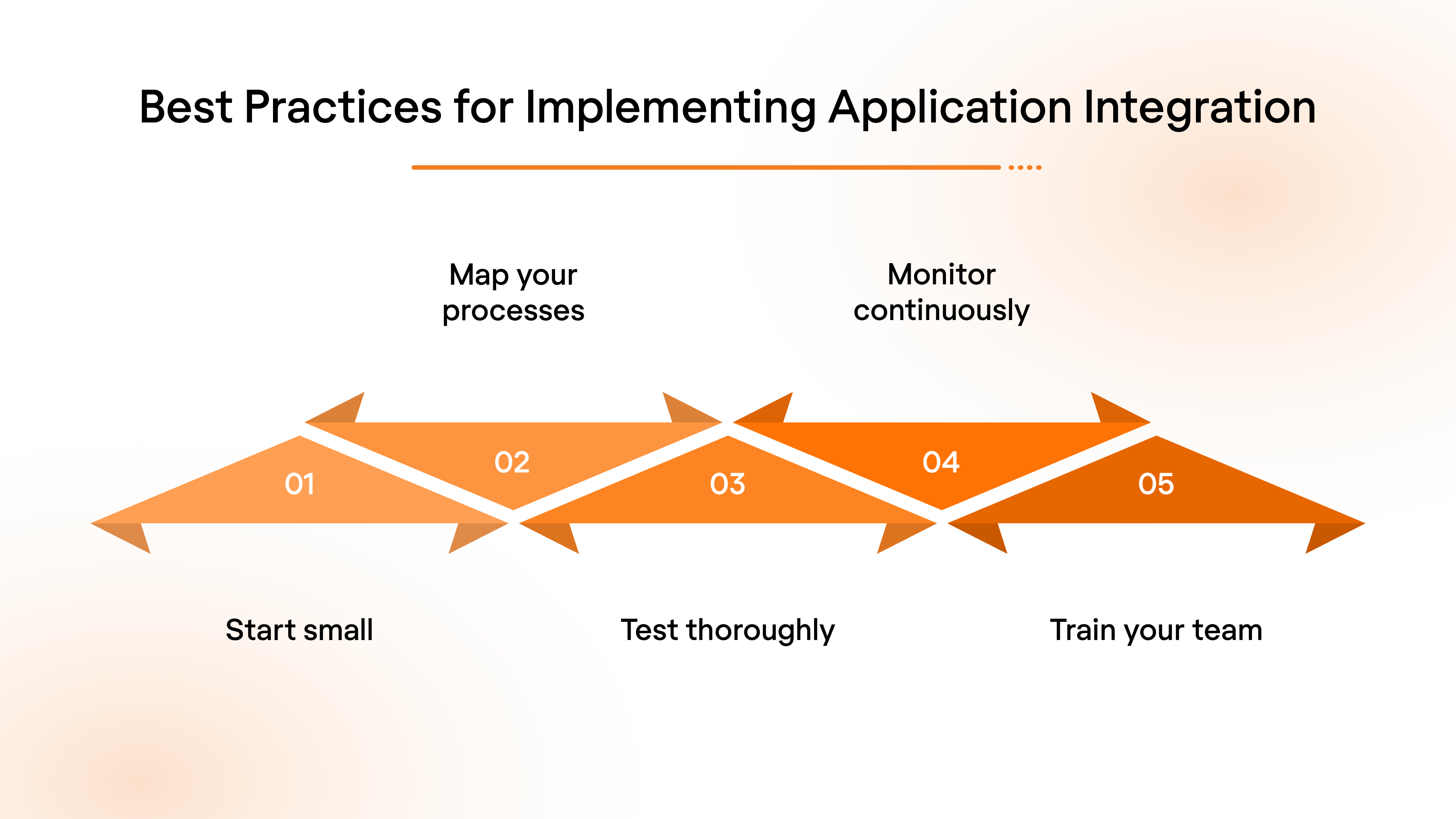
Implementing an integration solution effectively is just as important as choosing the right one. Following best practices ensures your workflows run smoothly, reduces errors, and helps your HR, payroll, and IT teams get the most value from the platform.
- Start small: Begin by integrating your most critical workflows, such as payroll processing and benefits synchronization. This allows your team to learn the system gradually and address any issues before scaling to more complex processes.
- Map your processes: Take time to understand your existing workflows and data flows. Identifying automation opportunities upfront ensures integrations are aligned with real business needs and avoids creating bottlenecks.
- Test thoroughly: Validate data transformations, error handling, and workflow logic in a controlled environment before full deployment. Thorough testing minimizes disruptions and ensures consistent, reliable performance.
- Monitor continuously: Use dashboards, alerts, and logging tools to track integration performance in real time. Continuous monitoring helps detect failures or inconsistencies quickly, enabling immediate corrective actions.
- Train your team: Equip HR, payroll, and IT staff with the knowledge to manage workflows and troubleshoot issues. Well-trained teams are more confident, reduce their reliance on external support, and ensure integrations deliver maximum benefit.
By following these practices, organizations can maximize the reliability and efficiency of their integrations. Proper planning and oversight ensure that HR and payroll workflows remain accurate, compliant, and adaptable to future changes.
Final Thoughts
Application integration solutions have become essential for HR, payroll, and B2B operations. Disconnected systems slow teams, cause errors, lead to duplicate work, and increase operational friction. By connecting platforms and automating workflows, organizations can eliminate these issues and focus on strategic priorities instead of manual processes.
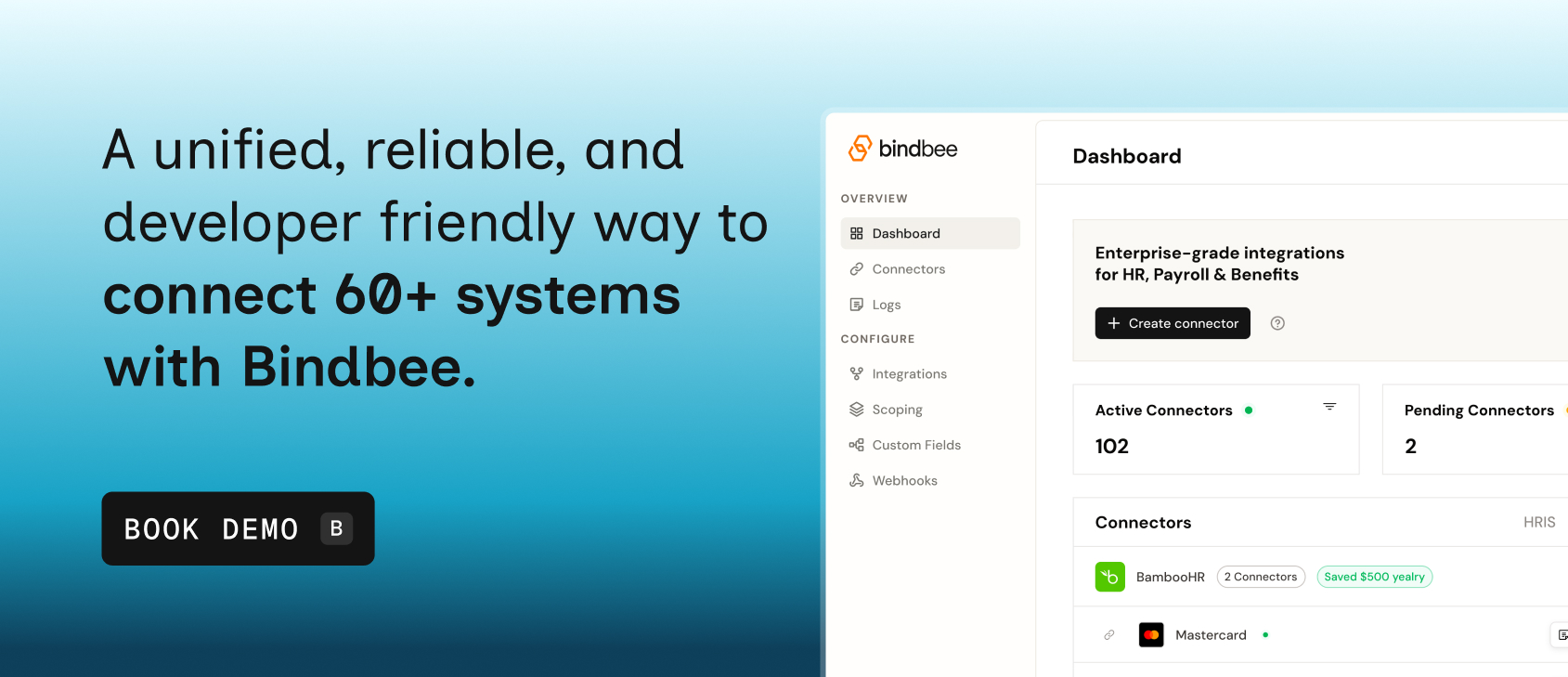
For teams looking to simplify HR and payroll integrations, Bindbee offers a unified API that connects multiple employment systems into a single platform. With standardized data models, pre-built connectors, and enterprise-grade security, Bindbee ensures accurate, real-time data while reducing engineering overhead, allowing teams to work more efficiently.
Request a demo to see how Bindbee can streamline your workflows and improve the employee experience without the overhead of custom integrations.
FAQs
1. How do integration platforms handle real-time data across multiple HR systems?
Most platforms use event-driven architecture or webhook triggers to push updates instantly. This ensures payroll, benefits, and HRIS systems stay synchronized without manual intervention, reducing errors and improving operational efficiency.
2. Can non-technical HR teams manage these integrations independently?
Low-code and no-code platforms allow HR or payroll teams to configure workflows, connect systems, and monitor integrations without engineering expertise. This reduces IT dependency and accelerates adoption across departments.
3. How do these solutions support compliance and data security?
Platforms implement encryption, access controls, audit logs, and GDPR-compliant data handling. Centralized monitoring and standardized data models ensure accurate, auditable records for payroll, HR, and benefits processes.
4. What factors impact the scalability of integration solutions?
Scalability depends on connector coverage, workflow automation capabilities, cloud infrastructure, and multi-tenant support. A scalable platform can handle growing employee bases, increased data volume, and multi-system integrations without performance degradation.
5. How do embedded iPaaS solutions differ from traditional integration platforms?
Embedded iPaaS allows SaaS providers to integrate third-party systems directly within their applications. Customers can self-configure integrations, reducing engineering effort and delivering seamless workflows without leaving the product interface.