
Introduction
Most engineering teams don't think about API management until something breaks. A payroll sync fails silently. Eligibility data goes stale before open enrollment. An enterprise prospect walks because your security documentation doesn't hold up to their compliance review.
The scale of the problem is real: according to MuleSoft's 2025 Connectivity Benchmark Report, the average enterprise manages 897 distinct applications — yet only 29% are integrated. Developers spend roughly 39% of their time building and maintaining custom integrations rather than shipping product features.
This guide covers the measurable advantages that structured API management delivers across six areas: developer velocity, security and compliance, operational costs, scalability, reliability, and partner ecosystem growth. Each section includes specific outcomes — not just concepts — so you can make the case internally or act on it directly.
TL;DR
- Developers waste 39% of their time on custom integrations — centralized API management recovers that capacity for product work
- A managed gateway eliminates the weakest-link problem: 99% of organizations reported API security incidents in the past year
- Without real-time monitoring, integration failures surface only after end users are already affected
- For HR Tech and benefits platforms, poor API management means stale eligibility data, failed enrollments, and lost enterprise deals
- Teams that invest early see measurable returns: platforms like those running on Bindbee cut onboarding time by 76% and time-to-value by 94%
What Is API Management?
API management is the process of designing, publishing, securing, monitoring, and retiring APIs in a controlled, consistent, and scalable way — covering the full API lifecycle, not just the initial build.
It applies to any organization that exposes or consumes APIs at scale:
- SaaS platforms connecting to third-party tools
- HR Tech companies integrating with multiple HRIS and payroll systems
- Enterprises managing internal microservices
Good API management is infrastructure for outcomes — invisible when done well. What becomes visible is faster onboarding, fewer outages, cleaner data, and engineering teams focused on building rather than plumbing.
Key Advantages of API Management
The advantages below are grounded in outcomes organizations actually measure — engineering time recovered, errors reduced, time-to-market accelerated, compliance risk mitigated.
Advantage 1: Centralized Integration Control and Reduced Engineering Overhead
Without centralization, every new integration is its own project. Each one requires custom build time, bespoke error handling, and ongoing maintenance as upstream APIs evolve. Multiply that across dozens of connections and the engineering team spends most of its time keeping integrations alive rather than shipping the product.
A managed API layer shifts where that time goes. Teams configure governance policies once — authentication, rate limiting, retries, versioning — and those behaviors apply uniformly across every connection. New integrations inherit standard behaviors rather than requiring each one to be rebuilt from scratch.
The numbers are stark. MuleSoft's 2025 Connectivity Benchmark Report found that 83% of organizations report integration challenges as a significant barrier to modernization, and 83% say project delays from integration work directly cause lost revenue.
What this looks like in practice: Newfront, an insurance brokerage platform, spent 8–12 weeks on custom integration development for each new enterprise client before adopting a unified API approach. After switching to Bindbee's single normalized API (which covers 60+ HRIS and payroll systems), that timeline dropped to 48 hours — saving over $800,000 annually in development resources and delivering 3x faster enterprise client onboarding.

The impact scales with integration count. For organizations connecting to five or fewer systems, overhead is manageable. For HR Tech platforms, benefits administrators, or payroll providers connecting to dozens of upstream systems, unmanaged integrations become the primary drag on engineering velocity.
KPIs this affects:
- Integration setup time (weeks → hours)
- Engineering hours per new connector
- Time-to-first-data for new customers
- Maintenance cost per integration
Advantage 2: Security, Compliance, and Data Integrity at Scale
Salt Security's Q1 2025 State of API Security Report puts the scope plainly: 99% of organizations encountered API security issues in the past 12 months, with 34% involving sensitive data exposure. Security misconfigurations account for 40% of exploited API vulnerabilities.
The root cause is usually inconsistency. When security is implemented ad hoc by individual development teams, some endpoints get proper authentication and access controls. Others don't. One misconfigured endpoint can create a material compliance gap — and organizations often don't discover it until an audit or an incident.
What centralized API management fixes:
- Authentication policies (OAuth 2.0, API keys, JWTs) configured once and enforced at the gateway level
- Rate limiting and IP filtering applied uniformly — not dependent on individual developer choices
- Full audit trails of who accessed what data and when
- Consistent encryption in transit and at rest across all API traffic
By then, data may have been stale for hours, or a payroll run has already processed against incorrect eligibility records.
Real-time API monitoring changes where problems get caught. Instead of surfacing after damage is done, degradation appears as it starts — anomalous error rates, latency spikes, failed sync events — and teams can respond before downstream processes are affected.
What centralized observability surfaces:
- Response times and latency trends per integration
- Error rates and failure patterns by endpoint
- Data freshness — time between upstream change and downstream sync
- API version adoption and which endpoints need migration
- Usage patterns that inform roadmap prioritization
For platforms where business processes depend on data accuracy, data lag is a direct operational risk. A benefits platform relying on stale eligibility data can process incorrect enrollments. A COBRA workflow triggered by termination events needs real-time detection, not a next-day batch file.
Bindbee's webhook system fires immediately when employment status, dependent data, or hours change in a source HRIS. ThrivePass cut their onboarding time from six weeks to under one week by replacing batch EDI 834 file processing with real-time webhooks, with claims adjudicating against current eligibility data rather than month-old exports.
Proactive alerting also covers infrastructure failures: when an upstream HRIS experiences downtime, automatic retry logic and persistent-failure notifications prevent silent data gaps from accumulating undetected.
What Happens When API Management Is Missing
The consequences of unmanaged APIs don't announce themselves. They compound quietly until something forces a reckoning.
The most common failure patterns:
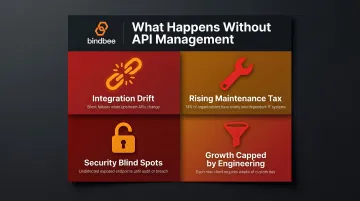
Integration drift happens when upstream APIs change without notice. Downstream processes break silently — payroll files fail to sync, eligibility data goes stale, enrollment records miss updates. No alert fires. The first signal is a user complaint or a compliance exception.
Rising maintenance tax: Every custom integration adds to a surface area of bespoke code that requires individual monitoring and manual fixes. The MuleSoft 2025 report found 74% of organizations have IT systems that are overly dependent on one another — meaning a single point of failure can cascade. This debt compounds as API count grows, eventually consuming the majority of engineering capacity.
Security blind spots: Without a centralized gateway enforcing consistent authentication, individual APIs become the weakest link. Organizations frequently don't know which endpoints are exposed until an audit or breach reveals it.
Growth caps at engineering throughput when each new customer or partner integration requires weeks of custom development. Business velocity becomes a headcount problem instead of a product problem.
Before adopting a unified API approach, Healthee spent 2+ months on custom integrations per employer — an 82% slower client onboarding process than what a governed approach later made possible.
Alma's engineering team burned 2–3 weeks per integration build on non-differentiating work. Compport's integration projects stretched up to two months, with development resources tied up in customization rather than product innovation.
Each of these is the predictable result of treating integration as a series of one-off problems rather than a governed operational practice.
How to Get the Most Value from API Management
API management delivers its full value when applied systematically — not tactically. Three conditions determine whether returns are high or marginal:
1. Standardize governance before APIs proliferate
Define authentication protocols, versioning conventions, rate limits, and error handling standards early. Retrofitting governance onto a sprawling integration estate costs significantly more than building it in from the start. Only 28% of organizations report having a clear, upfront API strategy implemented across the majority of their enterprise — meaning most are paying the retrofit cost.
2. Treat monitoring as operational infrastructure, not optional tooling
Set SLAs for API uptime and data freshness. Configure real-time alerts for anomalies and error rate thresholds. Review analytics regularly to catch degradation trends before they become incidents. If your team only learns about integration failures from end-user reports, your monitoring posture needs work.
3. Use purpose-built infrastructure for complex integration landscapes
For HR Tech platforms, benefits administrators, and InsureTech companies connecting to dozens of HRIS, payroll, and carrier systems, building that integration layer in-house drains engineering capacity better spent on product. Purpose-built infrastructure handles the complexity.
Bindbee's unified API, for example, normalizes employment data from 60+ HR systems into consistent, standardized models. Key capabilities include:
- Employee enrollments, employer benefit plans, dependent coverage, and payroll data through the same endpoints — regardless of underlying source system
- Custom integrations built in 7–10 days beyond the standard catalog
- Automatic handling of upstream API changes, versioning, retries, and data normalization
Engineering teams focus on product differentiation rather than integration maintenance.
Conclusion
What makes API management worth the investment is what it produces operationally: predictable API behavior, consistent security enforcement, and accurate data that teams can actually trust. Product teams ship faster. Compliance teams spend less time chasing audit gaps. Customer success teams stop firefighting integrations during onboarding.
The compounding nature of the benefit matters. Teams that invest in API management early recover engineering bandwidth, reduce incident rates, and onboard customers faster — advantages that widen as integration complexity grows. The teams that see the biggest returns are the ones that keep iterating on it — monitoring traffic patterns, tightening governance policies, and expanding coverage as new systems come online.
Frequently Asked Questions
What does API management do?
API management oversees the full lifecycle of APIs — from design and security to monitoring and retirement. It gives organizations consistent control over how APIs are accessed, governed, and maintained across all integrations, rather than leaving each connection managed case by case.
Why are APIs important for business?
APIs enable systems to share data, automate workflows, and power integrations that would otherwise require manual effort. According to MuleSoft's 2025 report, 40% of company revenue is now generated from APIs and API-related implementations.
Why is API monitoring important?
API monitoring provides real-time visibility into performance, error rates, and data freshness. Without it, failures surface only after end users are affected or downstream processes have already consumed stale data. Detection speed directly determines how much damage an outage causes.
What are API management tools?
API management tools handle the operational layer of APIs: gateways that enforce security and rate limits, developer portals for documentation and onboarding, analytics dashboards for usage tracking, and lifecycle management capabilities for versioning and deprecation.
Which are common API metrics?
The most tracked metrics are response time/latency, error rate, request throughput, uptime/availability, API adoption rate (active consumers), and data freshness — the time between an upstream change and downstream sync.
What are the benefits of using an API management platform?
Core operational benefits include:
- Reduced integration maintenance burden
- Consistent security enforcement across all APIs
- Real-time observability into usage and errors
- Faster developer onboarding
- Ability to scale integrations without proportional increases in engineering overhead