Introduction
HR and benefits platforms face a security tension that rarely gets discussed directly. These systems are constantly moving the most sensitive data in the employment context — Social Security Numbers, health plan elections, dependent information, banking details — across dozens of HRIS, payroll, and carrier integrations at once.
Most security conversations focus on what's stored: encrypt the database, restrict access, audit the logs. That's necessary. But it sidesteps a more fundamental design choice: whether the integration layer needs to store the data in the first place.
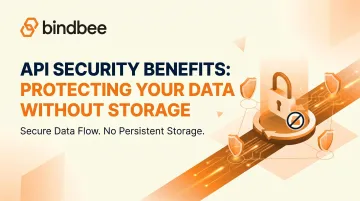
The safest data is data that was never written to disk. API architectures built around this principle — where the integration layer authenticates, transforms, and routes data without creating a persistent copy — deliver security advantages that compound across breach liability, compliance obligations, and third-party risk.
For platforms handling benefits enrollment, COBRA events, and payroll data at scale, the difference between storing and not storing can mean the difference between a contained access incident and a catastrophic multi-employer breach.
TL;DR
- No-storage API architectures remove the stored data layer as an attack surface — breached credentials can't expose records that were never kept
- Data minimization cuts average breach costs by $1.3M, according to IBM's 2024 Cost of a Data Breach Report
- GDPR, HIPAA, and CCPA are all built on data minimization; no-storage APIs satisfy this structurally, not just through policy
- Third-party breach involvement doubled to 30% in 2025 — vendors that never store data aren't worth targeting
- Fewer stored records means fewer breach notification obligations, smaller audit scope, and lower vendor risk scores
What Is API Security Without Data Storage?
The Core Architecture
API security without data storage means the integration layer functions as a conduit. It authenticates requests, transforms and normalizes data, and forwards it to the destination — writing nothing sensitive to any persistent store.
Contrast this with traditional integration middleware, which typically creates local copies of synced records. Every sync creates a new snapshot. Over time, the middleware accumulates a warehouse of employee records from every connected employer, becoming a valuable target independent of any source system.
In a no-storage or passthrough model, that warehouse never exists.
Where This Architecture Applies
This model is most relevant in unified integration APIs: platforms that connect HR systems, benefits platforms, payroll tools, and carriers on behalf of B2B software customers. In this context, the integration vendor sees data flowing through from dozens or hundreds of employer clients simultaneously.
Bindbee operates on this principle, normalizing data across 60+ HRIS and benefits systems (including Workday, ADP, BambooHR, Gusto, and Rippling) without creating a raw PII repository. The integration layer processes and normalizes the data model, then routes it directly to the destination.
Why Architecture Is a Security Decision
Treating the API as a conduit rather than a repository is an architectural decision made at the design stage — not a setting you toggle later. That decision has direct downstream consequences:
- Breach blast radius: how much data is exposed if the integration layer is compromised
- Compliance audit scope: which systems and data flows fall under GDPR or HIPAA review
- Vendor classification: whether your integration provider counts as a data custodian, and what obligations that creates
Key Advantages of API Security Without Data Storage
Each advantage below maps to a measurable outcome — not a theoretical security improvement.
Advantage 1: Smaller Breach Surface, Lower Breach Liability
When an integration API doesn't persist raw employee records, there's no database to exfiltrate. The attack surface shrinks to the access layer. A compromised API key can intercept a data flow — it cannot pull historical records from a store that doesn't exist.
This matters most in HR tech because the data in transit is extraordinarily sensitive. Bindbee routes employee SSNs, dependent SSNs, health plan elections, banking details, and COBRA qualifying events during typical benefits enrollment syncs. Each category carries specific regulatory protection under HIPAA, GDPR, and financial privacy laws.
Why breach liability scales with stored records:
- The IBM 2024 Cost of a Data Breach Report puts the average cost of a breach at $4.88M globally — $9.77M for healthcare, nearly double the average
- Employee PII costs $169 per record when breached; customer PII costs $173
- Mega-breaches involving 50M+ records average $375M in total cost
- Organizations that practiced data minimization averaged $4.14M per breach vs. $5.44M for those that didn't — a $1.3M differential
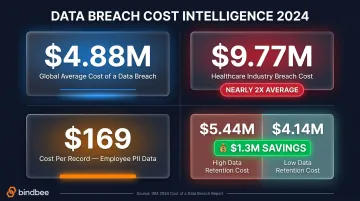
The math is direct: every record stored multiplies liability linearly. For an integration vendor connecting 10+ employer clients, a single compromise without the no-storage model could expose data from all of them simultaneously.
KPIs this affects:
- Breach disclosure obligation rate
- Incident response cost
- Cyber insurance premiums
- Vendor security audit scores
This is especially high-stakes for InsurTech, benefits administration, and HR Tech platforms aggregating data across multiple employer clients. A breach at the integration layer without a no-storage model is a multi-employer event.
Advantage 2: Compliance Becomes Structural, Not Procedural
GDPR, HIPAA, and CCPA share a foundational principle: collect and retain only what is necessary. APIs that don't store data comply with this principle by default. There's nothing to audit for unnecessary retention, no deletion workflow to maintain, no data residency conflict for cross-border employers.
Most compliance failures involving APIs don't come from the API being attacked. They come from "just in case" data accumulating liability over months or years.
Regulatory enforcement is real — and doesn't require a breach:
France's CNIL fined a mobile phone operator EUR 27 million in January 2026 specifically for excessive data retention periods — not for any breach. The CNIL's enforcement log shows a consistent pattern of fines ranging from EUR 20K to EUR 750K across retailers, call centers, and data brokers, all for retention violations alone.
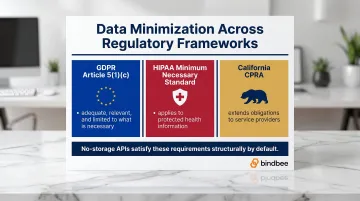
For integration vendors processing employee benefits data, the same logic applies across three frameworks:
- GDPR Article 5(1)(c): data must be "adequate, relevant and limited to what is necessary"
- HIPAA minimum necessary standard: applies the same constraint to protected health information
- California's CPRA: extends data minimization obligations to service providers
Compliance scope reduction is concrete:
SOC 2 Type II audits cost between $7,000 and $50,000 with a 3–12 month observation window. When the integration layer has no data retention to audit, the number of in-scope controls shrinks — fewer access controls to validate, fewer encryption requirements to demonstrate, fewer retention and disposal procedures to document.
Bindbee carries SOC 2 Type II and ISO 27001 certifications, providing independently verified evidence of how employment data is handled. For platforms signing Business Associate Agreements with healthcare employers, this audit trail matters directly to BAA scope and renewal cycles.
KPIs this affects:
- Compliance audit duration and cost
- Regulatory fine exposure
- Time to complete SOC 2 or HIPAA audit cycles
- BAA review complexity
Advantage 3: Third-Party Vendor Risk Is Contained at the Source
In traditional integration architectures, every vendor in the data chain holds a copy of the data — and becomes a breach point. A no-storage API breaks that chain.
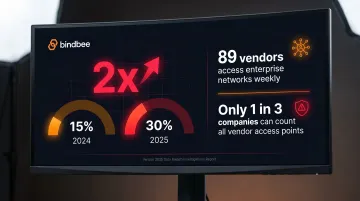
The numbers on third-party risk are stark. According to the Verizon 2025 Data Breach Investigations Report, third-party involvement in breaches doubled year-over-year from 15% to 30%. The average enterprise network is accessed by 89 different vendors every week, and only one-third of companies can accurately count how many vendors have access to their systems.
When an HR tech platform uses a unified integration API that only passes data in transit, the employer's workforce data stays in its source system (the HRIS) and the destination system (the benefits platform or carrier). The integration vendor never becomes a data custodian. No persistent copy exists at the integration layer to steal.
For enterprise buyers in HR Tech and InsurTech, this is increasingly a procurement signal. Security reviews now routinely include questions about whether integration vendors store raw employee data. Platforms that can demonstrate no-storage architecture reduce their vendor risk score not just for themselves, but for their enterprise customers' security assessments.
KPIs this affects:
- Third-party vendor risk score
- Number of BAAs or DPAs required
- Security review cycle duration for enterprise deals
- Customer trust and retention
A no-storage integration API eliminates a node from the third-party risk graph entirely — rather than adding a new exposure point at every additional employer connection.
What Happens When APIs Store Data They Shouldn't
The consequences of unnecessary retention in integration APIs compound in several directions at once:
- Breach blast radius expands with every stored employer record — a single vendor compromise exposes data across all connected clients simultaneously.
- Each retained record extends the audit surface, triggers additional GDPR and HIPAA obligations, and creates deletion workflow debt.
- Third-party risk propagates downstream. Your customers carry your storage risk in their own security assessments and vendor contracts.
- Regulators now target processors directly. The CNIL's enforcement pattern shows fines issued for unnecessary retention alone, with no breach required — and as scrutiny moves up the data supply chain, integration middleware vendors are increasingly in scope.
- Enterprise buyers who discover a vendor stores raw employee data terminate contracts upon security review — before any breach occurs.
The CNIL's €27M retention fine puts a concrete number on that exposure. Unnecessary storage is no longer a theoretical risk — it's an auditable liability.
How to Get the Most Value from a No-Storage API Security Model
Architecture sets the floor. Whether that floor holds depends on the practices you build on top of it — vendor vetting, access controls, and regular audits.
Verify Vendor Architecture Before Signing
Ask integration API providers directly:
- Do you store raw employee data at any point during a sync?
- What is your documented data retention policy?
- Do you hold SOC 2 Type II, ISO 27001, and HIPAA certifications?
Certifications require documented evidence of data minimization practices — they're not self-reported. Bindbee's SOC 2 Type II and ISO 27001 certifications provide independently audited confirmation of how employment data is handled in transit.
Pair No-Storage Design with Strong Access Controls
The benefit of not storing data is maximized when access to data in transit is also locked down:
- Short-lived tokens with minimal permission scopes
- OAuth-based authentication for source system connections
- Webhook-based notifications rather than polling, to minimize the window during which data is in flight
- Multi-factor authentication for all administrative access
Review Data Flows Quarterly
Controls only work if you verify them. Even no-storage APIs can develop unexpected retention — logging configurations, error-handling routines, and debugging tools can capture raw payloads if not configured to exclude them.
Run a quarterly review that compares what is actually written to logs against what your policy specifies — and assign a clear owner for remediating gaps. The distance between policy and implementation is where compliance exposure lives.
Conclusion
The strongest API security posture for HR and benefits data starts with a simple principle: the less data stored at the integration layer, the smaller the attack surface — and the less exposure you carry across breach risk, compliance scope, and vendor audits.
This architecture doesn't sacrifice functionality to get there. Bindbee processes benefits enrollment syncs, COBRA qualifying events, dependent data, and payroll details across 60+ systems without creating the persistent PII repository that makes integration vendors attractive targets.
Enterprise security reviews already ask pointed questions about where vendor data lives and how long it persists. Passthrough architectures answer both cleanly. Adopting this approach now removes immediate breach exposure and avoids the compliance obligations that accumulate with every record retained longer than necessary.
Frequently Asked Questions
What are the security benefits of API platforms that don't store data?
No-storage API platforms eliminate the stored data layer as an attack surface entirely. A breach of the API layer cannot expose records that don't exist, and compliance obligations under GDPR, HIPAA, and similar regulations are met structurally rather than through ongoing policy enforcement and deletion workflows.
What are the best security practices for APIs?
Designing APIs as passthrough conduits rather than data stores reduces the attack surface more than any single access control measure. Beyond that, core practices include strong authentication (OAuth 2.0, short-lived tokens), TLS encryption in transit, rate limiting, and continuous monitoring.
What are the three pillars of API security?
The three pillars are:
- Authentication and Authorization — ensuring only the right parties can access the API
- Data Protection — encrypting data in transit and minimizing what is retained
- Monitoring and Threat Detection — logging access patterns and responding to anomalies in real time
How does a no-storage API reduce compliance risk?
GDPR and HIPAA both require data minimization — retaining only what is necessary. APIs that don't store data comply with this structurally by default, eliminating deletion obligations, data residency conflicts, and the audit scope that accumulates with retained records over time.
Is a passthrough API architecture more secure than one that stores data?
For integration use cases where storage isn't operationally necessary, passthrough is inherently more secure. Breach exposure, compliance obligations, and vendor liability all scale with the volume of data stored — so eliminating persistent storage removes the variable driving each of those risks.
What types of sensitive data does HR API integration typically handle?
HR and benefits APIs typically route:
- Employee PII (SSNs, home addresses)
- Health benefits elections and dependent information
- Payroll and banking details
- Employment status and termination events
Each category carries specific regulatory protections under HIPAA, GDPR, and financial privacy laws.