According to KFF, 13.9 million uninsured Americans were eligible for Medicaid or subsidized Marketplace coverage in 2024 but hadn't enrolled. That's more than half of all uninsured people under 65.
The rules aren't complicated once you understand the framework. This article covers the four baseline enrollment requirements, how income determines subsidy eligibility, what actually disqualifies you, how employer coverage affects your options, and when you can enroll — including the significant 2025/2026 changes that affect subsidy amounts and who qualifies.
TL;DR
- Enrollment basics: You must live in the U.S., be a citizen or lawfully present immigrant, not be incarcerated, and not be enrolled in Medicare.
- No income ceiling for enrollment, but 2026 premium tax credits are capped at 400% FPL — enhanced subsidies expired at the end of 2025.
- Tax credits are blocked if you're eligible for Medicaid, CHIP, or affordable employer-sponsored coverage.
- 2026 changes are real: Enhanced subsidies expired at the end of 2025 — subsidized enrollees' premiums rose an estimated 114% on average, and enrollment dropped by over 1 million.
- Enrollment windows are strict: Open Enrollment or a qualifying life event (Special Enrollment Period) are your only entry points.
Who Can Enroll in ACA Marketplace Coverage: The Basic Rules
Four requirements determine whether someone can enroll in a Marketplace plan at all:
- U.S. residency — you must live in the state where you're applying
- Citizenship, national status, or lawful presence — green card holders, visa holders, refugees, and asylees qualify; undocumented immigrants do not
- Not incarcerated — though recently released individuals may qualify for a Special Enrollment Period
- Not enrolled in Medicare — enrollment in Medicare Part A or B makes you ineligible for a Marketplace plan entirely
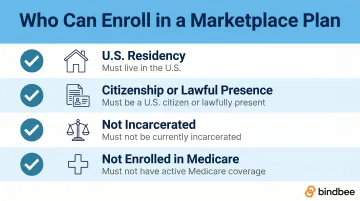
Most U.S. residents meet these criteria. The Marketplace isn't selective about enrollment — it's selective about subsidies, which are a separate determination.
Residency and Territory Rules
"Living in the U.S." means the state where you're applying and filing taxes. Residents of U.S. territories — Puerto Rico, Guam, the U.S. Virgin Islands, American Samoa, and the Northern Mariana Islands — cannot use the federal Marketplace.
Immigration Status Details
HealthCare.gov defines "lawfully present" broadly. Qualifying statuses include:
HealthCare.gov defines "lawfully present" broadly. Qualifying statuses include:
- Lawful permanent residents (green card holders)
- Refugees and asylees
- Asylum applicants
- TPS (Temporary Protected Status) holders
- Valid nonimmigrant visa holders (H-1B, student visas, U-visas, and others)
One notable 2026 change: the 2025 reconciliation law eliminated the exception that previously allowed lawfully present immigrants below 100% FPL to access Marketplace subsidies. The CBO estimates 300,000 people are newly ineligible for premium tax credits as a result.
Looking ahead to 2027, the law will restrict subsidies more broadly for non-green card immigrants, projected to affect an additional 900,000 people.
Household size doesn't affect enrollment eligibility. Individuals, couples, and families of any size can all apply — household size only factors into the subsidy calculation.
Income Requirements and ACA Subsidies: The Federal Poverty Level Explained
There is no income limit that blocks you from enrolling in a Marketplace plan — you can always pay full price. Income only determines whether you qualify for financial assistance.
How the Federal Poverty Level Works for ACA Purposes
The ACA measures income using Modified Adjusted Gross Income (MAGI) — your adjusted gross income plus untaxed foreign income, non-taxable Social Security benefits, and tax-exempt interest. For most people, MAGI is close to their regular AGI.
Here are the 2025 FPL benchmarks for the 48 contiguous states and D.C.:
| Household Size | 100% FPL | 250% FPL | 400% FPL |
|---|---|---|---|
| 1 person | $15,650 | $39,125 | $62,600 |
| 2 people | $21,150 | $52,875 | $84,600 |
| 3 people | $26,650 | $66,625 | $106,600 |
| 4 people | $32,150 | $80,375 | $128,600 |
The 2026 Subsidy Cliff
From 2021 through 2025, the American Rescue Plan Act and Inflation Reduction Act removed the 400% FPL income cap for premium tax credits. Congress didn't extend those provisions. Starting in 2026, the IRS confirmed that household income must fall between 100% and 400% FPL to qualify for premium tax credits.
Subsidized enrollees staying in the same plan saw their premiums rise an estimated 114% on average, and enrollment dropped by more than 1 million compared to the prior year — the first enrollment decline since 2020.
Cost-Sharing Reductions
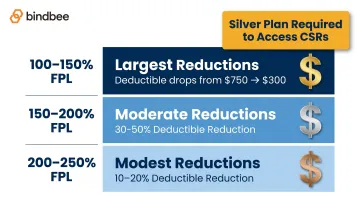
If your income falls between 100% and 250% FPL, you may also qualify for cost-sharing reductions (CSRs) — but only if you pick a Silver-tier plan. Choosing any other metal tier forfeits CSR eligibility even if you otherwise qualify.
CSR tiers work like this:
- 100–150% FPL: Substantially reduced deductibles and out-of-pocket maximums (example: a $750 deductible drops to $300)
- 150–200% FPL: Reduced deductibles and copays, though less aggressively than the lowest tier (typical deductible reductions range from 30–50%)
- 200–250% FPL: Modest reductions to out-of-pocket maximums; deductibles may drop by roughly 10–20% compared to a standard Silver plan
The Medicaid Coverage Gap
In the 10 states that have not expanded Medicaid, adults with income below 100% FPL face a real problem: they earn too much for their state's Medicaid program but too little for Marketplace subsidies (which start at 100% FPL). An estimated 1.4 million people fall into this gap with no affordable coverage pathway.
What Disqualifies You from ACA Subsidies?
Enrolling in a Marketplace plan is open to almost anyone meeting the four basic requirements. Qualifying for subsidies is narrower.
Medicare Enrollment
Anyone enrolled in Medicare Part A or B cannot enroll in a Marketplace plan at all. This is a disqualifier from enrollment itself, not just subsidies. Being eligible for Medicare but not yet enrolled doesn't automatically block Marketplace access.
Medicaid and CHIP Eligibility
You don't have to be enrolled in Medicaid or CHIP to lose subsidy eligibility — eligibility alone is enough to disqualify you. In the 40+ states that expanded Medicaid, adults with income at or below 138% FPL generally qualify for Medicaid and therefore can't receive Marketplace subsidies. The Marketplace application checks this automatically when you apply.
Affordable Employer-Sponsored Coverage
If your employer offers coverage that meets two standards, you're ineligible for subsidies:
- Affordability: The employee-only premium doesn't exceed approximately 9.02% of household income (the 2025 IRS threshold per Rev. Proc. 2024-35)
- Minimum value: The plan covers at least 60% of total allowed costs
If your employer's coverage clears both bars, you don't qualify for Marketplace premium tax credits — even if you'd prefer a Marketplace plan.
Employer-Sponsored Coverage and ACA Eligibility
The Family Glitch Fix
Before 2023, affordability was judged solely on the employee-only premium. If your self-only coverage cost $150/month (deemed affordable), your entire family was locked out of Marketplace subsidies — even if adding dependents to the employer plan cost $800/month.
The IRS finalized a fix effective for tax year 2023: affordability for family members is now assessed based on the cost of employee-plus-family coverage, not just the employee's own premium. If family coverage is unaffordable under that standard, dependents can access Marketplace subsidies even while the employee stays on the employer plan.
Why Real-Time Data Matters for Affordability Calculations
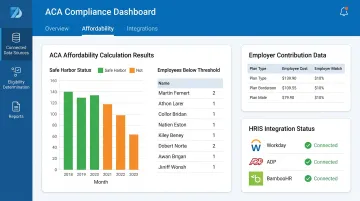
Determining whether employer coverage is "affordable" requires current compensation data, accurate premium contribution figures, and up-to-date enrollment information, all synced together. Benefits administration platforms that do this well rely on live feeds from HRIS and payroll systems rather than manual census files.
Bindbee's unified API connects to 60+ HRIS systems through a single normalized data model, pulling the exact data points affordability calculations require:
- Employee compensation and benefit elections
- Coverage tiers and employer contribution amounts
- ACA hours validation and waiting period calculations
- Benefit class assignment across Workday, ADP, Rippling, Gusto, and UKG
Its eligibility intelligence layer handles these checks so benefits platforms can run ACA affordability tests in real time, rather than waiting for the next batch file export.
Self-Employed Individuals
Without an employer offering coverage, self-employed individuals and small business owners fall entirely outside the employer-plan affordability question. They apply the same 100%–400% FPL framework as any other applicant and report their projected MAGI when enrolling through the Marketplace.
When Can You Enroll?
Open Enrollment
For 2026 coverage, Open Enrollment on the federal Marketplace ran November 1, 2025 through January 15, 2026. Plans selected by December 15 took effect January 1. State-run Marketplaces may set different dates — most follow the same window, but check your state's specific deadline.
Special Enrollment Periods
Outside Open Enrollment, you need a qualifying life event. The window is 60 days before or after the event. Common triggers include:
- Losing job-based coverage
- Getting married or divorced (with coverage loss)
- Having or adopting a child
- Moving to a new ZIP code with different plan options
- Turning 26 and aging off a parent's plan
- Gaining citizenship or lawful presence
- Leaving incarceration
- Income change affecting subsidy eligibility
2025/2026 Enrollment Rule Changes
CMS finalized the Marketplace Integrity and Affordability Rule in June 2025. The key change for enrollees: automatic renewals now require affirmative action. Previously, some plans auto-renewed without enrollee confirmation.
Under the new rule, enrollees who don't respond to eligibility verification requests can have their enrollment terminated rather than automatically continued. Check your Marketplace account before the deadline to confirm your plan is active for the coverage year.
Frequently Asked Questions
How do I know if I qualify for the Affordable Care Act?
The basic test is: U.S. residency, citizenship or lawful presence, not incarcerated, and not enrolled in Medicare. Anyone who meets those criteria can enroll in a Marketplace plan. Subsidy eligibility requires additional income and coverage criteria beyond baseline enrollment.
How much can you earn and still qualify for the Affordable Care Act?
There's no upper income limit to enroll in a Marketplace plan — you can always pay full price. For premium tax credits in 2026, income must fall at or below 400% FPL (reinstated after the enhanced subsidy provisions expired at the end of 2025). Anyone above that cap can still purchase an unsubsidized plan.
Who is eligible for ACA subsidies in 2026?
In 2026, eligibility starts at 100% FPL — households below that threshold are directed to Medicaid instead. You also need to lack access to affordable employer coverage and be ineligible for Medicare, Medicaid, or CHIP. The 400% FPL upper cap (covered above) applies for subsidy eligibility.
Are all Obamacare subsidies ending in 2025?
No. The enhanced subsidies — which removed the 400% FPL cap and increased credit amounts — expired at the end of 2025. The core ACA subsidy framework (covering households from 100%–400% FPL) continues in 2026. Fewer people qualify and amounts are smaller, but the program itself is intact.
What disqualifies you from the Affordable Care Act?
The main disqualifiers for subsidies: Medicare enrollment (also blocks plan enrollment entirely), Medicaid or CHIP eligibility, access to affordable employer-sponsored coverage meeting minimum value standards, incarceration, and undocumented immigration status.
What are the key requirements of the Affordable Care Act?
For Marketplace plans specifically: coverage of 10 essential health benefits, no denial for pre-existing conditions, income-based premium subsidies for eligible enrollees, and annual open enrollment windows.