Introduction
Most claim denials don't happen because a service was poorly documented or medically unnecessary. They happen before a patient ever walks through the door.
According to the Optum 2024 Revenue Cycle Denials Index, registration and eligibility issues account for 24.33% of all hospital claim denials — the single largest denial category across 124 million claim remits analyzed. Each rework attempt costs an average of $103.
60% of those denied claims are never resubmitted, meaning that revenue disappears entirely.
Most of these denials are preventable. Inactive coverage, a dependent not updated, a plan change that didn't sync — none of these require clinical review to catch. They require current data.
Real-time eligibility verification technology has existed for years, yet most platforms still depend on batch checks, manual portal lookups, or periodic file exports. That creates dangerous windows where coverage changes between the last check and the actual service date.
This guide explains exactly how eligibility APIs close that gap — what they query, how they process the response, and which denial categories they directly address.
TL;DR
- Eligibility APIs query payer and enrollment systems in real time to confirm active coverage, benefits details, and dependent status before a claim is submitted.
- Most eligibility-related denials stem from stale data: lapsed coverage, dependent changes not synced, or plan updates that never reached downstream systems.
- APIs automate the verification trigger, normalize data across sources, and flag the specific coverage gaps that drive the most common denial categories.
- The value extends beyond denial reduction — faster clean-claim submission, lower rework costs, and a more predictable revenue cycle.
- APIs built with event-driven triggers, life event webhooks, and multi-system connectivity deliver sustained denial prevention — not just one-time fixes.
What Are Eligibility APIs?
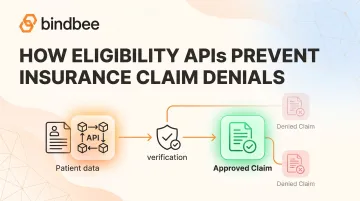
An eligibility API is a software interface that lets a platform programmatically query insurance payer or enrollment data sources to confirm whether a patient or member has active coverage, what their benefits include, and what their cost responsibility looks like — no manual portal lookups or phone calls required.
Under HIPAA Administrative Simplification, CMS adopted the ANSI X12 270 (eligibility inquiry) and 271 (eligibility response) transaction standards for exchanging member eligibility and benefits information. These form the protocol backbone most eligibility APIs are built on.
The Operational Problem They Solve
Benefits and coverage data changes constantly. Employees change jobs. Dependents are added or aged out. Open enrollment creates plan switches. Non-payment lapses coverage. When verification depends on manual lookups or batch file cycles, there's always a lag between when coverage changes and when the billing system catches up.
That lag is where denials live.
Not all insurance APIs do the same thing. Three are commonly conflated:
- Eligibility APIs confirm whether coverage exists and what it includes
- Prior authorization APIs request pre-approval for specific services
- Claims submission APIs transmit completed claims to payers
Eligibility is the upstream check. It determines whether submitting a claim is worth doing at all.
How Eligibility APIs Work to Prevent Claim Denials
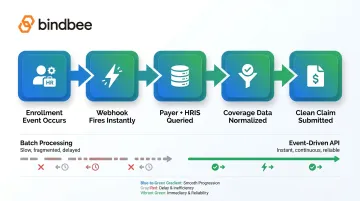
Eligibility APIs operate through a defined sequence: a check is triggered, data is queried, the response is normalized, discrepancies are flagged, and actionable coverage details pass downstream. Each step reduces a specific denial risk.
Triggering the Eligibility Check
Three trigger models exist, and they're not equally effective:
| Trigger Model | When It Runs | Primary Risk |
|---|---|---|
| Point-of-service | At appointment or registration | Coverage may have already lapsed |
| Pre-service | 24–48 hours before visit | Still misses same-day changes |
| Event-driven | When enrollment record changes | Catches changes at the source |
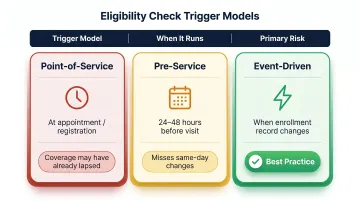
Event-driven triggers are the most underused and highest-impact model. Instead of waiting for a scheduled check, the API fires the moment an enrollment event occurs — a new hire, termination, or dependent change. Manual and periodic triggers create verification windows; event-driven APIs eliminate them.
Bindbee's webhook infrastructure is built on this model. When a termination is recorded in a payroll system, the employee_data_changed webhook fires instantly with the termination date and updated employment status — before any downstream system has time to process a claim against coverage that no longer exists.
Querying Payer and Enrollment Systems
The API queries two distinct data sources:
- Payer systems (via ANSI X12 270/271): confirms active coverage, plan type, benefits scope, and financial accumulators
- Enrollment/HRIS systems: cross-references plan elections, effective dates, and dependent relationships from the source of truth
Complete eligibility APIs query both sides. A payer query alone confirms whether coverage is on file; the HRIS query confirms what was actually elected. Querying only one source misses the mismatches where most eligibility denials originate.
This is the "garbage in, garbage out" problem that trips up single-source verification. If enrollment data entering the payer query is wrong, the response reflects that error. Bindbee solves this upstream — by normalizing data across 60+ HRIS, payroll, and carrier systems through a single API, enrollment data is accurate and current before the payer query fires.
Returning Actionable Coverage Data
A 271 response carries far more than a yes/no on active coverage. The full payload includes:
- Coverage status (active/inactive) with effective and termination dates
- Plan type (HMO, PPO, HDHP, etc.)
- Deductible and out-of-pocket balances
- Copay and coinsurance details by service type
- Dependent coverage relationships and effective dates
- Network participation status
- Pre-authorization requirements by procedure category
The value is in structure and normalization. Output that maps directly to claim submission fields means billing teams act on the response without interpretation. Automated discrepancy flags let the system halt claim creation the moment returned data doesn't match what was entered at registration.
The Denial Categories Eligibility APIs Directly Address
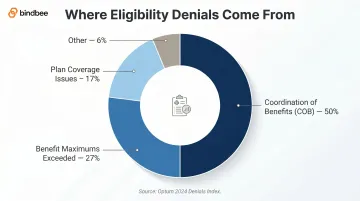
The Optum data breaks down the largest denial category further. Within registration and eligibility denials, the breakdown looks like this:
- Coordination of benefits (COB): 50% of denials
- Benefit maximums exceeded: 27% of denials
- Plan coverage issues: 17% of denials
These aren't abstract categories. Each one has a specific API-based solution.
Inactive or Lapsed Coverage
This is the most straightforward denial type: the patient's coverage ended before the service date, but no one caught it. Job changes, non-payment, and open enrollment lapses are the common culprits.
Real-time eligibility APIs catch inactive status at the point of registration, before service delivery, rather than after the payer rejects the claim on a termination date that was already in their system.
Incorrect Member or Dependent Data
Mismatched member IDs, incorrect dates of birth, or dependent relationships that weren't updated in the payer's system generate rejections on otherwise-clean claims. These mismatches typically originate when life events update the HRIS but don't propagate to the payer — common triggers include:
- Marriage or divorce
- New dependents added at birth or adoption
- Dependent age-out at 26
Eligibility APIs that return dependent-level data surface these discrepancies before submission. Bindbee's Dependent Benefits model covers exactly this gap: plan details, coverage dates, relationship mapping, and effective dates for each dependent, synced in real time from 60+ benefits administration and payroll systems.
Plan Type and Benefit Scope Mismatches
Submitting a claim for an out-of-network provider, an excluded procedure, or a service that's exceeded its visit limit generates a denial that looks like a billing error but is actually an eligibility failure. The coverage existed — just not for that service.
Eligibility APIs that return granular benefit details (service-specific coverage, visit limits, exclusions) let billing teams verify scope before the service is rendered, not after.
Missing Prior Authorization
A clean claim submitted without required pre-authorization will be denied regardless of eligibility status. Eligibility APIs that include authorization requirement flags tell the billing team in advance whether a given service requires pre-auth under the patient's specific plan. That single data point closes the gap before it becomes a denial.
Coordination of Benefits Errors
When a patient has multiple coverage sources, submitting to the wrong primary payer is a leading denial cause. COB accounts for half of all registration and eligibility denials in the Optum data. Eligibility APIs that return COB data identify primary versus secondary payer order before the claim is routed — eliminating the most common single cause of eligibility-related denials before it reaches adjudication.
Where Eligibility APIs Fit in the Revenue Cycle Workflow
Eligibility APIs aren't a billing function. They're a front-end revenue cycle control point positioned between patient registration and service delivery — upstream of claim creation.
That positioning matters because every error caught at registration prevents a cascade of downstream costs:
- Rework labor — $103 per claim, plus staff time on appeals
- Resubmission delay — extends days in A/R and payment cycle
- Write-off risk — 60% of denied claims are never resubmitted
- Patient billing disputes — unexpected bills after coverage verification failures erode trust
A hospital case cited in HFMA research illustrates the scale: by implementing front-end interventions on just 64 of 9,000 ED encounters, the organization prevented $37,000 in losses — a ratio that grows significantly at higher claim volumes.
Where an API connects determines what it can actually catch. The three primary integration touchpoints are:
Integration touchpoints where eligibility APIs connect:
- EHR and practice management systems — provider-side workflows at registration
- Benefits administration platforms — employer/member-side enrollment data
- Clearinghouses — claim validation before payer submission
The breadth of that integration surface determines how many denial categories the API can intercept. Payer-only connections miss enrollment mismatches from the HRIS side; HRIS-only connections miss payer-side coverage changes. Effective denial prevention depends on visibility into both.
What to Look for in an Eligibility API Solution
Real-Time and Event-Driven Sync
Batch-only verification creates the exact coverage windows that generate denials. Look for APIs that support both on-demand real-time queries and event-driven triggers for life events — new hire enrollment, dependent additions, and terminations.
Bindbee's webhook infrastructure fires on each of these events the moment a record changes in the source HRIS or payroll system. When ThrivePass switched from batch 834 file processing to real-time Bindbee webhooks, onboarding time dropped from 6 weeks to under 1 week and the eligibility data gaps that came with monthly file cycles disappeared entirely.
Multi-System Connectivity and Normalized Data Models
The broader an API's reach across payer networks, HRIS systems, and carrier platforms, the fewer gaps remain in coverage verification. Evaluate vendors on:
- Number of connected systems (including long-tail and legacy platforms)
- How data is normalized across sources into consistent schemas
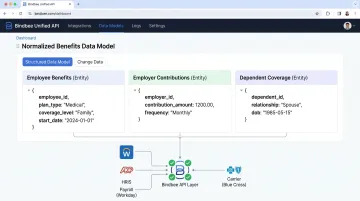
- Whether benefits data uses distinct models for Employee Benefits, Employer Benefits, and Dependent Benefits — or flattens everything into a single employee record
- Whether legacy file-based systems are handled via an SFTP-to-API bridge that normalizes flat file exports through the same unified interface
Generic employment APIs often collapse benefits data into a single employee object, losing the family coverage structure, dependent relationships, and plan-specific details that eligibility accuracy depends on.
Bindbee's benefits-first data models maintain these as separate, structured entities. Platforms like Newfront report 100% data coverage across all client HRIS systems after switching to Bindbee, where prior approaches left gaps in dependent and enrollment data.
Security, Compliance, and Audit Trail
Eligibility data includes sensitive PHI. Non-negotiable requirements:
- HIPAA compliance with a signed BAA covering eligibility transactions
- SOC 2 Type II for operational security controls
- ISO 27001 for information security management
- Audit logs of every eligibility query — for internal QA and post-payment audit defense
Bindbee holds SOC 2 Type II and ISO 27001 certifications and is HIPAA compliant, with full query logging across every sync and data change.
Frequently Asked Questions
Why is verifying insurance eligibility and benefits essential before rendering services?
Without pre-service verification, providers may deliver care against inactive or mismatched coverage — causing denied claims, delayed payment, and billing disputes that are entirely avoidable. Catching an eligibility error before service takes seconds; reworking a denied claim costs $103 and often results in no recovery.
What are three reasons why an insurance claim may be denied?
The three most common eligibility-related denial causes are:
- Inactive or lapsed coverage at the time of service
- Member or dependent data mismatches between the claim and payer records
- Missing prior authorization for services requiring pre-approval under the patient's plan
What data does an eligibility API typically return?
A complete eligibility response includes active coverage status, effective and termination dates, plan type, deductible and out-of-pocket balances, copay and coinsurance details, dependent coverage relationships, network participation status, and pre-authorization requirements by service type.
How does real-time eligibility verification differ from manual or batch verification?
Manual lookups are slow and error-prone; batch verification runs on a schedule, leaving a window where coverage can change before the service date. Real-time API verification queries live payer data at the moment of need, closing the stale-data gap where most eligibility denials originate.
Can eligibility APIs integrate with existing HRIS, EHR, or benefits administration systems?
Modern eligibility APIs connect via standard protocols, and unified API platforms normalize eligibility data across multiple HRIS, payroll, and carrier systems through a single integration — reducing the need to maintain separate connections per data source and ensuring coverage data stays current regardless of where the source record lives.
What happens to claims when eligibility data isn't updated after a life event like a termination or dependent change?
When enrollment records aren't synced after a life event, claims get submitted under coverage that's already been terminated or modified — producing denials that, in 60% of cases, never get resubmitted. Event-driven eligibility APIs with webhook notifications prevent this by triggering an immediate data refresh the moment a source record changes.