

Payroll Software Integration for Efficient HR and Payroll Operations
Summarise the blog with AI
Have you ever felt like payroll day turns into a manual slog of spreadsheets, corrections, and frantic reconciliations? You are not alone. Modern HR, payroll, and benefits teams are increasingly struggling because systems do not talk to each other, forcing repetitive work that steals time from strategic initiatives.
Recent industry data shows that only 41% of employers are satisfied with the connectivity between their HR systems. At the same time, many teams spend hours each week on manual data entry, error handling, and reconciliation. These inefficiencies increase operational cost and slow down payroll cycles, making accurate, compliant payroll harder than it should be.
In this blog, you’ll learn what payroll software integration is, why it matters, how it works, and best practices to improve payroll accuracy and efficiency.
Key Takeaways
- Faster Payroll Cycles: Automated data flows eliminate manual entry, enabling payroll teams to process salaries more quickly and accurately.
- Improved Data Accuracy: Integration ensures consistent employee records across HRIS, payroll, and benefits systems, reducing errors and compliance risks.
- Reduced Engineering and Administrative Load: Standardized connectors and APIs minimize the need for custom scripts and manual maintenance, freeing teams for strategic initiatives.
- Scalable Operations: Integrated systems support multiple departments, subsidiaries, or locations without disrupting workflows or reporting.
- Enhanced Employee Experience: Accurate, timely payroll and self-service options increase employee trust and satisfaction.
What is Payroll Software Integration?
Payroll software integration connects payroll systems with other employment-related platforms, such as HRIS (Human Resource Information Systems), ATS (Applicant Tracking Systems), time-tracking, and benefits software. This ensures automatic data synchronization, workflow automation, and centralized reporting.
Example: If an employee’s work hours are recorded in a time-tracking system, payroll integration automatically imports those hours into the payroll system without manual intervention. This reduces errors and administrative overhead.
Now let’s explore the tangible benefits payroll software integration can deliver across HR, payroll, and tech teams.
5 Key Benefits of Payroll Software Integration
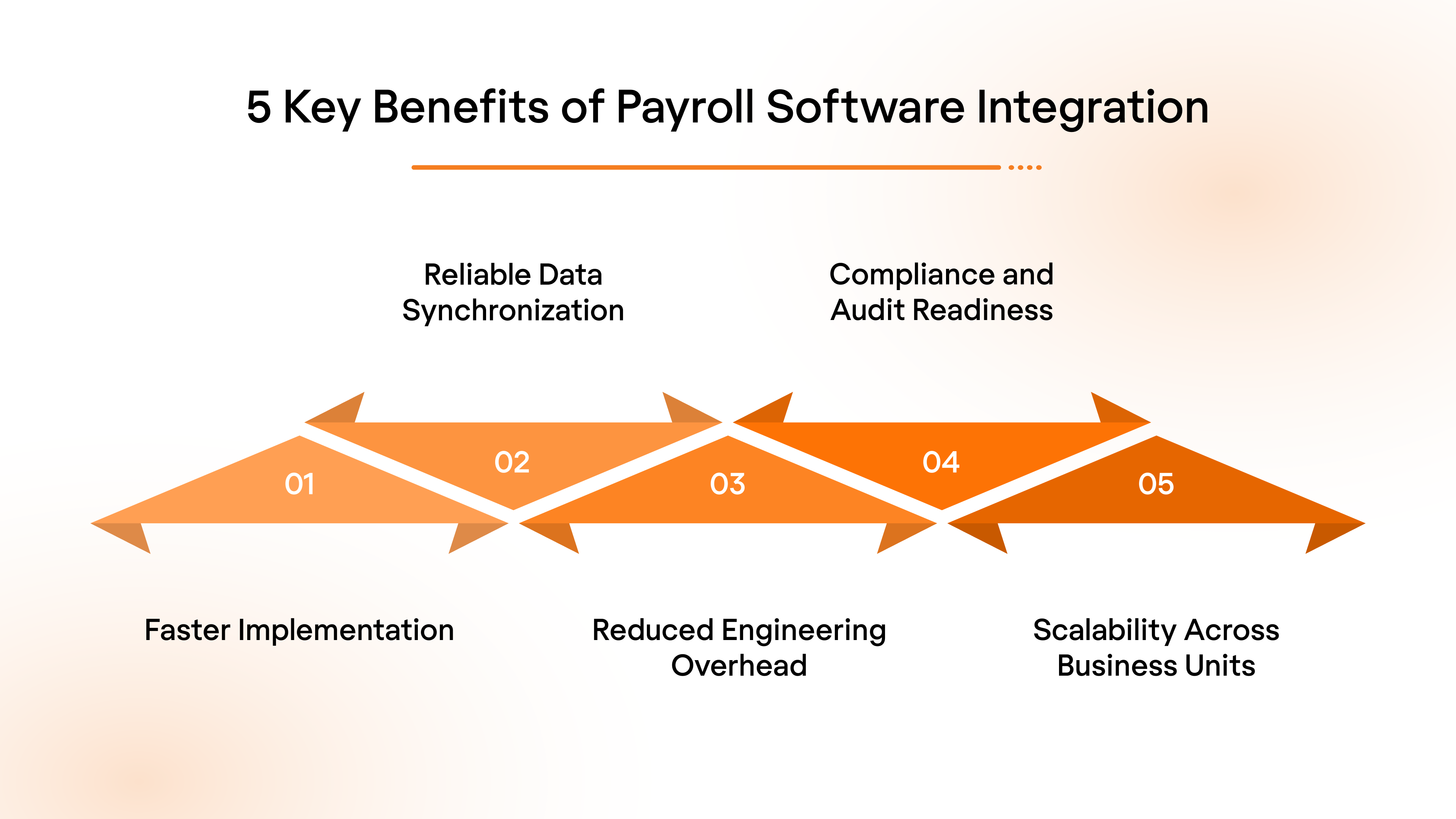
Integration is not just about connecting systems. It enables HR and payroll teams to operate more efficiently, maintain accuracy, and scale processes as organizations grow. Below, we break down the core benefits with actionable points.
1. Faster Implementation
Pre-built connectors and API-driven integrations drastically reduce setup time, allowing payroll processes to be deployed across departments without weeks of manual configuration.
How It Helps:
- Pre-built connectors and APIs enable rapid deployment of payroll systems, minimizing the need for extensive custom development.
- Organizations can onboard new employees and quickly sync historical data, ensuring payroll accuracy from day one.
- Multiple departments can implement payroll processes simultaneously without disrupting ongoing operations.
2. Reliable Data Synchronization
Integrated systems ensure that updates in employee records flow automatically across all connected platforms, reducing errors and improving payroll accuracy.
How It Helps:
- Changes to employee profiles, such as salary adjustments or leave updates, are reflected across all systems in real time.
- Automated synchronization eliminates duplicate entries and prevents misreported benefits or payroll errors.
- Accurate integration between HRIS, payroll, and time-tracking systems ensures consistent compliance and reporting.
3. Reduced Engineering Overhead
Integration platforms manage data mapping, monitoring, and maintenance, freeing engineering teams from repetitive tasks and allowing them to focus on strategic initiatives.
How It Helps:
- Automated workflows handle data transformations and error detection, reducing the need for manual intervention.
- Engineering teams spend less time maintaining point-to-point scripts and more time on high-value projects.
- Systems remain reliable even during updates or scaling across new departments or locations.
4. Compliance and Audit Readiness
Centralized payroll and HR data improve reporting accuracy and ensure audit readiness while maintaining regulatory compliance.
How It Helps:
- Payroll integration ensures accurate tax calculations and consistent application of labor regulations.
- Centralized data storage simplifies audits and reduces the risk of compliance penalties.
- Automated tracking of benefits, deductions, and employee status minimizes human error and supports reporting requirements.
5. Scalability Across Business Units
Integrated payroll systems can adapt as organizations expand, supporting multiple subsidiaries, locations, or employee types without disrupting workflows.
How It Helps:
- Payroll processes can accommodate growth, including new legal entities or international teams, without manual reconfiguration.
- Standardized workflows ensure consistency across departments and reduce administrative overhead during scaling.
- Centralized reporting provides clear insights across business units, enabling strategic decision-making.
Also Read: Everything You Need to Know About Payroll API Integration
Understanding these benefits is crucial, but how does payroll software integration actually work under the hood? Let’s explore the fundamental mechanisms that make these integrations reliable and scalable.
How Payroll Software Integration Works
Payroll software integration connects HR, payroll, time-tracking, benefits, and accounting systems to enable accurate, real-time data flow. This is typically achieved using APIs, middleware platforms, or embedded connectors, depending on system architecture.
Below are the primary integration approaches for connecting payroll systems effectively:
1. API-Based Integration
APIs (Application Programming Interfaces) allow systems to communicate directly, exchanging structured data in real time.
How It Works:
- Employee data, such as new hires, salary changes, or leave requests, is automatically pushed from HRIS to the payroll system.
- Payroll events, like bonuses or deductions, are instantly reflected in connected benefits and accounting platforms.
- APIs support validation rules, ensuring that only accurate, compliant data flows between systems and minimizing errors and exceptions.
Why It Matters: API-based integration is ideal for organizations that need real-time accuracy, frequent updates, and control over complex workflows without relying heavily on manual intervention.
2. Middleware Platforms
Middleware platforms act as an intermediary layer that standardizes and translates data formats between systems that may not natively communicate.
How It Works:
- Employee, payroll, and benefits data are extracted from source systems and converted into a format the target system can understand.
- Complex workflows spanning multiple applications, such as integrating time-tracking, HRIS, payroll, and finance systems, can be orchestrated centrally.
- Middleware ensures error handling, logging, and automated retries, preventing payroll or HR data loss or misalignment.
Why It Matters: Middleware is best suited for organizations with heterogeneous or legacy systems, enabling data consistency across platforms without modifying each system individually.
3. Embedded Connectors
Embedded connectors are pre-built integrations offered by payroll software vendors for commonly used HR, benefits, and accounting systems.
How It Works:
- Out-of-the-box connectors automatically map fields such as employee name, hours worked, salary, benefits, and tax deductions.
- Setup requires minimal configuration, reducing implementation time from weeks to days.
- Some connectors include monitoring dashboards to alert HR teams of any failed data transfers or discrepancies.
Why It Matters: Embedded connectors are ideal for organizations seeking low-maintenance, quick-to-deploy solutions that still maintain accurate data flow without heavy IT involvement.
Example: To illustrate how integration works end-to-end:
- An employee logs hours in a time-tracking system.
- The integration platform retrieves these hours via API or middleware.
- Payroll software automatically calculates gross pay, deductions, and benefits.
- Calculated payroll data is sent to accounting for financial reconciliation and reporting.
- Any errors, like missing employee records or invalid hours, trigger alerts for immediate correction before payroll is finalized.
Platforms like Bindbee simplify payroll integration by offering a unified layer for HRIS, payroll, benefits, and accounting systems. Standardized connectors replace custom builds, reducing implementation time, ongoing maintenance, and operational risk as integrations scale.
With a clear picture of how payroll software integration functions, the next step is to consider best practices for implementation to ensure smooth adoption and long-term efficiency.
Best Practices for Implementing Payroll Software Integration
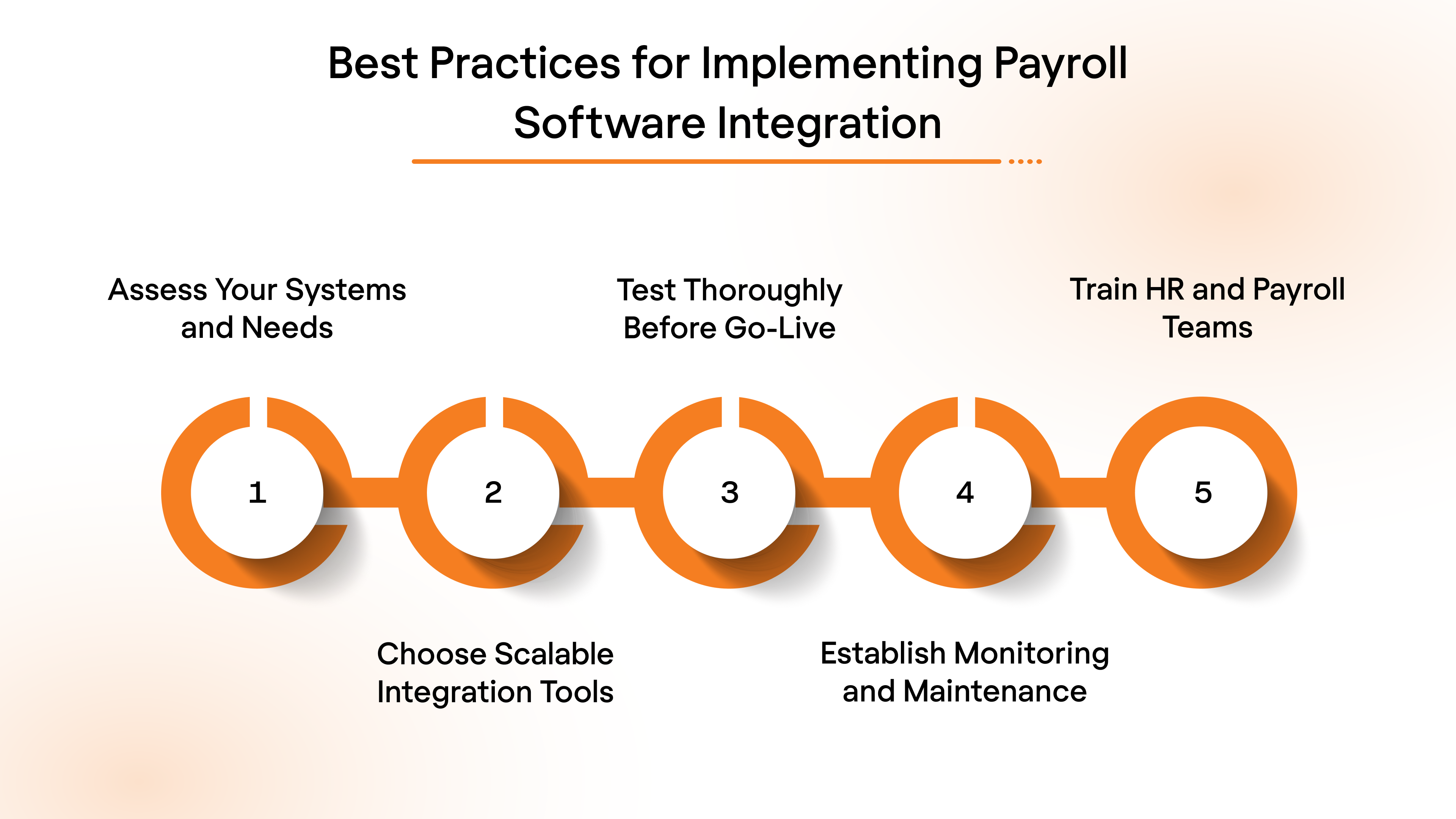
Even the most advanced payroll integration tools can fail without careful planning and execution. Following best practices ensures accuracy, efficiency, and long-term ROI while minimizing disruptions to HR and payroll operations.
1. Assess Your Systems and Needs
A clear understanding of all platforms and workflows is critical before starting integration.
How It Helps:
- Identify all HR, payroll, benefits, time-tracking, and accounting systems that require integration and prioritize based on business impact.
- Document current workflows, data dependencies, and points of friction to determine where automation will deliver the most value.
- Evaluate data formats, validation rules, and reporting requirements to prevent errors and ensure smooth end-to-end processes.
2. Choose Scalable Integration Tools
Select tools that not only meet current requirements but can also adapt to organizational growth and changing business needs.
How It Helps:
- Opt for platforms with pre-built connectors, low-maintenance APIs, and comprehensive monitoring features for ongoing reliability.
- Ensure the solution supports future expansion, including new departments, geographies, or systems, without requiring major reconfiguration.
- Verify vendor support for version updates, error handling, and customization options to maintain seamless integration over time.
3. Test Thoroughly Before Go-Live
End-to-end testing is essential to confirm that data flows, calculations, and exception handling work as intended.
How It Helps:
- Conduct payroll simulations using real-world scenarios, including adjustments, leave, bonuses, and terminations.
- Validate that data is accurately synchronized across HRIS, payroll, benefits, and accounting systems.
- Test alerts and exception-handling mechanisms to ensure potential errors are flagged before impacting payroll cycles.
4. Establish Monitoring and Maintenance
Proactive monitoring of integrations prevents errors from escalating and keeps systems aligned.
How It Helps:
- Implement automated alerts for failed data transfers, mismatched records, or processing delays.
- Regularly review and audit integrations to account for system updates or new regulatory requirements.
- Maintain clear documentation for troubleshooting, workflow changes, and historical reference, ensuring operational continuity.
5. Train HR and Payroll Teams
Even the best technology fails without knowledgeable users who understand workflows and responsibilities.
How It Helps:
- Provide detailed guidance on daily operations, exception handling, and reporting procedures.
- Encourage collaboration between HR, payroll, and IT teams to resolve issues quickly and maintain accuracy.
- Offer refresher training whenever system updates, new workflows, or additional platforms are introduced.
Also Read: HCM–Payroll Integration Explained: Key Benefits & Implementation Steps
Implementing these best practices reduces errors and ensures smooth adoption, helping organizations streamline payroll integration. Equally important is measuring impact; let’s examine the key metrics for evaluating integration success.
Measuring the Impact of Payroll Software Integration
Payroll integration delivers value only when its outcomes are measurable across accuracy, efficiency, and operational load. The following metrics help quantify real-world impact and support data-backed investment decisions.
- Error Reduction Rate: This measures the reduction in payroll errors, such as incorrect pay, tax miscalculations, or mismatches in employee data. Comparing error frequency before and after integration highlights how effectively automation replaces manual data handling.
- Processing Time Savings: Processing time savings reflect how much faster payroll cycles are completed once systems are integrated. Automated data flows remove manual imports and reconciliations, enabling payroll teams to close cycles with fewer delays and rework.
- Engineering Time Freed: This metric tracks the reduction in engineering effort required to maintain payroll integrations. Using managed connectors and standardized APIs reduces the need for custom scripts and ongoing fixes, freeing teams for higher-impact work.
- Data Accuracy and Compliance Alignment: This evaluates whether payroll data consistently meets regulatory and audit requirements. Integrated systems apply tax, benefits, and labor rules uniformly, lowering compliance risk and correction costs.
- Employee Satisfaction Indicators: Employee satisfaction is reflected in fewer payroll-related tickets and correction requests. Reliable integrations ensure employees are paid accurately and on time, improving trust in payroll operations.
These metrics allow HR, payroll, and technology leaders to validate integration ROI, identify areas for improvement, and guide continuous optimization. The next step is understanding how emerging trends will further shape payroll software integration strategies.
Future Trends in Payroll Software Integration
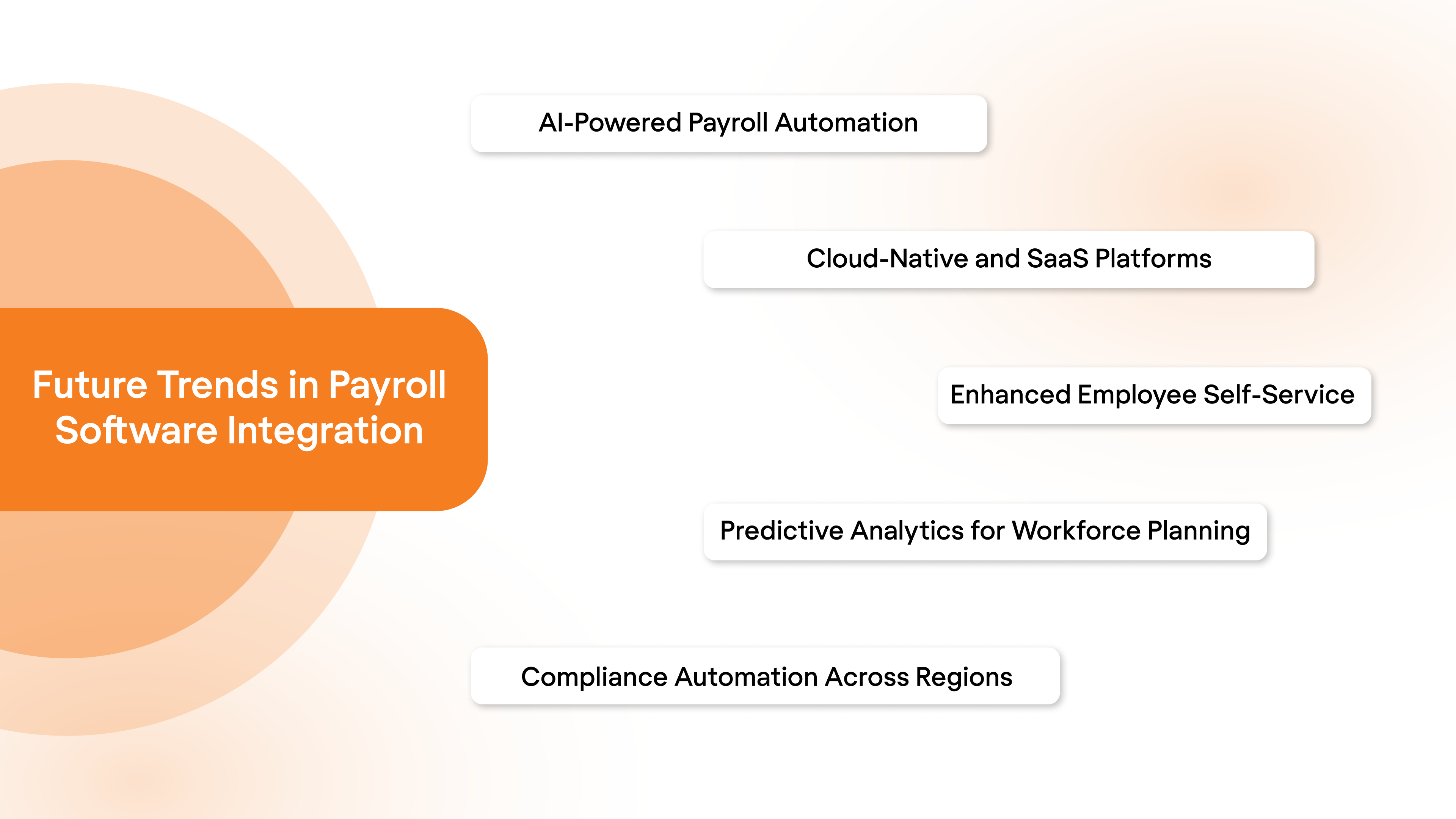
Payroll software integration is undergoing significant advancements, fueled by automation, AI, and the demand for seamless cross-platform connectivity. Staying aware of emerging trends enables organizations to anticipate changes, optimize workflows, maintain compliance, and enhance the employee experience.
1. AI-Powered Payroll Automation: AI manages complex calculations, predicts anomalies, and automates repetitive approvals. It flags compliance risks, streamlines payroll workflows, and delivers faster, more accurate payroll with actionable insights.
2. Cloud-Native and SaaS Platforms: Cloud-based payroll systems allow real-time access across locations without heavy on-premise infrastructure. SaaS platforms offer scalable APIs, pre-built connectors, and automatic updates. This supports global expansion while ensuring accuracy and compliance.
3. Enhanced Employee Self-Service: Self-service portals let employees view payslips, request leave, and update information in real time. Changes automatically sync across HR and payroll systems. This reduces HR workload and improves employee satisfaction.
4. Predictive Analytics for Workforce Planning: Payroll data feeds predictive models for staffing, overtime, and benefits planning. Organizations can forecast costs and proactively optimize labor allocation. Payroll becomes a strategic tool rather than a purely transactional process.
5. Compliance Automation Across Regions: Integration platforms now enforce tax and labor regulations automatically across jurisdictions. This reduces audit risks and manual oversight. Businesses can scale confidently without extensive legal intervention.
Businesses that adopt these trends early can shorten payroll cycles, improve data accuracy, and reduce operational overhead. At the core is reliable data flow across systems, which helps streamline payroll integration. Let’s see how Bindbee supports this through a unified integration layer.
Scalable Payroll Integration Starts With Bindbee
Separately managing onboarding data and payroll introduces errors, delays, and compliance risks. Bindbee delivers clean, normalized, payroll-ready data from 60+ HRIS, ATS, and payroll systems. Instead of managing one-off connectors and reconciling mismatched fields, your team works with a single, consistent dataset that payroll can trust from day one.
Here’s how Bindbee’s unified API supports scalable payroll‑onboarding workflows:
- Deep, Standardized Employment Data Model: Bindbee’s unified model covers employees, jobs, time entries, benefits, deductions, contributions, payroll runs, and more. Field mismatches, missing objects, and naming inconsistencies are resolved upstream.
- Connect with any HRIS, Payroll & ATS tool in Minutes: With Magic Link and the embeddable SDK, customers can instantly link their HRIS or payroll system from your product with no front-end coding needed.
- Real-Time + Daily Sync Options for Live Payroll Operations: Bindbee syncs workforce changes as they occur and runs stable daily loads for high-volume data. New hires, comp changes, time entries, benefits updates, and termination data stay continuously aligned.
- Issue Detection and Self-Healing Integrations: Bindbee’s Logs and Issues surface integration failures without requiring code changes. Automated retries and workflow repairs prevent most problems before they reach customers.
- Webhooks for Critical Events: Create webhooks in a few clicks to track sync events, downtime, or high-impact changes. This gives engineering and payroll teams real-time visibility into upstream data.
- Enterprise-Ready Security and Deployment Options: Bindbee is SOC 2, ISO, GDPR, and HIPAA compliant, with optional on-prem deployment and multi-geo data residency.
Together, these capabilities give your team what they’ve always needed: a single, consistent data layer that works across every employer system. Book a demo to see Bindbee in action.
FAQs
1. What is the difference between payroll software and payroll software integration?
Payroll software handles calculations and disbursements; integration connects that software with HR, time, benefits, and finance systems to avoid manual data transfers and errors.
2. How long does a typical payroll integration project take?
Timelines vary by complexity and the systems involved, but with pre‑built connectors, most implementations can be completed in weeks rather than months, compared with custom integrations.
3. Can payroll integration improve compliance with tax and labor laws?
Yes. Integrated systems automatically propagate changes in employee status, pay, and benefits into payroll calculations, minimizing manual compliance mistakes.
4. What are common pitfalls during payroll software integration?
Misaligned data fields, outdated legacy systems without APIs, and insufficient testing can cause failures or sync errors during high‑volume payroll runs.
5. How does payroll integration impact employee experience?
By reducing errors, late payments, and inconsistencies, integrated payroll systems improve trust and employee satisfaction while freeing HR teams to focus on strategic work.