

Payroll System with Employee Onboarding Integration Simplified
Summarise the blog with AI
Did you know nearly one in five payroll runs contains an error, and each mistake costs businesses an average of $291 to fix? For growing teams, these costs often surface during employee onboarding.
When employee data moves manually from offer letters to payroll systems, errors are almost inevitable. HR teams chase corrections, finance teams fix compliance gaps, and new hires start their journey frustrated. Payroll–onboarding integration solves this by automatically syncing employee data across systems, eliminating manual re-entry, and ensuring payroll accuracy from day one.
In this blog, you'll learn how a payroll system with employee onboarding integration reduces errors, saves time, ensures compliance, and improves the employee experience.
At a Glance
- What Payroll-Onboarding Integration is: An automated data flow that transfers new-hire onboarding data directly into payroll systems without manual intervention.
- Why It Matters: Manual onboarding-to-payroll handoffs cause payroll errors, delays, and compliance gaps from the first pay cycle.
- Where Integrations Fail: Duplicate data entry, incomplete tax and bank details, unclear system ownership, and missing validation rules.
- How to Integrate Properly: Define systems of record, standardize onboarding fields, validate inputs, automate sync triggers, enforce cutoffs, test with real hires, and monitor failures.
- Best Integration Methods: Native connectors, direct APIs, iPaaS, file-based transfers, and unified APIs. Unified APIs reduce build time and maintenance.
- Business Impact: Accurate first payroll, fewer corrections, stronger compliance, reduced HR effort, and improved new-hire experience.
What is a Payroll System with Employee Onboarding Integration?
A payroll system with employee onboarding integration is a tightly coupled workflow in which employee data captured during hiring serves as the authoritative input for payroll. Instead of re-entering information after onboarding, employee records move automatically and consistently into payroll systems.
This integration ensures:
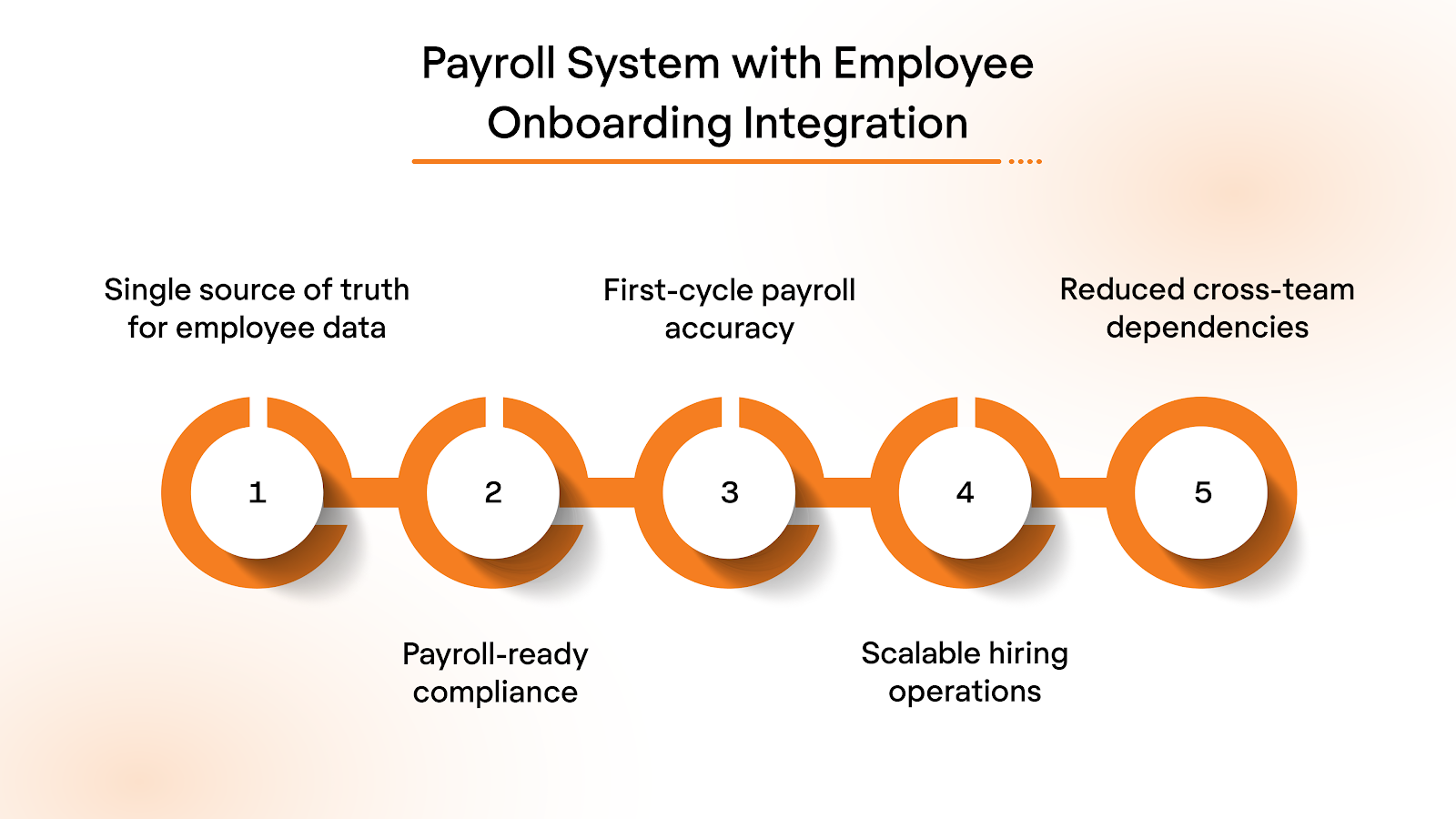
- Single source of truth for employee data: Personal details, compensation, tax declarations, and bank information are captured once during onboarding and reused across payroll cycles without duplication.
- Payroll-ready compliance from day one: Statutory identifiers, tax regimes, benefit eligibility, and deduction rules are validated at onboarding, reducing downstream compliance risks and retroactive corrections.
- First-cycle payroll accuracy: New hires are included correctly in their first payroll run, avoiding off-cycle payments, manual adjustments, and employee dissatisfaction.
- Scalable hiring operations: As headcount grows, payroll setup remains consistent and auditable without increasing HR or payroll workload.
- Reduced cross-team dependencies: HR, payroll, and finance teams operate on a synchronized data set, while engineering teams avoid brittle, one-off integrations.
In practice, this integration replaces manual handoffs with structured, validated data flows, enabling accurate payroll processing at scale. Next, we will examine practical approaches for effectively implementing onboarding and HR software integration with payroll.
Methods to Integrate Payroll System with Employee Onboarding
There is no one-size-fits-all approach to integrating employee onboarding with payroll. The correct method depends on hiring volume, compliance complexity, system landscape, and engineering capacity.
Below are the most common integration approaches, along with when each one makes sense:
1. File-Based Integration
Onboarding data is exported as structured files, such as CSV or XML, and periodically uploaded into payroll systems. While simple to implement, this method introduces delays, version mismatches, and the need for manual intervention, making it unsuitable for teams with frequent hires or strict compliance requirements.
2. Native HRMS-Payroll Connectors
These are prebuilt integrations provided by HR or payroll vendors to automatically sync onboarding data. They reduce setup time but often lack flexibility, struggle with complex compensation structures, and offer limited support for multi-entity or multi-country payroll scenarios.
3. Direct API Integration
Custom API connections push onboarding data directly into payroll systems with full control over data mapping and validation. This approach provides precision and flexibility but requires ongoing engineering effort to manage API changes, error handling, and regulatory updates.
4. iPaaS (Integration Platform as a Service)
iPaaS platforms act as middleware to orchestrate data flows between onboarding and payroll systems. They accelerate integration compared to custom builds, but add operational complexity and can obscure failures without careful monitoring.
5. Unified APIs
Unified APIs provide a standardized data model and a single integration layer across multiple payroll and onboarding systems. This method minimizes engineering overhead, simplifies compliance handling, and scales reliably as hiring volume and system complexity increase.
Also Read: Everything You Need to Know About Payroll API Integration
Once the integration is implemented, the tangible benefits for HR, payroll, and finance teams become apparent. Let us take a closer look.
What You Gain from True Payroll-Onboarding Integration
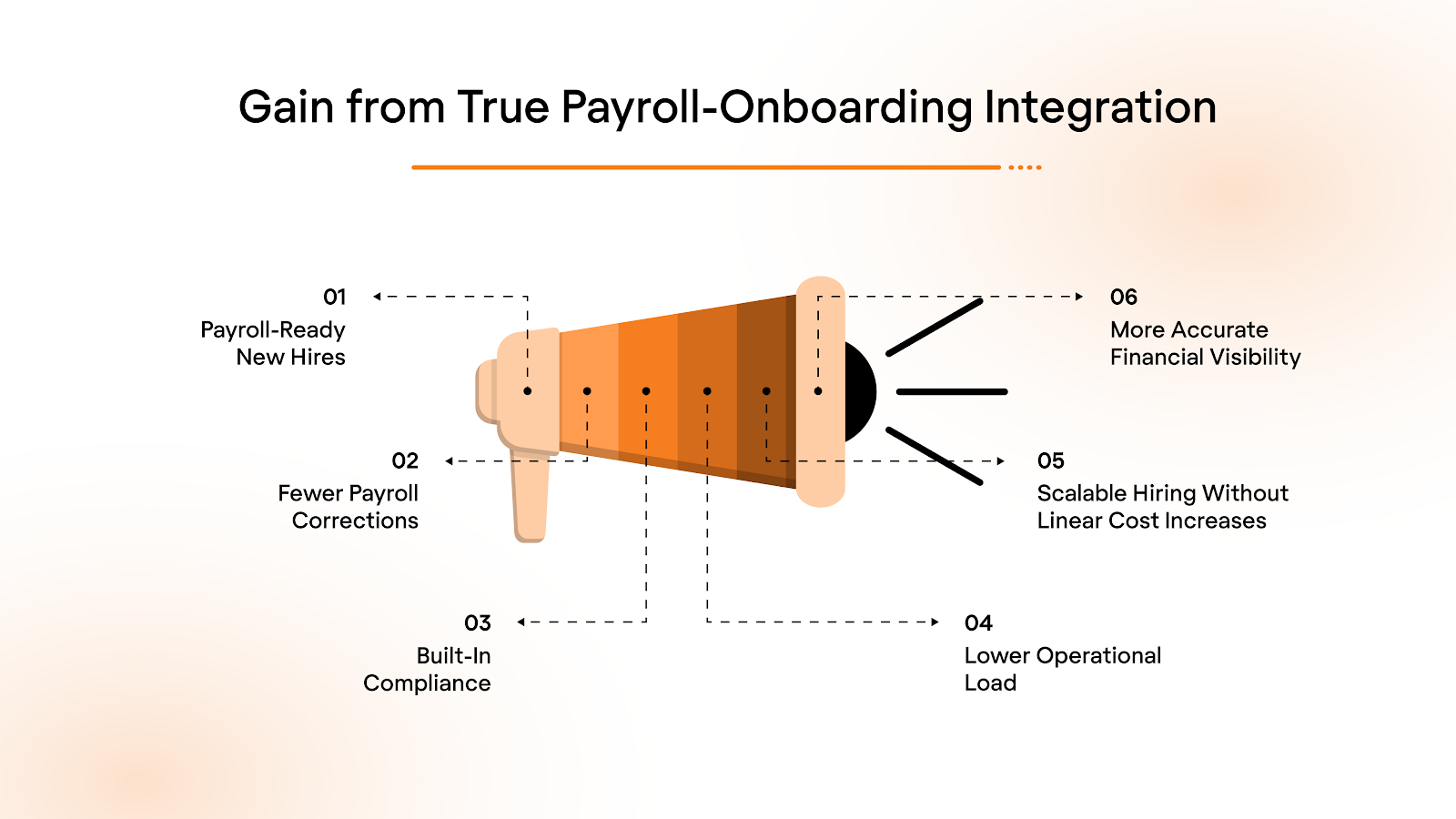
Comprehensive payroll–onboarding integration establishes a controlled, validated data flow where employee information is captured once, verified early, and reused reliably across payroll cycles. This reduces operational risk, strengthens compliance, and supports hiring at scale without increasing manual effort.
Here are the key benefits of implementing a payroll system with employee onboarding integration:
- Payroll-Ready New Hires from the First Cycle: New employees enter payroll with complete compensation, tax, bank, and benefits data already validated. This eliminates missed payments, off-cycle runs, and last-minute fixes during payroll processing.
- Fewer Payroll Corrections and Re-Runs: By removing duplicate data entry and enforcing validation during onboarding, organizations significantly reduce correction workflows, reversals, and retroactive adjustments that drain payroll and finance teams.
- Built-In Compliance at the Point of Hire: Statutory fields, tax regimes, contribution rules, and eligibility checks are captured and verified during onboarding. This minimizes downstream compliance gaps and reduces exposure during audits.
- Lower Operational Load Across Teams: HR, payroll, and finance teams no longer rely on manual handoffs or reconciliations. Clear system ownership and automated syncs reduce coordination overhead and support cleaner operations.
- Scalable Hiring Without Linear Cost Increases: As hiring volume grows, onboarding-to-payroll workflows remain consistent and auditable. The cost and effort per hire stay stable, even as headcount scales.
- More Accurate Financial Visibility: Finance teams gain timely, reliable insight into payroll liabilities, hiring costs, and compensation changes without reconciling multiple systems or spreadsheets.
Also Read: HCM–Payroll Integration Explained: Key Benefits & Implementation Steps
With the advantages clear, here’s a step-by-step look at how onboarding and HR software integration enables data to flow seamlessly into payroll, ensuring every new hire is payroll-ready from day one.
How Payroll-Onboarding Integration Works
Payroll-onboarding integration is a structured workflow that ensures employee data captured during hiring flows seamlessly into payroll. By validating and automating this data transfer, organizations reduce errors, ensure compliance, and make new hires payroll-ready from day one.
1. New Hire Created in Onboarding Tool
The employee completes all required forms and uploads documents, including personal information, tax forms, bank details, and benefit elections.
What to do:
- Ensure all mandatory fields are completed, and documents are uploaded before submission.
- Standardize field formats across locations and employee types to prevent mismatches.
2. Data Flows to Payroll System
Integration mechanisms like APIs, webhooks, or middleware automatically push verified onboarding data into payroll software.
What to do:
- Map all onboarding fields to corresponding payroll fields before syncing.
- Set up automated triggers to push data immediately after onboarding completion.
- Monitor initial syncs to catch mapping errors or failures early.
3. Automated Verification
Critical payroll fields are automatically validated, including tax IDs, banking information, benefits eligibility, and statutory compliance.
What to do:
- Define validation rules for mandatory fields, formats, and compliance requirements.
- Configure alerts for any discrepancies detected during automated checks.
- Periodically review validation logic to ensure alignment with changing regulations.
4. Payroll Ready on Day One
New hires appear fully configured in payroll, with salary schedules, benefits deductions, and statutory contributions applied accurately.
What to do:
- Confirm new hires are correctly included in the upcoming payroll cycle.
- Review first-cycle payroll reports for accuracy before final approval.
- Document exceptions and resolutions to refine onboarding-to-payroll workflows.
Note: Most integrations rely on REST APIs, webhooks, or iPaaS platforms. Middleware tools such as Zapier or custom API endpoints facilitate seamless synchronization while supporting validation, error handling, and audit logging.
Even with a solid integration plan, obstacles can arise. Let’s examine the common challenges and how to tackle them before they disrupt payroll accuracy.
The Biggest Challenges in Payroll-Onboarding Integration
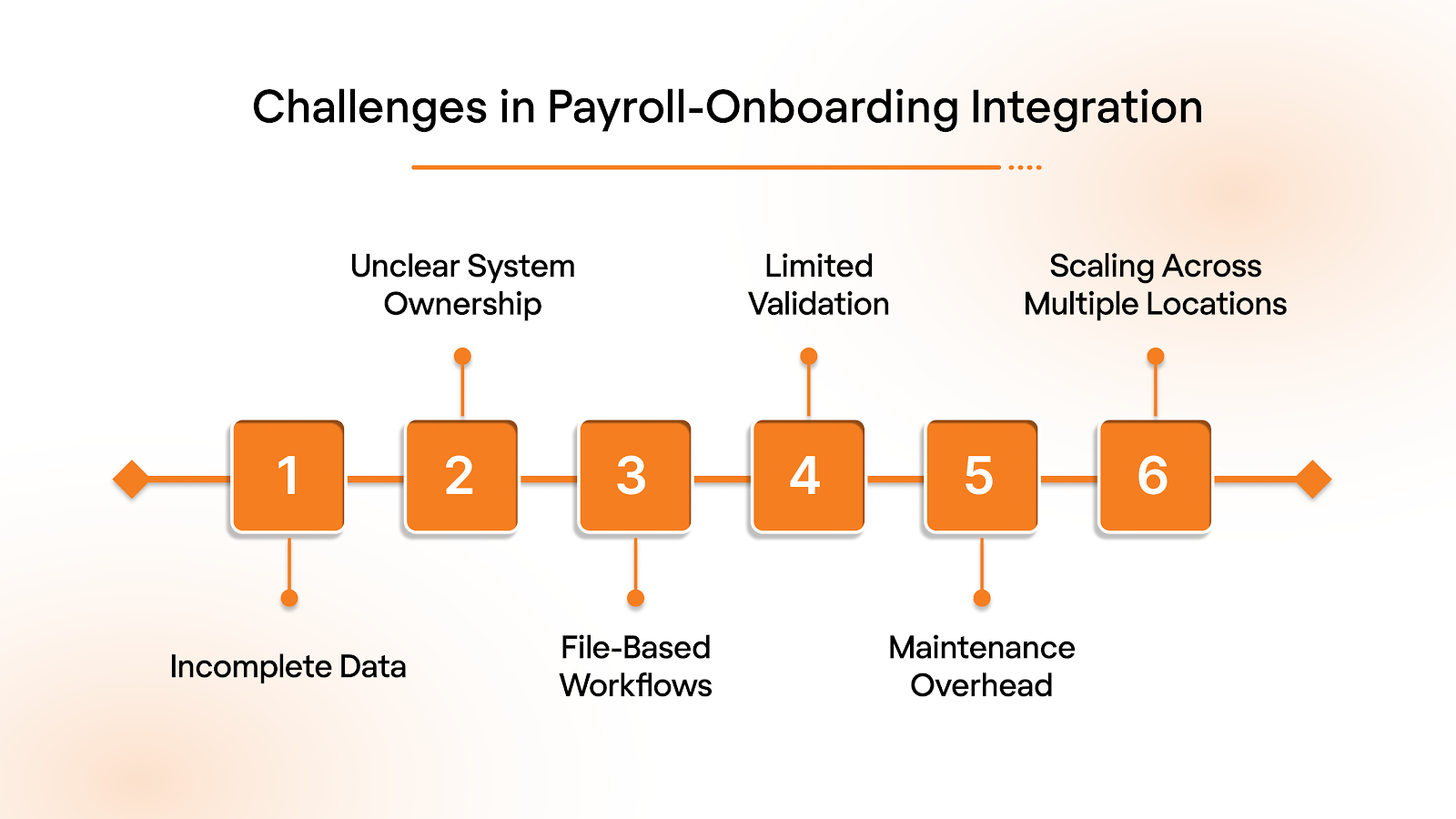
Integrating onboarding and payroll systems is not without obstacles. Misaligned data, unclear responsibilities, manual workflows, and system complexities can undermine accuracy, compliance, and efficiency. Understanding these common challenges helps organizations design integrations that minimize errors and scale reliably.
- Inconsistent or Incomplete Data: Onboarding tools and payroll systems often store data in different fields. Missing tax IDs, incomplete bank info, or mismatched employee records can cause payroll errors and manual reconciliation.
- Unclear System Ownership: Without clearly defined ownership, HR, payroll, and finance teams may assume someone else is responsible for data accuracy, leading to duplication, delays, and compliance risks.
- Manual Handoffs and File-Based Workflows: File exports, spreadsheets, or email-based handoffs introduce delays, version conflicts, and human errors, creating repeated corrections and off-cycle payroll runs.
- Limited Validation and Error Handling: Many integrations lack strong validation rules and error-handling mechanisms. Errors detected late in payroll cycles require costly re-runs and increase operational workload.
- Scaling Across Multiple Locations or Systems: Organizations with multiple entities, countries, or HR/payroll platforms face added complexity. Differences in statutory rules, pay schedules, and currencies can break integrations without careful configuration.
- Maintenance Overhead: Custom APIs or middleware require ongoing updates when payroll or HR systems change. Lack of monitoring or documentation can lead to silent failures and inconsistent payroll outcomes.
The takeaway is simple: payroll accuracy depends on clean, validated data. That’s where Bindbee comes in, providing a unified API to make integration scalable and reliable.
Scalable Payroll-Onboarding Integration Starts With Bindbee
Separately managing onboarding data and payroll introduces errors, delays, and compliance risks. Bindbee delivers clean, normalized, payroll-ready data from 60+ HRIS, ATS, and payroll systems. Instead of managing one-off connectors and reconciling mismatched fields, your team works with a single, consistent dataset that payroll can trust from day one.
Here’s how Bindbee’s unified API supports scalable payroll‑onboarding workflows:
- Deep, Standardized Employment Data Model: Bindbee’s unified model covers employees, jobs, time entries, benefits, deductions, contributions, payroll runs, and more. Field mismatches, missing objects, and naming inconsistencies are resolved upstream.
- Connect with any HRIS, Payroll & ATS tool in Minutes: With Magic Link and the embeddable SDK, customers can connect their HRIS or payroll system instantly from your product. No front-end code required.
- Real-Time + Daily Sync Options for Live Payroll Operations: Bindbee syncs workforce changes as they occur and runs stable daily loads for high-volume data. New hires, comp changes, time entries, benefits updates, and termination data stay continuously aligned.
- Issue Detection and Self-Healing Integrations: Bindbee’s Logs and Issues surface integration failures without requiring code changes. Automated retries and workflow repairs prevent most problems before they reach customers.
- Webhooks for Critical Events: Create webhooks in a few clicks to track sync events, downtime, or high-impact changes. This gives engineering and payroll teams real-time visibility into upstream data.
- Enterprise-Ready Security and Deployment Options: Bindbee is SOC 2, ISO, GDPR, and HIPAA compliant, with optional on-prem deployment and multi-geo data residency.
Together, these capabilities give your team what they’ve always needed: a single, consistent data layer that works across every employer system. Book a demo to see Bindbee in action.
FAQs
1. How does payroll-onboarding integration impact employee experience beyond the first paycheck?
Integration ensures accurate and timely benefits enrollment, tax deductions, and payroll visibility. Employees gain confidence in the company’s processes, reducing queries, frustration, and early turnover risks, while HR can focus on engagement and development initiatives.
2. Can payroll-onboarding integration help companies comply with multi-country labor regulations?
Yes. A unified integration standardizes data across systems and incorporates local statutory rules, tax regimes, and benefits compliance. This reduces manual errors, mitigates audit risk, and allows payroll teams to scale internationally without custom workflows.
3. What role does automation play in reducing payroll disputes?
Automated data sync eliminates manual entry errors, ensures deductions and benefits are applied correctly, and generates accurate first-cycle pay. This transparency reduces disputes and enhances trust between employees, HR, and finance teams.
4. How can payroll-onboarding integration support finance analytics and reporting?
Integrated data provides real-time insights into payroll liabilities, hiring costs, compensation changes, and benefits utilization. Finance teams can generate accurate reports without reconciling multiple spreadsheets or systems, improving forecasting and strategic decision-making.
5. What are the key factors for maintaining integration reliability over time?
Continuous monitoring, validation rules, version control, and automated error handling are essential. Regular testing, alerts for data mismatches, and the use of unified APIs minimize downtime, prevent payroll errors, and maintain trust across HR, payroll, and finance teams.