The problem is that "best auditor" means different things depending on where you are. A hypergrowth SaaS startup going through its first Type 2 audit needs something very different from an enterprise platform pursuing simultaneous SOC 2, FedRAMP, and ISO 27001 certifications.
This guide cuts through that confusion. You'll get a criteria-driven ranking of the five best SOC 2 auditors for 2026, a clear breakdown of what each firm does well, and the selection criteria that actually matter when you're making the call.
TL;DR
- SOC 2 audits must be performed by AICPA-accredited licensed CPA firms — no exceptions.
- The "best" auditor depends on your company size, industry, budget, and scope — not brand recognition.
- Big 4 firms are rarely necessary unless enterprise clients explicitly require them.
- Top auditors for 2026: Linford & Company, A-LIGN, Schellman, KirkpatrickPrice, and WithumSmith+Brown.
- How well you prepare — controls documented, evidence organized — directly determines your timeline and final cost.
What Is a SOC 2 Auditor?
A SOC 2 auditor is a licensed CPA or professional from an AICPA-accredited firm. They evaluate your organization's internal controls against the Trust Services Criteria (TSC) and issue an official attestation report — the document enterprise procurement teams, investors, and security reviewers actually require.
The Five Trust Services Criteria
The AICPA defines five TSC categories for SOC 2 examinations:
- Security — Protection from unauthorized access (required in 100% of SOC 2 reports)
- Availability — Systems operate as committed (included in roughly 55–65% of reports)
- Processing Integrity — Processing is complete, valid, accurate, and authorized
- Confidentiality — Protection of data designated as confidential
- Privacy — Collection, use, retention, and disposal of personal information
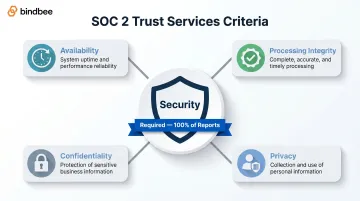
Security is mandatory. The remaining four criteria are scoped based on your customers' contractual requirements and the data types your system processes.
What Auditors Can and Cannot Do
One misconception trips up a lot of first-time audit clients: auditors can identify gaps and point you in the right direction, but per AICPA independence standards, they cannot design or implement your controls. The firm conducting your readiness work and the firm signing your audit report must be separate — this is a regulatory requirement, not a preference.
Type 1 vs. Type 2
| Audit Type | What It Evaluates | Typical Timeline |
|---|---|---|
| SOC 2 Type 1 | Control design at a single point in time | 5 weeks to 2 months |
| SOC 2 Type 2 | Design + operating effectiveness over time | 3–12 month observation period |
Type 2 reports now represent 75–80% of all SOC 2 reports issued, and enterprise buyers overwhelmingly require them. For HR Tech, Benefits Administration, and data-intensive SaaS platforms, a Type 2 report is increasingly the minimum bar for enterprise procurement — not a differentiator, but a prerequisite.
Best SOC 2 Auditors for 2026
These five firms were evaluated on AICPA accreditation, SaaS/tech industry experience, pricing transparency, partner involvement, audit methodology, and client feedback.
Linford & Company
Founded in 2013 by former Big Four auditors and information security specialists, Linford & Company is a Denver-based boutique CPA firm that focuses exclusively on information security audits. Partner Isaac Clarke started his career at Ernst & Young, and that Big Four pedigree shows in the firm's methodology without the corresponding price tag.
With over 1,200 clients and a firm requirement that all auditors carry at least 10 years of professional experience, Linford punches well above its size. The firm is particularly well-regarded for first-time SOC 2 engagements, where partner-level involvement throughout the process (not just at sign-off) makes a measurable difference in how smoothly evidence collection and fieldwork go.
| Criteria | Details |
|---|---|
| Best For | Startups and mid-market SaaS companies; first-time SOC 2 audits |
| Audit Types | SOC 1, SOC 2 (Type 1 & 2), HIPAA, ISO 27001, HITRUST, FedRAMP, CMMC |
| Pricing Range | Starting ~$8K; industry range cited as $20K–$150K with a median around $30K |
A-LIGN
A-LIGN is the highest-volume SOC 2 audit firm in the US, self-reported as the top global issuer of SOC 2 reports with over 36,000 total audits completed for more than 6,400 clients including Nasdaq and T-Mobile. Operating under the legal name Price and Associates CPAs, LLC, the firm is both PCAOB-registered and AICPA-accredited.
The firm's biggest differentiator for complex organizations is its A-SCEND platform: a proprietary audit management system that centralizes evidence collection, tracks milestones in real time, and integrates with major GRC automation tools. For companies pursuing multiple frameworks simultaneously — SOC 2 plus ISO 27001, FedRAMP, or HITRUST in a single engagement — A-LIGN's 400+ auditor team (200+ dedicated to SOC) is among the deepest-staffed in the market.
| Criteria | Details |
|---|---|
| Best For | Mid-market to enterprise SaaS; multi-framework compliance needs |
| Audit Types | SOC 2 (Type 1 & 2), FedRAMP, ISO 27001, ISO 42001, PCI DSS, HIPAA, HITRUST, CMMC |
| Pricing Range | Not publicly listed; quoted based on scope, TSC categories, and organization size |
Schellman
Schellman & Company is one of the largest independent SOC examination providers in the US, issuing more than 2,000 SOC reports annually across nearly 60 types of audits and assessments. The firm is PCAOB-registered and runs a split practice structure: Schellman & Company handles attest engagements, while Schellman Compliance handles non-attest advisory work, preserving auditor independence while keeping services under one roof.
Two things set Schellman apart heading into 2026. Their "single assessor" approach lets organizations pursue SOC 2 and ISO 27001 concurrently under one firm, reducing the coordination overhead of parallel audits. They're also ahead on AI and supply chain risk: AI Red Teaming, ISO 42001 assessments, and SOC for Supply Chain reports are all on offer as AICPA guidance expands in this direction.
| Criteria | Details |
|---|---|
| Best For | Enterprise and high-growth SaaS; complex cloud infrastructure; AI and supply chain risk |
| Audit Types | SOC 2 (Type 1 & 2), SOC for Supply Chain, ISO 27001, ISO 42001, PCI DSS, FedRAMP, HITRUST, CMMC |
| Pricing Range | Estimated $20K–$100K for Type 2; priced above boutique firms, below Big 4 |
KirkpatrickPrice
KirkpatrickPrice is a Nashville-based CPA firm founded in 2005, serving SaaS, FinTech, and Healthcare Technology clients with an education-forward audit approach. With over 2,000 clients and a team of roughly 130–150 professionals, the firm occupies a practical sweet spot: specialized enough to know SaaS control environments deeply, accessible enough for resource-constrained compliance teams.
What stands out is how the firm structures engagements. Every audit begins with a formal gap analysis that maps internal controls against SOC 2 Trust Services Criteria — so you know exactly what needs fixing before fieldwork starts. Clients use the firm's "Online Audit Manager" portal for evidence gathering, and the firm delivers reports in both standard and machine-readable Markdown format. It also offers the most transparent pricing of any firm on this list.
| Criteria | Details |
|---|---|
| Best For | SaaS startups, FinTech, and Healthcare Tech; first and repeat audits |
| Audit Types | SOC 2 (Type 1 & 2), SOC 1, ISO 27001, ISO 42001, HIPAA, PCI DSS |
| Pricing Range | Type 1: $8K–$15K; Type 2: $12K–$45K; Year 1 bundle ~$30K; annual renewal ~$25K |
WithumSmith+Brown (Withum)
Withum is a Top 25 CPA firm — ranked #16 on Vault's 2026 Top Accounting Firms list — with a dedicated cybersecurity and risk advisory practice that serves SaaS companies, HR Tech platforms, and digital health startups. What distinguishes Withum from the other firms here isn't just SOC 2 audit capability; it's the ability to combine SOC 2 with M&A cybersecurity due diligence, financial audit readiness, and transaction advisory services under one firm.
For venture-backed companies approaching a fundraise or acquisition, Withum's pre- and post-transaction cybersecurity due diligence practice helps investors and acquirers evaluate security posture as part of deal structuring — a workflow the boutique audit firms can't replicate.
| Criteria | Details |
|---|---|
| Best For | Growth-stage and venture-backed SaaS; SOC 2 alongside M&A or financial audit readiness |
| Audit Types | SOC 2 (Type 1 & 2), SOC 1, HIPAA, ISO 27001, PCI DSS, IT risk advisory, M&A cybersecurity due diligence |
| Pricing Range | Not publicly listed; quoted based on scope and services |
How We Chose the Best SOC 2 Auditors
Selection Criteria
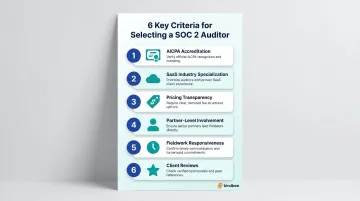
Each firm was evaluated across six dimensions:
- AICPA accreditation and CPA licensure — non-negotiable; only licensed CPA firms can legally perform SOC 2 attestations
- SaaS and tech industry specialization — auditors who understand cloud-native control environments move faster and ask better questions
- Pricing transparency and scope clarity — firms that publish or clearly explain pricing reduce the risk of scope surprises mid-engagement
- Partner-level involvement — the person who understands your environment shouldn't disappear after the kickoff call
- Responsiveness during fieldwork — delays in evidence review compound quickly; auditor accessibility matters
- Client feedback and verified reviews — G2, Gartner Peer Insights, and direct client references
Common Selection Mistakes to Avoid
- Choosing only on price — the cheapest quote often reflects the narrowest scope; cost overruns come later
- Assuming Big 4 is always better — unless your enterprise clients explicitly require a Big 4 auditor, boutique and mid-tier firms deliver equivalent reports with better accessibility
- Skipping the size-match check — an auditor with no experience auditing 30-person SaaS companies will struggle with your control environment, regardless of their brand
- Ignoring responsiveness signals — how quickly a firm responds during your sales conversation is a reliable proxy for how they'll behave during fieldwork
The AI and Supply Chain Question for 2026
Beyond the criteria above, one dimension has grown sharply more relevant heading into 2026: whether your auditor has updated their methodology to address AI and third-party supply chain risks. Nearly 90% of SOC 2 reports now include subservice providers, and AICPA guidance continues to expand its expectations around vendor risk disclosures.
Schellman (AI Red Teaming, ISO 42001, SOC for Supply Chain) and A-LIGN (ISO 42001) are furthest ahead on this dimension. Boutique firms vary considerably — during your scoping call, ask directly: "Have you updated your control testing procedures to address AI systems and subservice organization risks?" The answer will tell you everything you need to know.
Conclusion
Choosing a SOC 2 auditor comes down to fit: how well they understand your control environment, whether their timeline matches yours, and whether they treat the engagement as a partnership. Name recognition and price tag are poor proxies for either.
That partnership quality shows up early. Run parallel evaluations — get quotes from two or three firms, ask for sample reports, and request references from companies at a similar stage. How responsive a firm is during the sales conversation tells you everything; that behavior doesn't improve once the engagement starts.
For HR Tech and Benefits Administration platforms specifically, your compliance footprint doesn't stop at your own audit. Enterprise buyers scrutinize your entire vendor stack, including your integration infrastructure. Bindbee is SOC 2 Type II and ISO 27001 certified — so the HRIS and benefits data integrations powering your platform are already covered when procurement teams run their security reviews. One fewer gap to explain.
Frequently Asked Questions
What is a SOC 2 auditor?
A SOC 2 auditor is a licensed CPA or professional from an AICPA-accredited firm who evaluates an organization's internal controls against the Trust Services Criteria and issues an official attestation report. The report documents whether your controls are designed and operating effectively to protect customer data.
Who can audit SOC 2?
Only licensed CPA firms accredited by the AICPA can conduct SOC 2 audits. The auditor must also be fully independent — meaning no prior or ongoing advisory relationship with the organization being audited that would impair objectivity.
Which companies need SOC 2 compliance?
SOC 2 is most commonly required for SaaS companies, cloud service providers, HR Tech platforms, FinTech, and any organization storing or processing sensitive customer data on behalf of clients. Enterprise buyers in most tech verticals now require it during procurement.
How often is a SOC 2 audit required?
SOC 2 is not legally mandated, but Type 2 reports are typically renewed on a 12-month cycle. Enterprise procurement teams and security reviewers typically treat reports older than 12 months as stale.
How do I get SOC 2 compliance?
Define your scope and applicable Trust Services Criteria, implement required controls, and document policies and evidence. Then run a readiness assessment before engaging an AICPA-accredited CPA firm for the formal audit. Total first-year costs for most companies run $45,000–$70,000 including implementation and audit fees.
What is the difference between ISO 27001 and SOC 2?
SOC 2 is a US-origin AICPA attestation that produces a confidential report shared under NDA. ISO 27001 is an internationally recognized certification standard that results in a publicly referenceable certificate. Many companies operating globally — or in regulated sectors like benefits and healthcare tech — pursue both.