TLDR
- ACA compliance requires year-round tracking, IRS reporting, and carries penalties up to $2,900–$4,350 per employee annually
- 73% of HR teams find ACA compliance burdensome, and 70% spend 80+ hours per year on it
- Outsourcing covers eligibility monitoring, 1095-C/1094-C prep, IRS e-filing, and penalty dispute support
- Workforce complexity, high turnover, multi-state operations, and limited HR capacity all push toward outsourcing
- Whether outsourcing succeeds depends on clean, real-time data from your HRIS and payroll systems
What Is ACA Compliance—and Who Must Follow It?
The Affordable Care Act's Employer Shared Responsibility provisions apply to Applicable Large Employers (ALEs)—any organization that averaged 50 or more full-time equivalent employees during the prior calendar year. If that threshold applies to you, federal law requires you to offer minimum essential, affordable health coverage to full-time employees and their dependents, then report on it annually to the IRS.
That reporting centers on two forms:
- Form 1094-C — the transmittal form summarizing your ACA compliance across all employees
- Form 1095-C — an individual statement for each full-time employee detailing coverage offered, the employee's share of cost, and months of coverage
Electronic filing with the IRS is due March 31 of the year following the coverage year. Employee copies must be furnished by January 31 of that same year.
What the Penalties Actually Look Like
The IRS stopped tolerating good-faith errors after the 2020 tax year. Every filing since then has been held to full accuracy standards, and the financial stakes are real:
| Penalty Type | 2025 Annual Rate | Trigger |
|---|---|---|
| 4980H(a) | $2,900 per FTE | Failing to offer coverage to 95%+ of FTEs |
| 4980H(b) | $4,350 per affected employee | Offering coverage that's unaffordable or below minimum value |
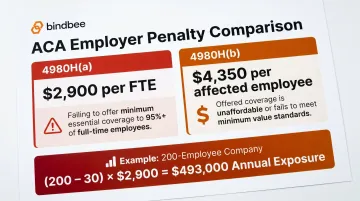
A 200-employee ALE that fails the 4980H(a) test faces (200 − 30) × $2,900 = $493,000 in annual exposure. This isn't a theoretical scenario. The IRS has assessed over $30 billion in ACA penalties to date, and enforcement has only tightened.
Why ACA Compliance Is Harder Than It Looks
Many HR teams underestimate ACA compliance until they receive an IRS Letter 226-J. The reason it catches organizations off guard: it looks like a year-end reporting task, but it's actually a 12-month data management challenge.
The Volume Problem
ACA compliance requires continuous monitoring across HR, payroll, and benefits systems all year. Every new hire, termination, hours threshold crossing, and life event is a potential eligibility trigger that affects what you owe, what you must offer, and what you must report.
According to Trusaic's 2023 research on ACA compliance, surveying 244 HR and benefits professionals:
- 70% of organizations spend more than 80 hours per year on ACA tasks
- 73% find the process burdensome
- 55% identified employee misclassification—especially of variable-hour workers—as their most common compliance problem
- 1 in 4 organizations reported being audited by the IRS for ACA non-compliance
The Classification and Regulatory Moving-Target Problem
Variable-hour, part-time, and seasonal workers create the most classification errors. The IRS Look-Back Measurement Method requires tracking hours over a 6–12 month measurement period to determine full-time status—a process that demands continuous, accurate data most payroll systems aren't built to handle.
Regulatory volatility adds another layer. The ACA affordability percentage shifted from 9.12% in 2023 to 8.39% in 2024 before rebounding to 9.02% in 2025, each change requiring employers to reprice their lowest-cost plan option. Multi-state employers also face additional reporting mandates in California, New Jersey, Rhode Island, Massachusetts, and Washington D.C., all layered on top of federal requirements.
The Overconfidence Risk
Perhaps the most counterintuitive finding: 80% of employers who received IRS penalty letters had previously rated themselves as highly confident in their compliance. Self-assessment surfaces what teams already know to check—it doesn't catch the gaps they don't know exist. That's precisely where third-party verification earns its value.
What Outsourcing ACA Compliance Actually Includes
Outsourcing ACA compliance means transferring the operational work of meeting your ACA obligations to a third-party provider. The scope varies by service tier.
The Three Service Models
| Model | What the Vendor Does | What You Still Own |
|---|---|---|
| Self-service software | Provides platform and IRS transmission | Data entry, code selection, accuracy verification |
| Co-sourced | Software + advisory review, code validation, some eligibility tracking | Final accuracy decisions, data ownership |
| Fully outsourced | End-to-end: data ingestion, eligibility determination, form prep, filing, distribution, IRS dispute response | Providing accurate source data |
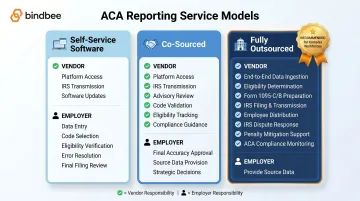
For most mid-size employers with workforce complexity, co-sourced or fully outsourced arrangements deliver the most meaningful risk reduction.
What Full-Service Outsourcing Covers
A full-service ACA compliance provider handles:
- Year-round eligibility and hours tracking using lookback measurement periods
- Alerts when variable-hour employees cross the 30-hour threshold triggering coverage obligations
- 1095-C code generation, employee distribution, and secure record storage
- 1094-C preparation and IRS e-filing
- Corrections to previously filed returns
- Letter 226-J response and penalty dispute support
Trusaic's internal study of penalty responses found that expert intervention completely eliminated penalties in 43% of cases, with a median final penalty of just $1,040—a 99% reduction from original IRS assessments.
Employers who handled IRS responses on their own achieved a 50%+ reduction only 36% of the time.
Despite this, fewer than 50% of ACA compliance vendors offer accuracy verification support before filing, and only 41% provide IRS dispute response assistance. Ask any vendor you're evaluating whether they offer both—most don't, and that gap is where penalties slip through.
In-House vs. Outsourced: How to Decide
When to Outsource
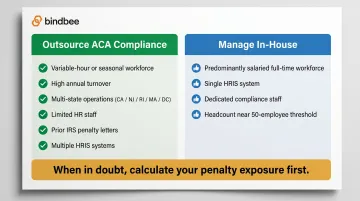
Strong signals that outsourcing makes sense:
- Large proportion of variable-hour, part-time, or seasonal employees
- High annual turnover that creates constant eligibility events
- Operations in CA, NJ, RI, MA, or DC (state-level mandates add filing layers)
- Limited HR staff handling compliance as a part-time responsibility
- Prior IRS penalty letters or audit history
- Multiple HRIS or payroll systems across different business units
When In-House May Work
In-house management tends to work when your organization has:
- Predominantly salaried, full-time workforce with stable headcount
- A single HRIS covering all employees
- Dedicated HR compliance staff (not compliance as a side responsibility)
- Headcount near the 50-employee ALE threshold with low workforce complexity
The ROI Calculation
Start with labor. If your team spends 80+ hours annually on ACA tasks at a benefits specialist's rate of $35–40/hour, that's $2,800–$3,200 in direct staff time — before accounting for management oversight or error remediation. For complex workforces, actual hours run much higher.
Then factor in penalty exposure. A single 4980H(b) violation affecting 15 employees costs $65,250 at 2025 rates. Outsourced ACA compliance — typically priced per employee — pays for itself if it prevents one moderate penalty event. For ALEs with 200+ employees or meaningful workforce complexity, outsourcing is the default choice; the only real decision is which partner to use.
What to Look for in an ACA Compliance Partner
Not all ACA vendors offer the same protection. Given that fewer than half provide accuracy verification and only 41% support IRS disputes, choosing the wrong partner can leave you exposed to exactly the penalties you're trying to avoid.
Evaluate partners on these specific points:
- Can they respond to Letter 226-J on your behalf? Ask for documented dispute outcomes, not just assurances.
- Do they validate data against IRS records before submission, or just transmit what you send?
- Can they handle CA, NJ, RI, MA, and DC state mandate filings without requiring additional vendors?
- How do they ingest data from your HRIS and payroll systems? Manual CSV exports introduce lag that causes filing errors.
- Do they track eligibility year-round or only activate at year-end? Ask specifically how they handle mid-year terminations.
- SOC 2 Type II is the baseline for vendors handling employee SSNs and health plan data — confirm HIPAA Business Associate Agreements are in place.
- Will you have direct access to ACA subject matter experts, or a generic help desk?
The Role of Clean Data in Making ACA Outsourcing Work
Outsourcing ACA compliance transfers the process work—but not the data responsibility. The most common root causes of IRS penalties (misclassification, incorrect coverage codes, missed eligibility events) typically originate upstream in HRIS and payroll systems, not in the filing process itself.
What Good Data Infrastructure Looks Like
ACA compliance vendors need reliable, current access to:
- Employee hire and termination dates, employment status
- Hours worked (especially for variable-hour employees)
- Benefits enrollment elections, coverage tiers, and effective dates
- Dependent information including relationships, dates of birth, and SSNs
- Payroll deduction amounts and contribution records
Monthly CSV exports create 30–90 day data lags. When a termination or hours reduction happens on day 1 but doesn't reach your compliance vendor until day 45, eligibility triggers get missed—and those misses show up as penalties.
Where Data Integration Matters for Benefits Platforms
For benefits platforms, TPAs, and HR tech companies that power ACA-adjacent workflows, the data freshness problem is a platform-level challenge. Bindbee's unified API normalizes employment and benefits data across 60+ HRIS and payroll systems—including Workday, ADP, UKG, Paychex, and the long tail of regional platforms—into a consistent, structured format that ACA compliance processes can actually use.
The eligibility intelligence layer handles the ACA-specific logic your compliance vendor depends on:
- ACA hours validation across full-time, part-time, and variable-hour classifications
- Waiting period calculations and benefit class assignment by employment status, location, and tenure
- Webhooks for life events (new hires, terminations, dependent changes) that flag qualifying events in real time rather than through manual census reconciliation
That last point closes the audit gap that monthly batch files leave open. Instead of discovering a missed eligibility trigger at filing time, your compliance vendor sees the event when it happens.
For legacy systems that only export flat files, Bindbee's SFTP-to-API bridge normalizes CSV, XML, and fixed-width formats into the same unified schema as modern API-connected systems. Your compliance vendor gets one consistent data stream regardless of how many source systems your employer clients run.
Frequently Asked Questions
What is compliance outsourcing?
Compliance outsourcing means hiring a third-party provider to manage regulatory obligations on your behalf. In the ACA context, this includes eligibility tracking, 1095-C/1094-C preparation, IRS filing, and penalty dispute support—freeing internal teams to focus on other work while specialists reduce risk.
What are ACA compliance requirements?
ALEs (employers with 50+ full-time equivalent employees) must offer minimum essential, affordable health coverage to full-time employees, track hours year-round, distribute Form 1095-C to employees, and file Form 1094-C with the IRS electronically by March 31 of the following year.
Can a compliance officer be outsourced?
The legal responsibility for ACA compliance always remains with the employer. However, the operational work—eligibility tracking, IRS form preparation, reporting, and even penalty dispute responses—can be fully outsourced to a specialized vendor or third-party administrator.
What tasks does an outsourced ACA vendor actually handle?
An outsourced vendor takes on the day-to-day execution: eligibility monitoring, coverage offer determinations, 1095-C generation and distribution, IRS filing, and responding to penalty notices. The employer retains oversight and final accountability, while the vendor owns the operational workload.
Who is ultimately responsible for ACA compliance if you outsource it?
The Applicable Large Employer remains legally liable for any penalties even when compliance work is outsourced. That's why vendor contracts should explicitly define who owns each task, what SLAs apply to IRS filing deadlines, and how penalty notices get escalated.
What data does an ACA compliance vendor typically need?
Vendors typically need employee hours (especially for variable-hour workers), hire and termination dates, benefits enrollment elections with effective dates, dependent information, and coverage offer records. Real-time feeds from HRIS and payroll systems are far more reliable than periodic manual exports.