Introduction
Picture this: an HR Tech team wins a new enterprise client, kicks off the integration project, and immediately hits a wall. Scoping takes two weeks. Custom development takes six more. Testing reveals field mapping mismatches that scoping had missed. The go-live slips by a month, then another. By the time the connection is live, the client's confidence has eroded—and the engineering team is already behind on the next one.
This isn't a project management failure. It's a structural problem baked into how enterprise HR technology works.
Most enterprises run a patchwork of HR systems: separate platforms for payroll, benefits administration, applicant tracking, time management, and workforce analytics—each adopted independently, each with its own data model and API behavior.
According to a 2026 industry survey, the average organization now uses 16.24 HR applications—nearly double the count from two survey periods prior—while 68% still operate disconnected HR platforms.
This article breaks down the five biggest HR system integration challenges enterprises face—from API inconsistency and data normalization to security compliance and long-tail system coverage—and what a more durable approach looks like.
TLDR
- Fragmented HR tech stacks create data silos, duplicate records, and unreliable reporting—affecting payroll accuracy, benefits enrollment, and workforce analytics
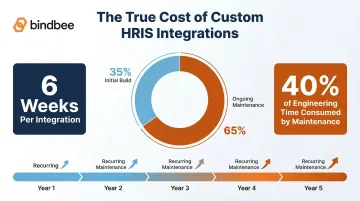
- Each custom HRIS integration takes ~6 weeks to build, and maintenance eats 60–70% of total integration cost over its lifetime
- Disconnected platforms multiply compliance exposure under GDPR, HIPAA, and CCPA—especially for sensitive employee data
- Legacy SFTP and EDI file exports are incompatible with modern API-first integration
- Slow integration cycles delay go-live, compress revenue timelines, and create scaling ceilings as employer client counts grow
Fragmented HR Tech Stacks and Data Silos
Most enterprise HR environments weren't designed—they accumulated. A company adopts a payroll platform, later adds a separate benefits administration tool, layers in an ATS, and eventually adds time tracking and performance management systems. None of these were built to talk to each other.
The result: the same employee exists in multiple systems, often with conflicting records. A promotion recorded in the HRIS doesn't propagate to the payroll system. A dependent added during open enrollment never reaches the benefits carrier. A termination processed in one platform leaves an active record in three others.
The Real Cost of Disconnected Data
HR teams in organizations with siloed data spend 23% more time on administrative tasks and experience 31% higher error rates in employee data management. HR managers report spending an average of 14 hours per week manually aggregating data—nearly two full working days—just reconciling records that automated systems should keep current.
For benefits administration specifically, the consequences are direct and financial:
- Employees end up in the wrong plan or with no coverage when enrollment syncs fail
- Dependent data mismatches create coverage gaps and trigger COBRA compliance issues
- Payroll deductions come out wrong when benefits elections never reach the payroll system
- Employees get locked out of coverage until the next open enrollment when eligibility windows are missed
These aren't edge cases — they're the default state when HR systems don't share data reliably. The operational toll extends beyond HR teams to the platforms serving them. Healthee's Head of Operations described their pre-integration reality directly: "Before Bindbee, every new employer meant weeks of back-and-forth getting census data. Custom integrations were taking 2+ months each."
Why It Gets Worse at Scale
At enterprise scale, the fragmentation problem compounds. As companies acquire subsidiaries, expand geographically, or add HR tools for different employee populations, integration points don't grow linearly—the connection math turns against them fast. Ten systems require 45 potential point-to-point connections. Add one more system and that's nine additional connections.
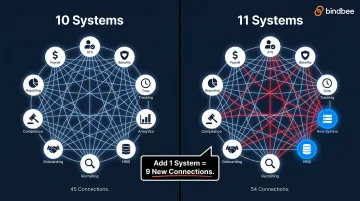
Without a unifying data layer, the overhead of keeping these systems aligned grows faster than any ops team can manually track.
Only 21% of HR leaders believe their organizations effectively use data to make decisions—a direct consequence of data that lives in silos, reconciled manually, and trusted inconsistently.
Engineering Cost and Ongoing Maintenance Burden
Building custom HRIS integrations in-house looks attractive on paper — full control, no vendor dependency, built exactly to spec. In practice, the economics rarely hold up.
A single HRIS integration averages 6 weeks to build from scoping through certification. Supporting five platforms requires approximately 30 engineer-weeks for the initial build alone—more than half a year of one senior engineer's time. A Workday integration specifically can take 1 to 3 months; standard Workday implementations average 8.2 months from kickoff to go-live.
The Maintenance Trap
The initial build isn't the real cost. Initial development accounts for only 30–40% of total integration ownership cost; maintenance and updates consume the remaining 60–70%.
HRIS vendors push changes constantly:
- Workday releases bi-annual breaking API changes
- BambooHR imposes a 400-field limit per employee record request
- Gusto enforces rate limits of 200 requests per minute
- Authentication mechanisms, required fields, and endpoint structures shift without long lead times
Every upstream change requires downstream engineering work. Across SaaS companies broadly, roughly 40% of engineering time is consumed by integration maintenance rather than product development. That's not a one-time cost—it's a recurring tax on the team's capacity to build anything new.
The N×M Scaling Problem
The scaling math is unforgiving. An HR Tech company supporting 10 HRIS platforms doesn't face 10 maintenance problems—it faces a matrix of platform-specific field mappings, authentication quirks, and edge cases. Employment status, termination reason, and job title are represented differently in every system. Workday's data model looks nothing like BambooHR's, which looks nothing like ADP's.
Compport's senior developer described the experience directly: "To integrate with multiple HRIS platforms, we have to handle multiple scenarios and multiple mappings. With Bindbee, we had a constant dataset we are working with that has helped us save a lot of time."
The opportunity cost is measurable. Newfront reduced integration deployment from 8–12 weeks to 48 hours, recovering over $800,000 annually in engineering resources. Those engineers now work on core product instead of decoding API documentation. Budgie Health saved 5 man-months of engineering bandwidth and had 30 HR and payroll integrations live by day four.
A unified API handles connections across 60+ HRIS, payroll, and benefits systems through a single normalized layer. Setup drops from weeks to under a day, and when vendors push breaking changes, the maintenance burden stays off your product team's plate entirely — absorbed by the infrastructure layer instead.
Data Security, Compliance, and Privacy Risks at Scale
HR data is uniquely sensitive. Social Security numbers, salary history, health benefits elections, dependent information, and immigration status flow through these integrations. Every system connection is a potential exposure point.
The global average cost of a data breach reached $4.88 million in 2024. For healthcare-related data, that figure nearly doubles—healthcare breaches averaged $9.77 million per incident in 2024, the costliest sector for 12 consecutive years.
The regulatory surface area is wide:
- GDPR requires lawful basis, data minimization, and residency controls for European employee data
- HIPAA governs health benefits data in the US—violations carry criminal penalties up to $250,000 and 10 years in prison
- CCPA applies to California-based employees
- SOC 2 Type II sets baseline expectations for vendor security posture
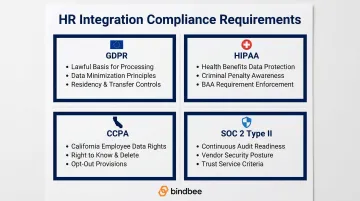
H&M's EUR 35.3 million GDPR fine for mishandling employee data remains the starkest example of what happens when employee data governance fails at scale.
Multi-Vendor Compliance Risk
Each integration partner introduces its own compliance posture. An enterprise that connects a non-compliant third-party tool into its HR data flow inherits that vendor's gaps. Verifying the primary HRIS vendor's certifications isn't enough: every system in the data chain needs evaluation.
For benefits platforms, this means holding vendors to specific standards before any data flows:
- BAA execution: Any vendor touching protected health information must sign a Business Associate Agreement — HIPAA requires it, no exceptions
- SOC 2 Type II (not Type I): Demonstrates continuous control effectiveness across an audit period, not a one-time snapshot
- Data residency coverage: Certifications should span every region where employee data is processed (US, EU, APAC)
Bindbee carries SOC 2 Type II, ISO 27001, and HIPAA compliance certifications with GDPR-ready status and multi-region data residency. The compliance posture of the integration infrastructure layer matters as much as the HR systems on either end of it.
Audit trails add another layer of complexity. When data moves and transforms across platforms, organizations need end-to-end logging of what was accessed, modified, and by whom. Fragmented point-to-point integrations make this nearly impossible without a centralized governance layer providing unified visibility.
Legacy Systems, API Incompatibilities, and Format Mismatches
Modern HR Tech platforms assume REST APIs. Most enterprise HR environments don't exclusively provide them.
Nearly 40% of businesses remain dependent on aging on-premise HR and ERP systems, with SAP's mainstream ECC support ending December 2025 and Microsoft Dynamics GP following by 2029. Among Fortune 500 companies, 70% still operate software more than 20 years old.
These systems communicate through flat-file SFTP exports, EDI 834 transactions, and proprietary formats—none of which work with API-first integration approaches out of the box.
The practical workaround is an SFTP-to-API bridge: automatically processing SFTP file drops, normalizing CSV, XML, or fixed-width formats into standardized JSON, and serving that data through the same API endpoints as direct integrations.
Systems like ADP Workforce Now, Paylocity, isolved, and bswift commonly use SFTP-based data transfer. A bridge approach means consuming applications can't distinguish between legacy and modern sources—the data looks identical regardless of origin.
Even when two systems both offer APIs, field mapping creates its own set of problems. Employment status, pay frequency, termination codes, and job levels are represented differently across every vendor. A mismatch in cross-system mappings can silently corrupt downstream records without triggering any obvious error state:
- Wrong benefits deductions applied to employee paychecks
- Incorrect eligibility determinations blocking or approving coverage
- Payroll errors that surface only at period close
The vendor lock-in risk compounds the cost of these custom connectors. Organizations that build deep, bespoke integrations into a specific HRIS find that switching vendors later is disproportionately expensive. That reduces negotiating leverage, slows adoption of better tools, and creates long-term architectural rigidity.
Slow Integration Cycles and the Scaling Ceiling
For HR Tech vendors and benefits platforms, integration speed is a revenue problem.
A 4-to-8-week integration cycle per employer means delayed go-lives, delayed subscription revenue, and a window where the customer may lose confidence or start evaluating alternatives.
For benefits platforms specifically, missing an open enrollment window — typically just 2 to 4 weeks in the fall — due to integration delays can cost both the employer and the platform the entire plan year's opportunity.
As the employer client base grows, the backlog compounds. Each new employer client requires connections to their specific HRIS configuration. Without scalable integration infrastructure, growth in customers creates proportional growth in integration debt. The engineering team can't clear the backlog faster than new connections arrive.
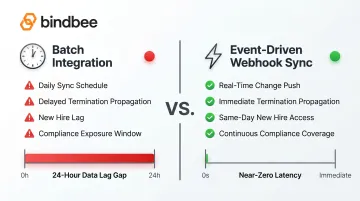
Integration speed and sync frequency are two separate failure modes — and both matter. Batch-based integrations that sync once daily fail to meet enterprise expectations for real-time accuracy:
- New hires need same-day system access
- Terminations must propagate immediately to prevent compliance exposure
- Continued benefits coverage for former employees creates direct financial and legal risk
ThrivePass resolved this with Bindbee, cutting new hire onboarding from 6 weeks to under 1 week and activating coverage on day one instead of day 30.
Webhook-based event architectures solve the latency problem by pushing changes the moment they occur in the source system. Building these natively for each HRIS requires months of engineering work per system. Consuming them through a unified layer that normalizes events across 60+ systems collapses that timeline to days.
How to Build a More Resilient HR Integration Strategy
Three decisions determine whether an enterprise HR integration architecture scales or stalls.
1. Resolve the Build vs. Buy Question Early
Building custom integrations in-house makes sense for one or two shallow connections with stable APIs. Beyond that, the math reverses. Self-maintained integrations eventually exceed the cost of third-party solutions by 40–70%, according to industry benchmarks — before factoring in engineering time pulled away from core product work.
A unified API provider normalizes data across dozens of HRIS, payroll, and benefits systems through a single interface. The team builds once; every supported system is immediately available. Minimum evaluation criteria for any provider include:
- SOC 2 Type II and ISO 27001 certification
- HIPAA compliance for health and benefits data
- Multi-region data residency support
2. Start with a Data Governance Audit
Connecting systems before establishing data ownership amplifies existing problems rather than solving them. Before building any technical connection:
- Identify which system is the authoritative source for each data type (employee record, compensation, enrollment status, benefit class)
- Clean up duplicate records and inconsistencies in existing systems
- Document field mappings across platforms
- Establish data quality standards and validation rules
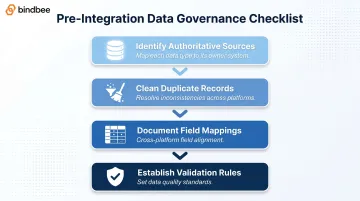
Without this groundwork, integration speeds up data movement — but the data itself remains unreliable.
3. Prioritize Event-Driven Sync Architecture
Batch exports are a temporary solution. Long-term, integrations need to respond to events—not run on schedules. Life events (new hire, termination, dependent change, benefits election, COBRA qualifying event) require near-real-time sync. Delays create payroll errors, benefits gaps, and compliance exposures.
Webhook-based architectures push changes as they happen. When evaluating integration infrastructure, look specifically for built-in sync notifications and event-based updates for the life events that matter most to your workflows—not just periodic bulk syncs.
Frequently Asked Questions
What is a key challenge in integrating technology with HR?
The central challenge is HR tech stack fragmentation. Most enterprises run 16+ disconnected systems for payroll, benefits, and workforce management — none of which were built to share data — and connecting them requires significant engineering effort, data normalization, and ongoing maintenance.
How long does HR system integration typically take for enterprises?
Traditional custom integrations take 4 to 8 weeks per HRIS connection—accounting for scoping, development, testing, and certification—and that timeline multiplies across every additional platform. Unified API solutions compress this to under a day by providing pre-built, normalized connectors across 60+ systems simultaneously.
What is the difference between point-to-point integration and a unified HR API?
Point-to-point integrations connect two specific systems with custom code, creating a fragile, high-maintenance link that breaks whenever either system changes. A unified API normalizes data from many systems behind a single interface, so teams build once and connect to all supported platforms without individual custom development or per-system maintenance.
How do enterprises ensure data privacy compliance across multiple HR systems?
Enterprises must audit every data flow, verify each vendor's compliance certifications (SOC 2 Type II, ISO 27001, HIPAA, GDPR), and enforce role-based access controls with end-to-end audit trails. Every vendor in the data chain carries compliance risk — not just the primary HRIS.
What should enterprises do before starting an HR system integration project?
Start with a data audit: identify which system owns each data type, clean up duplicates, and establish data governance rules before any technical connections are built. Skipping this step is the most common reason integration projects fail to deliver reliable data quality.
How can HR Tech vendors reduce the engineering cost of HRIS integrations?
Use a unified HRIS API layer rather than building native integrations. This shifts per-system maintenance off the engineering team, reduces time-to-integration from weeks to hours, and frees development resources for core product work. For any team managing three or more integration targets, the economics clearly favor unified API infrastructure over in-house builds.