Introduction
HR Tech platforms face a structural problem that gets worse with every new customer. A single enterprise might run Workday for HR, ADP for payroll, a separate carrier system for benefits, and a legacy platform still pushing SFTP exports every Monday morning. None of these systems share a data model, use the same field names, or update on the same cadence.
The result: eligibility errors, onboarding delays, and engineering teams spending months building integrations instead of product.
According to HR.com's 2025 State of HR Technology report, 81% of organizations say poor integration limits their ability to meet important HR goals — and 46% cite lack of integration as their single biggest HR technology challenge.
What follows is a practical breakdown of how a unified platform solves that problem — from ingesting raw data across dozens of source systems to delivering normalized, benefits-ready data through one API.
TLDR
- The average organization now runs 16.24 HR applications — and 62% manage at least 2–4 simultaneously
- A unified platform abstracts all source systems behind one normalized API — no per-system integration required
- Benefits-first data models (Employee, Employer, Dependent) are critical for Benefits Admin, Insurtech, and TPA use cases
- Real-time webhooks fire on new hires, terminations, and dependent changes — no polling required
- Bindbee customers report 76% faster onboarding and 94% improvement in Time-to-Value
The Problem: Why Managing Global Workforce Data Is So Complex
Most HR Tech platforms underestimate the fragmentation problem until they're three customers deep and already behind on their roadmap.
The Multi-System Reality
HR.com's 2025 data tells a clear story:
- 62% of organizations use 2–4 paid HR solutions from different providers
- 17% use 5–7 solutions
- 4% use 8 or more
- The average organization now runs 16.24 HR applications — nearly double the 8.85 reported just a few survey periods earlier
That fragmentation isn't temporary. The US HR and payroll software market has grown at 5.7% annually between 2019 and 2024, meaning the long tail of systems keeps getting longer.
The Engineering Cost of Going It Alone
Point-to-point integrations are expensive to build and painful to maintain. Based on reported build times across common HRIS integrations:
| Integration | Build Time (Point-to-Point) |
|---|---|
| Workday | 1–3 months |
| Gusto / Rippling | 3–6 weeks each |
| 46-system expansion (Apploi case study) | 13–17 months estimated |
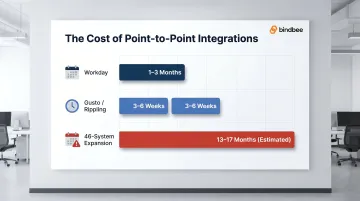
One platform described it plainly: custom HRIS integrations were "taking 2+ months each." Another noted that "what used to take 6 engineers 6 months now takes 1 engineer 1 week" after switching to a unified API.
The Downstream Consequences
Those build costs are only half the problem. When integrations are inconsistent or stale, the data quality failures compound downstream:
- Enrollment errors surface from mismatched employment status fields
- Benefits eligibility gaps open up when termination updates arrive days late
- Manual CSV reconciliation consumes support and ops bandwidth
- Sales deals stall because a prospect's HRIS isn't on the supported list
These aren't edge cases. Only 39% of organizations report their HR solutions are usefully integrated, and just 42% consider their people analytics highly accurate.
What a Unified Platform Actually Does with Global Workforce Data
The core idea is straightforward: instead of building a separate integration for every HRIS your customers use, you build one integration with a unified platform — and that platform handles everything behind it.
The Abstraction Layer Architecture
A unified platform sits between your HR Tech product and the dozens of source systems your customers run. It connects to each system using whatever method that system supports: REST APIs with OAuth, API key authentication, Workday's ISU credentials, or SFTP file exports for legacy systems. Raw data flows in from all of them.
That raw data gets normalized into a single consistent schema and delivered through one unified API. From your product's perspective, it doesn't matter whether a customer runs Workday or BambooHR — the data looks the same either way.
Bindbee, for example, connects to 60+ HRIS, payroll, benefits, and carrier systems — including Workday, ADP, Gusto, Rippling, UKG, SAP SuccessFactors, and the broader long-tail of regional platforms — and delivers all of it through a single normalized API endpoint.
Real-Time Sync vs. Batch Imports
How quickly data moves through that unified layer determines whether your product can act on it. Batch imports create a fundamental problem: the data you're working with is always slightly wrong. An employee terminated on Tuesday doesn't show as inactive until Friday's sync. A new hire's benefits eligibility window passes before enrollment is triggered.
Bindbee's approach uses automatic incremental syncs after the initial data pull, with webhook notifications firing immediately when specific events occur — no polling, no stale records.
The gap matters most in benefits administration. A 30-day delay between a qualifying event and a system update is the difference between compliant administration and a coverage gap.
From Raw System Data to Unified Records
Normalization goes deeper than field names. Every layer of structural difference between systems needs resolving:
- Field-name conflicts:
employment_statusin Workday,emp_statusin BambooHR — both normalized to the same field in the unified schema - Data type mismatches: one system sends dates as MM/DD/YYYY, another uses ISO 8601
- Missing fields: some systems don't expose certain objects via API; others require custom report configurations
- Custom fields: every HRIS has them, and most integration layers drop them entirely
Bindbee handles custom fields by passing them through in a custom_fields object alongside normalized data, accessible via include_custom_fields=true in API requests. Custom fields stay intact and queryable, not silently stripped at the integration layer.
How Data Normalization Works Across Disparate HR Systems
Normalization is where unified platforms earn their keep. Moving data between systems is relatively simple. Translating 60+ different data structures into one coherent schema — without losing critical nuance — is the hard part.
Benefits-First Data Models
Most generic HRIS integrations treat benefits as a footnote: a few flat fields on the employee record. For Benefits Admin, Insurtech, and TPA platforms, that's not workable.
Bindbee uses three distinct benefits data models designed specifically for benefits workflows:
- Employee Benefits — plan name, provider, coverage tier, contribution amounts, effective dates
- Employer Benefits — available benefit plan details at the organizational level
- Dependent Benefits — which plans cover each dependent, with coverage dates and eligibility details
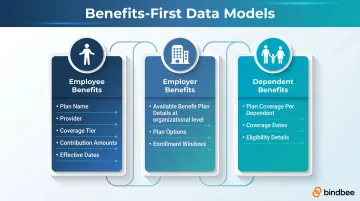
This structure matters for real workflows. When an FSA/HSA provider needs to verify family coverage tier, or a TPA needs to confirm a dependent's enrollment effective date, the data needs to be there at the right level of specificity — not buried in a generic employee object.
Handling Legacy Systems Without APIs
Many enterprise HR systems — particularly in healthcare, insurance, and manufacturing — don't have modern APIs. They export EDI 834 files, CSVs, or custom flat file formats via SFTP.
HIPAA mandates that all health plans accept the ANSI 834 Version 5010 format for electronic enrollment transactions — making EDI 834 a persistent reality in benefits data exchange, regardless of how modern other parts of the stack become.
Bindbee's SFTP-to-API bridge handles this directly:
- Automatically ingests file drops from legacy systems (CSV, XML, fixed-width formats)
- Parses and normalizes file contents through the same validation pipeline as API-connected systems
- Serves the output through the same unified API endpoints as modern REST integrations
The result: whether a customer's benefits data comes from a Workday API or a weekly SFTP file, it looks identical on the receiving end. One Bindbee customer noted that their systems "couldn't tell the difference — it all looked the same through Bindbee's unified interface."
Data Governance and Validation
Normalization without validation creates a different problem: clean-looking data that can't be trusted. Bindbee validates every change before it reaches your API endpoint — errors are caught at sync time, not discovered later in a downstream report. Key governance capabilities include:
- Comprehensive audit trails for every update
- Searchable sync logs with real-time visibility into errors and customer impact
- Validation layers that check and normalize every change before it reaches your API
- Role-based access controls so only authorized personnel touch sensitive data
Core Capabilities That Make Global Workforce Data Management Work
Real-Time Event Webhooks
Polling for updates introduces latency your workflows can't afford. Bindbee's webhook system fires notifications the moment specific lifecycle events occur in the source HRIS:
- New hire added
- Employment status changed (termination, hours reduction)
- Dependent enrollment added or removed
- Qualifying life events (marriage, divorce, birth, dependent age-out)
- Demographic or work location changes
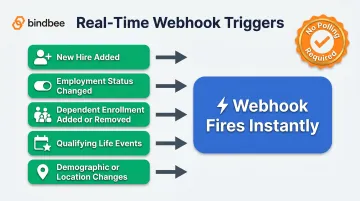
For benefits platforms, this matters most at the edges — when an employee is terminated and COBRA eligibility begins, or when a dependent is added and coverage needs to activate before the next monthly sync would catch it.
Magic Link Employer Onboarding
Getting employers to connect their HRIS has traditionally been a project: IT tickets, OAuth setup, back-and-forth over API credentials. Bindbee's Magic Link component flips that.
Employers authenticate through a guided, branded flow embedded directly in your product. No IT involvement, no manual configuration — most employers connect in under 10 minutes.
One platform reported that "before Bindbee, every new employer meant weeks of back-and-forth getting census data. Now employers connect their HRIS in minutes, and we're live the same day."
Breadth of System Coverage
Every HRIS your platform doesn't support is a deal you can't close. If a prospect runs Rippling, Gusto, or TriNet and you're not connected, that's a lost sale — not a roadmap item.
Bindbee's 60+ connectors cover the full spectrum:
- Enterprise: Workday, SAP SuccessFactors, UKG, ADP
- Mid-market: Paychex, Paylocity, BambooHR, Paycom
- SMB: Gusto, Rippling, Namely
- Plus: ATS systems, carrier integrations, and regional/legacy platforms via SFTP
Broader coverage removes a consistent sales objection and compresses deal cycles — particularly for enterprise prospects who screen on integration support before engaging.
Security, Compliance, and Data Governance for Global Workforce Data
Workforce data ranks among the most sensitive information any platform processes. Employee PII, health information, dependent records, and compensation details are regulated across multiple overlapping frameworks — and IBM's 2024 Cost of a Data Breach Report found employee PII to be the costliest record type to breach at $169 per record.
The compliance landscape is also expanding. Data protection laws are now in effect in 144 countries as of 2025. Workforce data flowing through integration pipelines must comply with jurisdiction-specific rules that multiply with every country where a customer employs workers.
Key Certifications and What They Verify
| Certification | What It Verifies |
|---|---|
| SOC 2 Type II | Operational effectiveness of security controls over 6–12 months (not just design) |
| ISO 27001 | Systematic information security management with ongoing risk assessment |
| HIPAA Compliance | Appropriate safeguards for Protected Health Information in benefits contexts |
| GDPR Readiness | Data minimization, access controls, audit logging, and data residency controls for EU employee data |
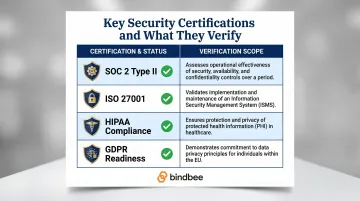
Bindbee holds SOC 2 Type II and ISO 27001 certifications and is both HIPAA compliant and GDPR ready. That combination means HR Tech platforms, benefits administrators, and payroll providers can operate across jurisdictions without building separate compliance infrastructure for each use case.
Data Access Controls in Practice
- HTTPS/TLS encryption for all data in transit; encryption at rest on AWS infrastructure
- Multi-factor authentication required for all admin access
- Least-privilege access model with periodic access reviews
- Full audit logs for every data access and change event
- Data Processing Addendum with EU Standard Contractual Clauses for GDPR-covered transfers
How Bindbee Powers Unified Global Workforce Data for HR Tech Platforms
Bindbee connects 60+ HRIS, payroll, benefits, and carrier systems through a single normalized API — with benefits-first data models, automatic incremental syncs, zero integration maintenance, and setup measured in hours.
The platform serves HR Tech, Benefits Admin, Insurtech, TPA, and Payroll platforms — 50+ benefits platforms run on Bindbee, including Newfront, Healthee, Pasito, Clever Benefits, and ThrivePass.
What the Outcomes Look Like in Practice
The Phin case study provides the clearest documented benchmark:
- 76% reduction in onboarding time for new customers
- 94% optimization in Time-to-Value
- $115,000+ annual savings in development costs
Newfront's numbers run at a different scale: deployment time dropped from 8–12 weeks to 48 hours, engineering time on integration work fell by 90%, and annual savings exceeded $800,000.
Engineering bandwidth is the real return. Across both cases, the same three shifts show up:
- Time spent building and maintaining HRIS connectors moves back to core product development
- Sales cycles shorten — no deal stalls on a missing integration
- Employer onboarding accelerates from weeks to minutes
For HR Tech platforms evaluating integration infrastructure, the numbers favor a unified API once you need to support more than 5–10 HRIS systems, the cumulative cost of native integrations exceeds the cost of a unified API within the first year — and the gap widens as coverage requirements grow.
Frequently Asked Questions
What is global workforce management?
Global workforce management is the practice of coordinating and optimizing a workforce spread across multiple countries — covering HR data, payroll, compliance, benefits, and scheduling. Unified platforms handle this at scale by consolidating data from every system each country location uses into a single normalized layer.
What features should global workforce management tools include?
The foundational requirements are multi-system integration, data normalization, real-time sync, and compliance support across regions. The ability to connect to whatever HR and payroll systems each location already uses — rather than requiring system migrations — is the minimum requirement for any multinational deployment.
How does a unified platform handle data from legacy HR systems that don't have modern APIs?
Platforms like Bindbee use an SFTP-to-API bridge to ingest file-based exports (CSV, XML, EDI 834, fixed-width formats) from legacy systems, normalize them through the same pipeline as API-connected systems, and serve the results through the unified API.
What does data normalization mean in the context of global workforce data?
Normalization is the process of mapping inconsistent field names, data types, and structures from different HR systems into a single common schema. A field called employment_status in Workday and emp_status in BambooHR become the same normalized field — so your platform writes code once and it works identically across all source systems.
How does a unified workforce data platform ensure GDPR and data privacy compliance?
Compliant platforms implement TLS encryption in transit, encryption at rest, role-based access controls, audit logging, and data residency controls — and hold certifications like SOC 2 Type II, ISO 27001, HIPAA compliance, and GDPR readiness. Bindbee maintains all four frameworks and provides Standard Contractual Clauses for EU data transfers.
What types of workforce data events can trigger real-time notifications in a unified platform?
Key lifecycle events include new hires, terminations, employment status changes, hours reductions, dependent additions and removals, qualifying life events (marriage, divorce, birth, dependent age-out), and demographic changes. Webhook-based notifications allow HR Tech platforms to act on these events in real time rather than waiting for the next scheduled sync.