Introduction
When payroll is outsourced, most HR teams assume the hard work is done. The provider handles wages, taxes, direct deposits — what's left to worry about?
Quite a lot.
The real complexity sits at the boundary between the outsourced payroll system and the benefits administration platform. Data has to move accurately in both directions:
- Benefits → Payroll: Enrollment decisions (health plan tier, dependent coverage, 401(k) contribution rate, HSA elections) must map to the correct deduction codes and amounts
- Payroll → Benefits: Employment events (new hire, termination, salary change) must trigger the right eligibility updates in the benefits system
When either direction breaks down, employees get wrong deductions, lose coverage, or enroll in plans they're no longer eligible for.
This guide is written for HR tech builders, benefits administration platforms, and TPAs who need to understand this integration at a technical and operational level. By the end, you'll know exactly how the data flows, where integrations break, and what separates a reliable implementation from one that generates support tickets every pay cycle.
TL;DR
- Outsourced payroll integration with benefits is the ongoing, bidirectional data synchronization between an external payroll provider and a benefits administration platform
- Benefits platforms send enrollment decisions; payroll systems apply corresponding pre- and post-tax deductions each pay cycle
- Key data exchanged includes eligibility status, plan elections, contribution amounts, effective dates, and dependent records — though field naming and formats vary by system
- Common failures: stale termination records, missed life event triggers, and flat-file transfers that miss mid-cycle changes
- Benefits platforms serving multiple employer clients face compounding complexity, since every payroll provider uses different formats, field conventions, and sync mechanisms
What Is Outsourced Payroll Integration with Employee Benefits?
Outsourced payroll integration with employee benefits is the process by which an employer's external payroll provider and their benefits administration system continuously exchange employee data. The goal is straightforward: every benefits election must be reflected in the payroll system's deduction logic, and every payroll-side event must trigger the appropriate eligibility update in benefits.
How It Differs from Basic Payroll Outsourcing
Standard outsourced payroll covers wage calculations, tax filings, and direct deposits. Its scope ends at the payroll system's boundary.
Benefits integration adds an entirely separate layer. It requires:
- Plan definitions: which plans are available, at what cost, and what the employer contributes
- Dependent coverage records: who is enrolled, under which plan, and with what effective dates
- Life event triggers: new hires, terminations, qualifying life events, and open enrollment changes
None of this flows automatically from standard payroll outsourcing. The payroll provider can apply whatever deduction amount it's told to apply — but it cannot independently manage enrollment logic, dependent eligibility rules, or carrier feeds. That requires an explicit, bidirectional integration with the benefits system.
Why Benefits Platforms Depend on Reliable Payroll Integration
The dependency is direct and the failure consequences are financial. A 48-hour lag between an enrollment change and a payroll update can produce incorrect employee contributions, missed employer matches, or active coverage for terminated employees. These aren't just operational nuisances — they carry regulatory price tags.
The COBRA Compliance Clock
When a qualifying event occurs (termination, hours reduction, dependent loss of coverage), a strict notification chain begins. The DOL's employer guide to COBRA establishes:
- Employer notifies plan administrator: within 30 days
- Plan administrator furnishes COBRA election notice: within 14 days
- Combined maximum window: 44 days
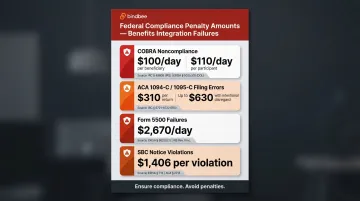
When a payroll system records a termination but that event isn't transmitted promptly to the benefits platform, the COBRA clock runs silently — and the penalties compound daily. Under IRC Section 4980B, the IRS excise tax for noncompliance is $100 per day per qualified beneficiary ($200/day per family). The DOL can separately assess $110 per day per participant for COBRA notice failures under ERISA.
ACA and ERISA Exposure
IRS penalties under Sections 6721/6722 for incorrect or late 1094-C/1095-C filings reach $310 per return (after August 1) for tax year 2024, with intentional disregard penalties of $630 per return and no cap. For an employer with 500 full-time employees, that's potential exposure exceeding $155,000 at the $310 tier alone.
Per Groom Law Group's 2024 ERISA penalty analysis, additional exposure includes:
- $2,670/day for Form 5500 filing failures
- $1,406 per violation for missing Summary of Benefits and Coverage notices
- $141/day per employee for CHIP notice failures
Every day a stale payroll record sits unresolved in a benefits platform, the per-participant liability compounds. For benefits platforms serving dozens of employer groups, that exposure multiplies across every affected account.
How Outsourced Payroll Integration with Benefits Works
At a high level, an employee or employer event originates in either the HRIS/payroll system or the benefits platform. Data moves across systems via API, EDI file, or flat-file transfer. The receiving system updates its records, deductions are recalculated, and carriers receive updated enrollment feeds.
Here's what that looks like step by step.
Step 1: Employee or Life Event Trigger
A change record is created in either system. Triggering events include:
- New hire added to payroll
- Employee selecting benefits during open enrollment
- Qualifying life event (marriage, new dependent, loss of coverage)
- Termination
The originating system isn't always the same, which immediately creates synchronization complexity. A termination processed in the payroll system needs to reach the benefits platform. A dependent addition recorded in the benefits platform needs to update the payroll deduction calculation.
Step 2: Data Exchange Across Systems
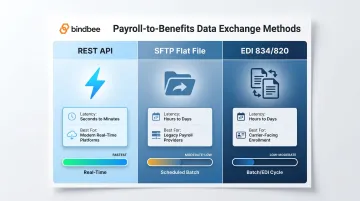
The integration layer passes enrollment and eligibility data between systems. Three mechanisms are commonly used:
| Method | Latency | Best For |
|---|---|---|
| REST API | Seconds to minutes | Modern platforms needing real-time sync |
| SFTP flat file | Hours to days | Legacy payroll providers |
| EDI 834/820 | Hours to days | Carrier-facing enrollment transmissions |
Field naming conventions, data formats, and authentication methods vary significantly across payroll providers. A benefits platform serving multiple employer clients must map each provider's unique structure to its own normalized data model — this translation layer is where most mapping errors occur.
Step 3: Deduction Application and Enrollment Confirmation
The payroll system applies or updates deduction codes for the upcoming pay cycle. The benefits platform updates enrollment records and initiates carrier enrollment feeds (EDI 834 to insurance carriers).
Both systems need to confirm alignment at this stage. Discrepancies caught here — mismatched amounts, missing effective dates — are recoverable. Those that go undetected become compliance liabilities, accumulating silently until an audit, an employee complaint, or a carrier billing dispute surfaces them.
Bidirectional reconciliation is the safeguard: comparing what was deducted on payroll against what carriers billed catches mismatches before they compound across multiple pay cycles.
Step 4: Ongoing Incremental Sync
The integration is not a one-time setup. Mid-cycle changes continuously require updates:
- Salary adjustments affecting HSA contribution limits
- Dependents aging off plans
- Address changes affecting plan eligibility
- Benefits tier changes after qualifying life events
Benefits platforms must be designed to receive and process delta records (incremental changes), not just full population refreshes. Many integration failures occur here, not during initial setup.
Open enrollment is the most common stress test: thousands of changes need to reach the payroll system before the next pay run. Teams that tested configuration but skipped end-to-end enrollment scenario testing tend to discover the gaps at the worst possible time.
Key Factors That Affect Integration Quality
Data Model Compatibility
Payroll providers structure records around the employee as a single entity. Benefits platforms require separate data models for employee benefits, employer contributions, and dependent benefits.
When a payroll provider's export flattens everything into one employee record (or omits dependent-level fields entirely), the benefits platform can't populate complete carrier feeds or accurate premium calculations. The specific fields most commonly missing from standard payroll exports:
- Dependent relationship, date of birth, and individual coverage elections
- Employer contribution amounts broken out by plan type
- Plan-to-enrollment relationships (which plan an employee elected, not just what was deducted)
- Effective dates at the dependent level, not just the employee level
Platforms like Bindbee address this by maintaining three distinct normalized models — Employee Benefits, Employer Benefits, and Dependent Benefits — rather than embedding everything in a single employee record. This structure enables benefits platforms to validate eligibility issues before they reach the carrier.
Sync Frequency and Data Latency
Batch syncs (daily or weekly) create windows where data is stale. A termination processed Monday may not reach the benefits platform until Friday — leaving active coverage for an ineligible employee for the entire week.
The practical options:
| Method | Strengths | Limitation |
|---|---|---|
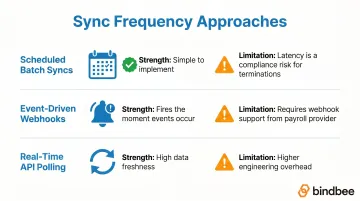
| Scheduled batch syncs | Simple to implement | Latency is a compliance risk for terminations |
| Event-driven webhooks | Fires the moment events occur | Requires webhook support from the payroll provider |
| Real-time API polling | High data freshness | Higher engineering overhead |
For COBRA administration specifically, daily batch processing isn't sufficient for managing the 44-day notice window. Termination events need to reach the benefits system within hours, not days.
Legacy System Formats
Data latency isn't the only pipeline problem. Many mid-market and regional payroll providers don't offer REST APIs. They export via SFTP flat files or support EDI transactions only. Benefits platforms integrating with these providers need either an internal translation layer or a partner that bridges legacy file formats to modern API calls.
Bindbee's SFTP-to-API Bridge handles exactly this scenario by ingesting CSV, XML, and fixed-width flat files deposited by legacy payroll systems, normalizing them into a unified data model, and serving them through the same API endpoints as direct integrations. From the benefits platform's perspective, the data source is transparent.
Scale of the Integration Surface
A benefits platform serving multiple employers may maintain simultaneous integrations with dozens of different outsourced payroll providers — each with unique field structures, authentication requirements, and update schedules. Building and maintaining these one by one creates significant engineering overhead.
Clever Benefits, for example, previously spent 2-3 weeks building each individual integration. After connecting to Bindbee's unified API — which normalizes data from 60+ HRIS and payroll systems including ADP, Paychex, Gusto, Rippling, UKG, Paylocity, and Paycom — they deployed 60+ integrations at once.
Compliance and Security Requirements
Beyond scale, every payroll-to-benefits data exchange involving health plan enrollment carries compliance obligations. Health plan enrollment data constitutes Protected Health Information (PHI) under HIPAA, which means each exchange requires:
- PHI encrypted in transit and at rest
- Signed Business Associate Agreements (BAAs) with any vendor processing enrollment data (including integration middleware providers)
- HITECH Act compliance, which creates direct liability for business associates, not just covered entities
On the payroll side, SOC 2 Type II has become the de facto standard for demonstrating data security controls to enterprise customers. Vendors handling both payroll and benefits data in the same integration pipeline must meet both HIPAA and SOC 2 requirements — a dual certification requirement that most point-to-point integration builders aren't equipped to satisfy.
Common Integration Failures and Misconceptions
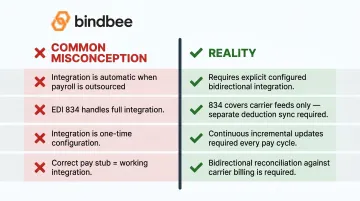
"Payroll integration is automatic when payroll is outsourced"
Not true. An outsourced payroll provider can apply a deduction amount it's told to apply. It cannot independently manage enrollment logic, dependent eligibility rules, plan tier transitions, or carrier feeds. Those require an explicit, configured integration with the benefits system. The two functions are separate and don't connect automatically.
"The EDI 834 handles the full integration"
The 834 is the HIPAA-mandated standard for transmitting enrollment data from a benefits platform to an insurance carrier. It does not cover the payroll deduction layer. A separate data feed is required to synchronize enrollment decisions with the payroll system's deduction codes. Many teams conflate these two distinct data flows and then discover the gap when deductions are misapplied despite correct carrier enrollment.
"The integration is a one-time configuration"
Open enrollment alone requires the integration to handle thousands of concurrent enrollment changes within a compressed timeframe. Add qualifying life events, new hires, terminations, and dependent changes — the integration is processing incremental updates constantly.
Organizations typically discover this gap after an open enrollment period where changes fail to reach payroll before the next pay run.
"If deductions on pay stubs look correct, the integration is working"
The deduction amount on a pay stub can be correct while enrollment status, dependent coverage tier, or plan effective date data is stale or mismatched in the background. This creates ERISA and ACA compliance risk that's invisible on the pay stub. Proper integration validation means bidirectional reconciliation: comparing what payroll deducted against what carriers billed, not just spot-checking paychecks.
Frequently Asked Questions
How does outsourcing payroll work?
Payroll outsourcing means a third-party provider handles wage calculations, tax withholdings, direct deposits, and payroll tax filings on your behalf. Arrangements range from fully outsourced models to partial setups where only specific functions — like tax filing — are delegated.
How does payroll integration work?
Payroll integration is the automated exchange of data between a payroll system and connected platforms (HRIS, benefits administration, time and attendance), keeping employee records, deductions, and changes synchronized without manual re-entry. Common mechanisms include REST API connections, scheduled file transfers, and event-driven webhooks.
What are the benefits of outsourcing payroll?
Primary benefits include reduced administrative burden, improved tax compliance, access to payroll expertise, and lower error rates. For HR tech platforms, outsourced payroll providers also create the integration surface through which benefits and HR systems connect to a single source of payroll truth.
What HR functions should not be outsourced?
Core strategic functions — employee relations decisions, performance management, culture initiatives, and disciplinary actions — are generally kept in-house because they require organizational context and direct employee relationships. Transactional functions like payroll processing and benefits administration enrollment are standard outsourcing candidates.
What data is exchanged between outsourced payroll and benefits systems?
Key data exchanged includes:
- Employee eligibility status, hire dates, and termination dates
- Pay frequency and compensation details
- Benefits elections (plan type, tier, contribution amounts)
- Dependent information (relationship, date of birth, coverage status)
- Effective dates for all changes
What are the main challenges when integrating outsourced payroll with a benefits platform?
The most common integration challenges include:
- Inconsistent data formats across different payroll providers
- Sync latency that creates stale eligibility records
- Legacy SFTP-only providers requiring translation layers
- Compliance requirements (HIPAA for health plan data, SOC 2 for payroll data) governing how data moves through the pipeline