Introduction
ICHRA administration can be set up two ways: configure a self-service software platform and manage the mechanics yourself, or hand off operations to a full-service vendor who bundles technology with live support. The choice sounds like a budget decision — but it's really a risk decision.
The administration model you choose affects how reliably payroll data flows, how much compliance exposure sits on your HR team, and whether your ICHRA scales cleanly as headcount grows. With ICHRA adoption up 29% from 2023 to 2024 — and ALE participation jumping 84% in that same period — more employers are navigating this decision for the first time.
This guide compares both models across the dimensions that matter most: what each actually delivers, where compliance risk lands, and how the underlying integration layer determines whether either approach holds up at scale.
TL;DR
- ICHRA software = self-serve tools for plan setup, reimbursement tracking, and IRS reporting — works best for small teams with strong HR expertise
- Full-service vendors = technology plus live support, custom plan design, and managed compliance — better suited for growing or multi-state employers
- Both achieve compliance; error risk increases with software-only administration at scale
- HRIS and payroll integration quality determines how accurate day-to-day administration is — for either model
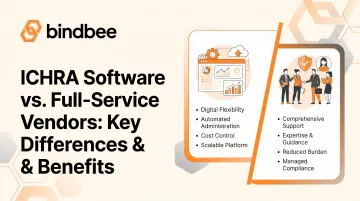
ICHRA Software vs. Full-Service Vendors: Quick Comparison
| Dimension | ICHRA Software | Full-Service Vendor |
|---|---|---|
| Employer onboarding | Self-serve setup | Dedicated account team |
| Plan design support | Templated configurations | Custom strategy and class structuring |
| Employee support | Digital-only | Live guidance and enrollment help |
| Compliance management | Basic rules enforcement | Automated + human review |
| HRIS/payroll integrations | Limited or manual | Full sync with major systems |
| ACA reporting (ALEs) | Variable — platform-dependent | Typically included |
Choosing between the two comes down to four factors:
- Team size and HR capacity — lean teams benefit from managed support; larger HR orgs can absorb self-serve workflows
- ALE status — applicable large employers need reliable ACA reporting, which varies significantly by software platform
- Complexity of benefit classes — multiple employee classes or variable-hour workforces typically require custom plan structuring
- Compliance ownership appetite — if your team wants to own compliance internally, software gives that control; if not, a full-service vendor removes that burden
What Is ICHRA Software?
ICHRA software is a technology platform that handles the administrative mechanics of running an Individual Coverage Health Reimbursement Arrangement. It covers plan setup, digital notice delivery, reimbursement documentation, and IRS reporting — but without a managed-service provider in the loop.
The model is self-directed: the platform provides structure, but the employer (or their broker) retains primary responsibility for understanding the rules, managing documents, and fielding employee questions.
Core Feature Set
Typical ICHRA software includes:
- Self-service employer onboarding and plan configuration
- Employee eligibility management
- Expense reimbursement workflows and documentation
- Automated notice delivery (with employer review)
- Basic compliance alerts for IRS and ACA rules
That feature set covers the basics. Where these platforms tend to fall short is in keeping pace with regulatory changes — for example, the ACA affordability threshold has shifted from 8.39% in 2024 to 9.02% in 2025 to 9.96% for 2026 plan years, and not all platforms update their compliance logic accordingly.
Compliance Tradeoffs to Know
Software can enforce basic rules. As employee populations grow or plan designs get more involved, errors accumulate without human oversight. Four areas carry the most risk:
- Missing the 90-day advance notice deadline or omitting required content elements creates immediate compliance exposure
- Failing to verify that employees maintain qualifying individual coverage before processing reimbursements — error-prone without dedicated HR staff
- Misapplying employee class definitions: the IRS recognizes 11 permissible classes with minimum size requirements that scale by employer size; incorrect application triggers nondiscrimination violations
- Miscalculating ACA affordability: ALEs must test against the lowest-cost Silver plan in each employee's geographic rating area, and the threshold shifts every year
Use Cases for ICHRA Software
Ideal employer profile:
- Small teams (typically 1–10 employees)
- HR-savvy operators comfortable owning compliance
- Cost-sensitive businesses offering benefits for the first time
- Brokers and benefits consultants who manage compliance strategy themselves
Scenario: A 6-person startup wants to offer health benefits without committing to group plan premiums. An ICHRA software platform lets them set a defined contribution amount, send required notices, and track reimbursements — with the founding team or their broker handling compliance questions directly.
What Is a Full-Service ICHRA Vendor?
A full-service ICHRA vendor combines technology with live operational support, delivering a more turnkey benefits administration experience. Beyond initial plan setup, they take on most of the ongoing compliance workflow — with the employer retaining final legal responsibility.
What Full-Service Adds Beyond Software
| Capability | Software | Full-Service Vendor |
|---|---|---|
| Custom ICHRA plan design | ✗ | ✓ |
| Guided employee onboarding | ✗ | ✓ |
| ACA affordability testing (annual updates) | Partial | ✓ |
| ACA reporting (Forms 1094-C / 1095-C) | Variable | ✓ |
| W-2 preparation and IRS filing | ✗ | ✓ |
| Active renewal support | ✗ | ✓ |
| Human review of compliance decisions | ✗ | ✓ |
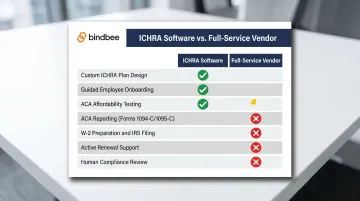
One important clarification: even with a full-service vendor, the legal compliance obligation stays with the employer. Vendors reduce operational risk — they don't transfer legal liability.
The Broker and HR Team Advantage
Full-service vendors take the operational load off HR teams and advisors. They handle quoting, renewals, and compliance reviews, freeing HR to focus on strategy rather than reconciling reimbursement records or second-guessing affordability calculations.
The compliance advantage is most concrete at the edges: catching discriminatory plan designs before they're filed, flagging reimbursement eligibility errors before they trigger an audit, and updating affordability thresholds automatically when IRS parameters change each year.
Use Cases for a Full-Service ICHRA Vendor
Ideal employer profile:
- Scaling teams (25+ employees)
- Remote or multi-state workforces
- Employers transitioning from group health plans
- Organizations that want to minimize internal HR burden
Scenario: An 80-person company operating across five states needs class structuring that accounts for geographic rating area differences, ACA affordability calculations that update by location, and employee-level plan matching support. A full-service vendor manages all of it, including annual renewal reviews, so HR isn't rebuilding the compliance framework from scratch each year.
Which ICHRA Administration Model Is Right for You?
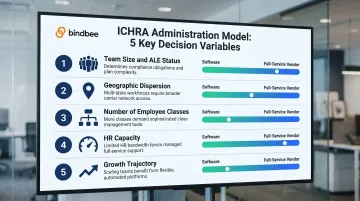
The decision comes down to five variables:
- Team size and ALE status — crossing 50 FTEs triggers ACA reporting obligations (Forms 1094-C and 1095-C) that materially increase complexity
- Geographic dispersion — multi-state workforces require location-specific affordability testing for every employee
- Number of employee classes — more than 2–3 classes creates exponentially more compliance decision points
- HR capacity — how much compliance ownership can your team realistically absorb?
- Growth trajectory — where will headcount be in 12 months?
Situational Recommendations
Choose ICHRA software if:
- Fewer than 25 employees, single state, one employee class
- Deep in-house HR expertise or a broker managing compliance strategy
- Cost sensitivity is the primary driver
Choose a full-service vendor if:
- Scaling past 25 employees or already an ALE
- Operating across multiple states or multiple employee classes
- You want to reduce HR burden rather than own compliance decisions internally
The Common Transition Pattern — and Its Hidden Costs
Many employers start with software at small scale and migrate to full-service as complexity grows. That path works — but mid-cycle migration carries real costs:
Many employers start with software at small scale and migrate to full-service as complexity grows. That path works — but mid-cycle migration carries real costs:
- Data migration between platforms
- Re-delivery of ICHRA notices if plan terms change
- Potential re-filing of ACA reports if the prior platform produced errors
- Employee re-enrollment disruption
Starting with a full-service vendor from the outset — even if it feels like overkill at 20 employees — avoids that friction entirely.
The right model isn't about size alone — it's about how much compliance risk your team can own today, and whether that answer will still hold 18 months from now.
Why Integrations Are the Backbone of ICHRA Administration
Regardless of which model you choose, the quality of HRIS and payroll integrations determines how accurate day-to-day administration actually is. Plan setup and compliance logic matter — but they're only as reliable as the employee data feeding them.
What Breaks Without Reliable Integrations
According to Bentek's benefits administration research, 1 in 5 payrolls contain errors due to manual intervention, with the average cost to fix a single payroll error at $291. The broader HR tech picture is just as fragmented: 68% of organizations cite data silos as their top HR technology concern, and employees spend an average of 12 hours per week searching for information across disconnected systems.
In ICHRA administration, manual data entry creates cascading problems:
- Stale eligibility data leads to reimbursements processed for employees who no longer qualify
- Missed life event triggers — new hires, terminations, dependent changes — create coverage gaps and compliance violations
- Payroll deduction errors require manual reconciliation that scales linearly with headcount
- Affordability calculation drift when employee addresses or compensation data isn't updated in real time
How a Unified API Layer Solves This
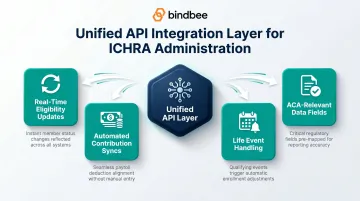
ICHRA platforms — whether software or full-service — that connect to a unified API layer like Bindbee's can access normalized employment data across 60+ HRIS and payroll systems through a single integration. Instead of maintaining separate connections to Workday, ADP, Gusto, Rippling, BambooHR, Paychex, UKG, and dozens more, a single Bindbee connection normalizes employee, compensation, dependent, and benefits enrollment data across all connected systems.
The practical outcomes for ICHRA administration:
- Real-time eligibility updates via webhooks when employment status, hours, or dependent data changes in the source system
- Automated contribution syncs that push deduction changes directly to payroll systems — eliminating spreadsheet handoffs
- Life event handling for new hires, terminations, marriage, dependent changes, and COBRA qualifying events — detected at the moment they occur rather than at the next batch reconciliation
- ACA-relevant data fields including hours worked, employee classification, compensation, and geographic location — normalized across systems for affordability testing
Budgie Health, a benefits platform, connected Bindbee's API in 3 days and gained access to 30 HRIS and payroll integrations, saving 5 months of engineering time and over $100,000 in development costs. Clever Benefits deployed 60+ integrations simultaneously and cut payroll admin time by 70% by writing deductions directly to payroll systems instead of reconciling spreadsheets.
For ICHRA platforms serving employers with legacy systems, Bindbee also provides an SFTP-to-API bridge that normalizes file-based exports from systems like bswift, Plansource, and isolved into the same unified API response — so older employer infrastructure doesn't create a separate data pathway.
At scale, integration quality determines whether compliance stays automated or becomes a manual burden that compounds with every new hire. For ICHRA platforms, that distinction shows up in audit exposure, administrator hours, and employer retention.
Frequently Asked Questions
What is the difference between ICHRA software and a full-service ICHRA vendor?
ICHRA software is a self-serve platform for reimbursement tracking, notice delivery, and basic compliance. A full-service vendor adds live support, custom plan design, and managed compliance workflows. The right choice depends on team size, HR capacity, and how much compliance ownership you want to retain internally.
What are HRIS integrations?
HRIS integrations are connections between an HR information system and external platforms — like an ICHRA administrator — that allow employee data (hire dates, eligibility status, compensation) to flow automatically between systems instead of requiring manual entry or file uploads.
Can you have an ICHRA and a group health plan?
An employer cannot offer both an ICHRA and a traditional group health plan to the same class of employees simultaneously. Different benefit types can apply to different employee classes — such as an ICHRA for part-time workers and a group plan for full-time salaried staff — provided those classes meet IRS minimum size requirements.
Is ICHRA software sufficient for ACA compliance?
For small employers below 50 FTEs using a single employee class in one state, software handles compliance requirements adequately. As headcount, geographic dispersion, and class complexity grow, error risk rises — full-service vendors add the human review layer that catches problems before they become penalties.
What does an HRIS do?
An HRIS centralizes employee records including hiring data, compensation, benefits elections, and employment status. ICHRA administrators rely on it to determine eligibility and calculate reimbursements accurately, which makes the quality of the connection between the two systems critical.
When should a company switch from ICHRA software to a full-service vendor?
The clearest triggers: headcount exceeds 25 employees, the workforce spans multiple states, or you're managing more than two employee classes. When compliance management starts consuming meaningful HR bandwidth — or when ACA reporting becomes a requirement — full-service administration typically pays for itself.