Introduction
HR and benefits teams are dealing with a persistent operational problem: dental enrollment data that lives in one system, employee records in another, and a carrier that gets updates days or weeks late. When someone gets hired, married, or terminated, that information doesn't flow automatically to dental coverage — and the consequences are real.
Manual benefits data entry errors run at 1–4% of fields under normal conditions, spiking to 18–40% during open enrollment crunch periods. Each error costs an average of $291 to remediate. For teams managing dental benefits across hundreds or thousands of employees, that math adds up quickly.
In 2026, HR integration is the primary evaluation criterion for any dental benefits platform. Plan design and network size matter — but only if the platform can stay synchronized with your HRIS.
That's what this article addresses. Below are five dental benefits management solutions evaluated specifically on HR integration depth, along with the criteria HR and benefits tech teams should use to make the right call.
TL;DR
- Disconnected dental benefits systems cause eligibility errors, compliance gaps, and manual rework — each incident can cost employers hundreds of dollars
- Top five platforms for HR integration in 2026: Beam Benefits, Benefitfocus, Employee Navigator, PlanSource, and Ease
- API-based integrations outperform legacy EDI batch processing — EDI error rates in benefits enrollment reach roughly 25%
- Evaluate platforms on HRIS sync depth, dependent data handling, life event automation, and compliance certifications — not just premium pricing
- For teams building on these platforms: open APIs, webhook support, and normalized data models are non-negotiable
What Is Dental Benefits Management and Why HR Integration Matters in 2026
The Software Layer Between Employers and Carriers
Dental benefits management, in the employer context, covers the platform layer between the employer's HR systems and the dental carrier: enrollment, eligibility tracking, dependent management, billing reconciliation, and compliance reporting. These platforms translate workforce data into coverage actions.
This is distinct from dental practice management software (what dental offices use). Employer-side dental benefits platforms are fundamentally data pipes: they need to know who's employed, who their dependents are, what plan they've elected, and when any of that changes.
Why Integration Became Non-Negotiable
Three recurring breakdowns drive most dental benefits errors:
- A new hire misses their enrollment window because HR data didn't reach the carrier in time
- A terminated employee's coverage runs 30 days past separation — a live compliance exposure
- A dependent added during open enrollment doesn't appear in the carrier's system, triggering denied claims
Every one of these traces back to the same root cause: HR data and dental benefits data sitting in separate systems without real-time synchronization.
Dental electronic transaction adoption sits at just 28%, compared to 80% for medical plans — meaning the automation gap in dental is wider than nearly any other benefits category. That gap creates outsized opportunity for platforms that get integration right.
EDI vs. API: Why the Gap Matters
Two integration architectures dominate dental benefits administration:
| Approach | How It Works | Key Limitation |
|---|---|---|
| EDI 834 (file-based) | Batch files transmitted weekly/monthly via SFTP | 25% error rate in ACA markets; errors may surface days later |
| API-based | Real-time data exchange on demand | Requires modern carrier and HRIS support |
EDI 834 error rates reach approximately 25% in ACA marketplace contexts, and roughly 40% of large firms report persistent EDI errors. A single bad file can delay enrollment corrections for an entire batch cycle — sometimes a full week.
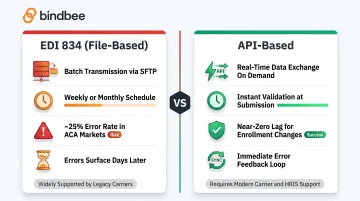
API-based integrations solve this by validating data at the point of submission and syncing changes in near real-time. The tradeoff: many dental carriers still require EDI, so the strongest platforms support both.
The solutions below were evaluated on how well they bridge EDI and API — not on plan design or network breadth alone.
Best Dental Benefits Management Solutions for HR Integration in 2026
The solutions below span dental carriers, benefits administration platforms, and broker-distributed enrollment tools — covering the full spectrum from single-digit headcount SMBs to large enterprises. Each was evaluated on HR integration depth, enrollment automation, dependent data completeness, compliance standards, and employer feedback across SMB and enterprise segments.
Beam Benefits
Beam Benefits (formerly Beam Dental) is a tech-first dental carrier focused on small and mid-sized businesses, distributed through brokers and PEOs. The company has expanded beyond dental to offer vision, life, disability, and supplemental health plans under the Beam Benefits brand.
Its standout HR integration feature is native connectivity with PrismHR, the leading PEO technology platform. For employers running on PEO infrastructure, dental enrollment and eligibility updates flow automatically — no manual re-entry required. Beam is also available through Employee Navigator's marketplace, giving broker-served employers another path to connected enrollment.
| Attribute | Details |
|---|---|
| Key Features | Tech-integrated dental and ancillary plans, digital quoting, rapid implementation (five business days or less), PEO-native enrollment |
| HR Integration Approach | PrismHR native integration; Employee Navigator marketplace; EDI and direct platform APIs through PEO partnerships |
| Best Fit | SMBs and employers using PEO platforms who want a dental carrier with clean HR system connectivity |
Note: Beam's IoT toothbrush program (Beam Perks) was discontinued in May 2025 after participation dropped to 4% of eligible members.
Benefitfocus (Voya Financial)
Benefitfocus is an enterprise benefits administration platform operating as a Voya Financial subsidiary. It manages the full benefits lifecycle — including dental — for large employers and health plans. Voya's Employee Benefits segment delivered $152 million in pre-tax adjusted operating earnings in 2025, up from $40 million the prior year.
Its HR integration approach is API-first: pre-built connections to major HCM and payroll platforms, with support for LIMRA's LDEx standards covering both file-based and API-based data exchange. Dental enrollment is available through carrier catalog partners including MetLife.
| Attribute | Details |
|---|---|
| Key Features | Multi-carrier dental enrollment, ACA compliance, COBRA administration, employee self-service portal, analytics dashboard, billing reconciliation |
| HR Integration Approach | Pre-built API connections to major HCM/payroll platforms; LDEx standards for carrier data exchange; EDI and API carrier feeds |
| Best Fit | Large enterprises and health plans managing complex, multi-carrier dental benefits with full compliance requirements |
Employee Navigator
Employee Navigator is a benefits administration and HR platform used by brokers and employers to manage health, dental, and ancillary benefits. It operates on a broker-centric model — most mid-market employers access it through their benefits broker.
Integration breadth is its clearest differentiator. As of December 2025, Employee Navigator supports more than 500 integrated partners — up from the often-cited "300+" figure — including 72 new payroll integrations added in 2025 alone.
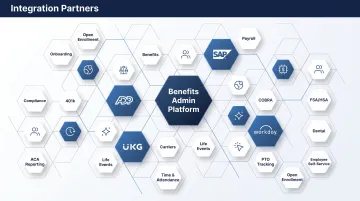
It also acquired Ease in April 2023, combining two broker-focused SMB platforms into a single ecosystem.
| Attribute | Details |
|---|---|
| Key Features | Dental and ancillary benefits enrollment, 500+ HR/payroll integrations, onboarding workflows, compliance reporting, real-time payroll data sync |
| HR Integration Approach | API and file-based payroll/HRIS integrations; broker-managed employer setup; real-time payroll sync |
| Best Fit | Mid-market employers working through brokers who need broad HR system compatibility for dental and ancillary benefits |
PlanSource
PlanSource is a cloud-based benefits administration platform (owned by Vista Equity Partners) supporting dental, health, and voluntary benefits for mid-to-large employers. It currently serves nearly 4.5 million consumers across its customer base.
Its integration engine is configurable and bi-directional — dental eligibility data flows automatically when employees are hired, change status, or add dependents. PlanSource also offers billing reconciliation tools that audit and consolidate carrier invoices against enrollment data, reducing the back-and-forth that typically consumes benefits admin time.
| Attribute | Details |
|---|---|
| Key Features | Dental and full benefits administration, open enrollment automation with AI-powered validation, carrier billing reconciliation, ACA compliance and reporting |
| HR Integration Approach | Bi-directional HRIS/payroll integrations via configurable connectors; EDI and API carrier feeds |
| Best Fit | Mid-to-large employers seeking a configurable benefits platform with strong open enrollment automation and ACA compliance tools |
Ease
Ease is a benefits administration platform designed for small businesses, distributed through insurance brokers. It was acquired by Employee Navigator in April 2023 and continues to operate under its own brand with an active platform integration roadmap.
For SMB employers, Ease's value is straightforward: it connects to common payroll platforms — ADP Workforce Now, Paycor, Paylocity, Heartland — to sync employee data and dental enrollment changes automatically.
The broker-driven onboarding model means small teams without dedicated HR staff can get set up without heavy lifting. Ease's broker network supports more than 75,000 employer groups.
| Attribute | Details |
|---|---|
| Key Features | Dental and health enrollment, payroll integrations, employee self-service, broker-managed plan setup, COBRA partner integrations |
| HR Integration Approach | Pre-built payroll/HRIS integrations for SMB platforms via EaseConnect; file-based and API sync depending on connected system |
| Best Fit | Small businesses and their brokers needing straightforward dental enrollment connected to existing payroll systems |
How to Evaluate Dental Benefits Management Solutions
The Five Evaluation Dimensions
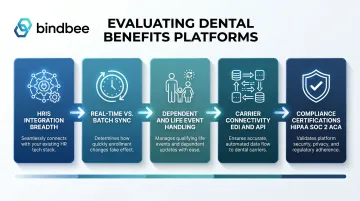
Most buyers select dental benefits platforms based on premium pricing and network size — and then discover six months later that their carrier is still sending enrollment updates via monthly spreadsheet. Avoid that outcome by evaluating on these five dimensions first:
- HRIS integration breadth — How many of your actual HR systems are natively supported? Verify directly from vendor documentation, not marketing materials
- Real-time vs. batch sync — Does enrollment data update instantly when a hire or termination occurs, or does it wait for the next file cycle?
- Dependent and life event handling — Can the platform detect marriage, birth, or adoption events and automatically initiate dependent enrollment workflows?
- Carrier connectivity — Does the platform support both EDI 834 (for legacy carrier compatibility) and API-based feeds for real-time validation?
- Compliance certifications — At minimum: HIPAA compliance for PHI handling, SOC 2 Type II for data security, and ACA reporting for applicable large employers
What Separates Enterprise-Grade from Basic
The strongest platforms treat enrollment data as a live data layer — not a one-time file upload. When an employee's status changes in the HRIS, the dental carrier should know within minutes, not days.
For benefits tech companies building on top of these platforms, the integration layer matters as much as the product itself. Platforms with open APIs, webhook support for life events, and normalized dependent data models are far easier to build on — and solutions that unify this infrastructure (such as Bindbee's unified API, which normalizes dental benefits and HR data across 60+ systems) rank higher for technical extensibility.
For a benefits platform supporting employers on Workday, ADP, and BambooHR simultaneously, the alternative is maintaining three separate integration codebases.
Data completeness is often the hidden differentiator. Dependent relationships, coverage tier elections, and effective dates need to be surfaced as structured, queryable fields — not buried in a flat file. Platforms that expose this data cleanly reduce downstream claims errors and carrier reconciliation disputes.
Conclusion
The best dental benefits management solutions for HR integration in 2026 are built around one shared foundation: data connectivity that's designed in from day one, not bolted on after launch. Real-time HRIS sync, automated dependent lifecycle handling, and accurate carrier data aren't optional — without them, even well-designed benefits programs collapse into manual reconciliation and eligibility errors.
When evaluating platforms, go deeper than plan design and network breadth. Ask three questions most buyers skip entirely:
- Does the platform support bi-directional HRIS sync, or only one-way data pushes?
- Does it expose clean APIs for enrollment data your other tools can consume?
- Can the integration layer scale as your HR tech stack adds new systems?
These aren't edge-case concerns. They're the questions that determine whether post-go-live operations run smoothly or generate constant support tickets.
If you're on the build side — a benefits tech platform or HR software company that needs to connect dental benefits data across multiple HRIS systems — the integration layer itself becomes the product decision. Bindbee provides that infrastructure: a single API that normalizes enrollment, eligibility, and dependent data from 60+ HR systems, cutting integration build time from weeks to under a day.
Frequently Asked Questions
What is dental benefits management software?
Dental benefits management software is the platform layer that handles enrollment, eligibility tracking, dependent management, and carrier billing for employer-sponsored dental plans. Unlike dental practice management software used by dental offices, this category sits between employers (or their HR systems) and dental carriers.
How do dental benefits platforms integrate with HRIS systems?
Integration occurs via EDI file transfers or API-based connections. API integrations enable real-time syncing of employee records, enrollment changes, and terminations, while EDI is a legacy batch approach that processes updates on weekly or monthly schedules — creating lag between HR events and carrier records.
What employee data needs to sync between an HRIS and a dental benefits platform?
The core data fields include employee demographic information, employment status, plan elections, dependent names and relationships, coverage tier selections, coverage effective dates, and life event triggers such as new hires, terminations, and qualifying family status changes.
What is the difference between EDI and API integration for dental benefits?
EDI (Electronic Data Interchange) uses standardized file formats — typically the 834 transaction — exchanged on a scheduled basis via SFTP. It's widely supported by carriers but slow for real-time needs. API integration enables on-demand, real-time data exchange between HR systems and benefits platforms, with instant validation at the point of submission.
How do dental benefits platforms handle dependent enrollment changes?
Leading platforms support life event triggers (marriage, birth, adoption) that automatically initiate dependent enrollment workflows. Real-time HRIS sync ensures carriers receive updated dependent data without manual re-entry, reducing claim denials from stale dependent records.
What compliance standards should a dental benefits management solution meet?
HIPAA compliance is the baseline for handling protected health information, and SOC 2 Type II is the standard for SaaS data security. ACA reporting is required for applicable large employers (50+ full-time employees), and platforms should comply with state-specific insurance regulations where plans are distributed.