
Introduction
Enterprise buyers in HR Tech and Benefits SaaS no longer treat integrations as a nice-to-have. They expect your platform to connect with their existing HRIS, payroll, and benefits systems before signing — not after. According to the G2 2024 Buyer Behavior Report, which surveyed nearly 2,000 B2B decision-makers, integration and implementation ranks among the top four software evaluation factors globally — and for buyers in customer-facing roles, it's the single most important one.
The engineering cost behind that expectation is concrete. Each native integration means 4–8 weeks of scoping, auth flows, schema mapping, and ongoing maintenance. Scale that to 10+ systems and integration work becomes a permanent backlog competing directly against your product roadmap.
Unified APIs change the underlying math. This article covers how they work in practice: deployment timelines, per-integration maintenance cost, what integration coverage does for enterprise deal cycles, and how the returns compound as your customer base grows.
TL;DR
- A unified API replaces dozens of one-off integrations with a single connection covering 60+ HRIS, payroll, ATS, and benefits systems
- Setup takes under a day — compared to 4–8 weeks per system with native integrations
- Maintenance drops to near zero: version changes, schema updates, and auth rotations are handled at the platform layer
- Newfront cut integration deployment from 8–12 weeks to 48 hours, recovering $800,000+ in annual engineering costs
- Each new customer on a different HR system ships without a new build cycle — the advantage compounds with every deal closed
What Is a Unified API?
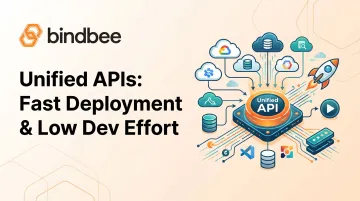
A unified API is a single interface that normalizes connections to multiple third-party systems — HRIS, payroll, benefits, ATS — so your product integrates once and works across all of them without rebuilding authentication, data models, or sync logic per system.
For B2B SaaS products in HR Tech, Benefits Administration, and InsurTech, this matters because customers arrive with wildly different existing systems. One enterprise account uses Workday. The next uses ADP. The next uses a regional payroll provider you've never heard of. Without a unified layer, each of those is a new engineering project.
How Bindbee's Approach Works
Bindbee's unified API covers 60+ employment systems — including Workday, ADP, BambooHR, Gusto, Rippling, Paychex, UKG, SAP SuccessFactors, and Greenhouse. Every system is accessible through one normalized interface, with the same endpoint structure and data models regardless of which system the customer uses.
Most generic APIs stop at employee records. Bindbee includes a benefits-first data model that structures benefits data across three distinct models:
- Employee Benefits — plan selections, coverage tiers, contribution amounts, effective dates
- Employer Benefits — plan availability and employer-sponsored benefit details
- Dependent Benefits — dependent relationships, dates of birth, SSNs, and coverage information for enrollment and carrier submissions
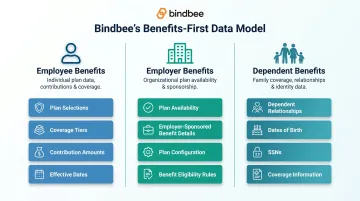
For benefits platforms specifically, that depth is what makes the difference — generic HR data fields routinely omit the enrollment-specific context needed for eligibility workflows, carrier submissions, and payroll deduction mapping.
A unified API is infrastructure, not a feature. It doesn't give you one more thing to demo — it removes a recurring cost from your engineering roadmap.
Three Advantages of Unified APIs: Deployment Speed, Maintenance, and Scale
The advantages below each tie to measurable outcomes: time-to-deploy, engineering hours, and integration coverage breadth. These aren't abstract capability claims.
Advantage 1: Deployment in Hours, Not Weeks
Native HRIS and payroll integrations typically take 4–12 weeks to build and deploy, based on observed build timelines across Bindbee's customer base. Complex enterprise systems like Workday can run 2–6 months for a production-ready connection. The hidden costs go beyond sprint time — a single production-grade integration carries estimated first-year costs of $50,000–$150,000 including build, QA, maintenance, and support overhead.
Bindbee's setup runs under one day. Most customers complete the initial connection in under 10 minutes via Magic Link, Bindbee's embedded authentication component that handles OAuth and credential management without customers storing tokens or building auth flows themselves.
What the time compression looks like in practice:
| Approach | Setup Time | Year-1 Cost Estimate |
|---|---|---|
| Native HRIS integration | 4–12 weeks | $50K–$150K per system |
| Complex enterprise (Workday) | 2–6 months | Higher at scale |
| Bindbee unified API | Under 1 day | One-time infrastructure investment |
Real customer outcomes from Bindbee's deployments:
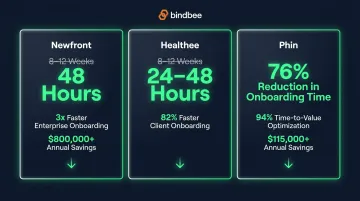
- Newfront: Integration deployment cut from 8–12 weeks to 48 hours; 3x faster enterprise client onboarding
- Healthee: Deployment reduced from 8–12 weeks to 24–48 hours; 82% faster client onboarding
- Phin: 76% reduction in onboarding time, 94% optimization in time-to-value, $115,000+ annual savings
This connects directly to revenue. The G2 2024 Buyer Behavior Report found that 57% of buyers expect positive ROI within 3 months of purchase. When a native integration takes 8–12 weeks just to deploy, that window closes before the product is even live.
When this matters most: Open enrollment season, rapid enterprise onboarding where Workday or ADP integration is a contract precondition, and any deal where the customer's HRIS isn't already on your supported list.
Advantage 2: Drastically Lower Ongoing Engineering Effort
The build is only the beginning. Every native integration your team owns requires monitoring for upstream changes, applying patches after provider updates, running regression tests, and handling customer tickets when syncs break.
Workday ships biannual releases (R1 in spring, R2 in fall) and each cycle can introduce schema changes, deprecated fields, or modified authentication flows that force engineering sprints downstream. That's a minimum of two mandatory review-and-adapt cycles per year, per integration, on top of any unplanned breaking changes.
A unified API absorbs this completely. Bindbee owns ongoing maintenance across all 60+ supported systems. When a provider updates their API, Bindbee's team handles the migration. Customer integrations continue working without code changes on their end.
Engineering hours recovered:
- Cypherworx saved 5 man-months of engineering time, totaling $150,000+ in savings
- Compport eliminated 8-week build cycles per integration, with $150,000+ annual savings in technical resources
- Newfront recovered $800,000+ annually in engineering resources — redirected to core product development
The pattern Bindbee customers consistently report: what used to take 6 engineers 6 months now takes 1 engineer 1 week. That's roughly a 96% reduction in integration engineering effort.
KPIs this improves:
- Engineering hours on maintenance vs. product development
- Integration-related support ticket volume
- Mean time to resolve integration failures
- Developer velocity on core roadmap
When this matters most: Once you've scaled past 5 integrations, onboarded enterprise customers with non-standard configurations, or survived a provider-side API deprecation that pulled engineers off roadmap work unexpectedly.
Advantage 3: Scale Integration Coverage Without Scaling Dev Headcount
The US payroll market alone has approximately 665 providers serving 6.3 million employers, yet the top 10 providers cover only about 60% of the SMB market. That means even after integrating with the 10 largest platforms, roughly 40% of potential employer customers use something else entirely.
Building native connectors one by one cannot close that gap. Each new connector requires its own sprint, QA cycle, and ongoing maintenance — headcount scales with coverage, not with revenue.
With a unified API, adding support for a new HR system isn't a new engineering project — it's an incremental configuration against existing infrastructure. Bindbee customers who needed a system outside the standard catalog typically get a custom connector built and tested within 7–10 days, incorporated into the same normalized data model as the rest of the catalog.
The coverage-to-revenue connection is direct. Prismatic's analysis of B2B SaaS deals found that for products with ACV over $75K, missing integrations are evaluated as deal-killers early in the sales cycle. Enterprise deals that previously stalled on "do you support our HRIS?" close faster when the answer is yes for every reasonable system request.
Grazzy's deployment illustrates the scale unlock: 60+ integrations deployed at once, replacing a 2–3 week build cycle per integration that would have taken years to replicate natively.
KPIs this improves:
- Number of supported integrations
- Deal win rate tied to integration coverage
- Time to support a new customer-requested system
- Integration-related churn from "you don't support our HRIS"
What Happens When Unified APIs Are Missing or Ignored
Managing integrations natively looks manageable at two or three connectors. At ten, it's an engineering tax that never stops growing.
What starts as two or three custom connectors becomes an integration maintenance tax that drains engineering capacity. Here's how the failure modes compound:
- Every enterprise prospect using a different HRIS triggers weeks of scoping and development — the sales pipeline backs up waiting for engineering availability
- Provider-side deprecations (Workday R1/R2, ADP API updates) pull engineers off roadmap work with no warning and no budget for it
- Schema drift across point-to-point integrations causes eligibility errors, enrollment sync failures, and incorrect payroll deductions that reach customers before your team catches them
- Approximately 50% of SaaS companies have lost deals due to missing integrations — scaling to 10+ native connectors without dedicated headcount is operationally unsustainable
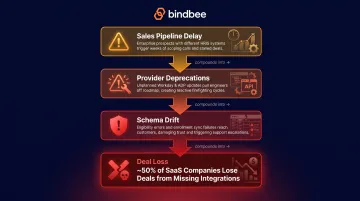
The cumulative effect is an engineering team permanently in catch-up mode. Every sprint spent patching a broken Workday connector is a sprint not spent on the product features that win deals.
How to Get the Most Value from a Unified API
Deploying a unified API is the infrastructure foundation. Extracting maximum value from it comes down to three operational practices:
1. Activate Webhooks for Lifecycle Events
Bindbee's webhook system fires on new hires, terminations, employment status changes, hours reductions, and dependent changes. This shifts integrations from polling-based batch updates to event-driven workflows — critical for benefits platforms that need to hit COBRA notice windows (14–44 days) or trigger enrollment workflows the day a qualifying event occurs, not weeks later.
2. Treat Integration Coverage as a GTM Asset
Sales teams that can answer "do you integrate with Workday/ADP/UKG?" immediately — without routing to engineering — close deals faster and avoid the deal-stall pattern that kills six-figure contracts. Put your integration library to work:
- Document every supported system and keep the list current
- Demo integration coverage during sales cycles, especially for enterprise prospects
- Align your supported systems list against the top HR platforms your target accounts actually use
3. Monitor Integration Health Proactively
Bindbee provides centralized dashboards with searchable logs, sync status tracking, automated alerts, and error detection. Use them. Teams that catch sync failures before customers report them maintain trust; teams that only check when tickets arrive erode it.
One discipline to reinforce across all three practices: stay within the unified schema. The zero-maintenance benefit only holds if your team avoids building workarounds for edge cases that break the normalized model. That standardized data structure is what keeps ongoing engineering effort near zero as your integration library grows.
A note on domain specificity: generic unified APIs cover more categories but with less depth in any single one. For Benefits SaaS, that tradeoff matters.
Bindbee's benefits-first architecture treats Employee Benefits, Employer Benefits, and Dependent Benefits as distinct models. That structure produces cleaner, more actionable data for enrollment workflows, carrier submissions, and eligibility management than a horizontal platform designed for general HR data sync.
Conclusion
Unified APIs convert integrations from a recurring engineering cost into a one-time infrastructure decision. The time savings are structural: hours versus weeks per deployment, not a marginal optimization. The maintenance savings compound with every new integration added to the catalog. And the coverage breadth translates directly into deals won rather than lost.
Both advantages scale with your customer base. Every new customer with a different HR system benefits from infrastructure that already exists. That's the investment case: the first integration pays for the infrastructure; every one after that is nearly free to add. The enterprise deal you land two years from now closes faster because your supported systems list already includes theirs.
HR Tech and Benefits SaaS buyers now filter vendors by integration breadth before they request a demo. Teams that settled this infrastructure question early don't scramble to add a connector when a deal requires it — they already have it.
Frequently Asked Questions
How do web APIs simplify the development of web applications?
APIs provide pre-built interfaces for connecting systems, letting developers focus on business logic instead of low-level connectivity code. Unified APIs go further: one interface abstracts multiple systems, compressing weeks of integration work into hours of configuration.
How long does it take to deploy a unified API integration?
Setup with Bindbee's unified API typically takes under a day, with most customers connecting their HRIS in under 10 minutes via Magic Link. Compare that to the 4–12 weeks per system that native integrations require because authentication, normalization, and schema mapping are handled at the platform layer, not by your engineering team.
What is the difference between a unified API and building native integrations?
Native integrations mean building and maintaining a separate connection for every system your customers use. A unified API collapses that into one integration: one auth flow, one schema, one maintenance contract — regardless of how many systems sit behind it.
How much engineering effort does a unified API save compared to custom integration builds?
Each native integration typically requires weeks of engineering time upfront plus recurring maintenance for every provider API update. Bindbee customers report outcomes like 5 man-months saved per integration cycle, $800,000+ in annual engineering resource recovery (Newfront), and a shift from 6 engineers working 6 months to 1 engineer working 1 week.
Are unified APIs secure enough for sensitive HR and benefits data?
Bindbee holds SOC 2 Type II, ISO 27001, and HIPAA certifications, signs Business Associate Agreements for protected health information, and supports GDPR-compliant multi-region data residency across US, EU, and APAC. Compliance overhead is handled at the platform level, not passed to your team.
Can a unified API handle real-time data sync, or does it introduce delays?
Bindbee supports event-driven sync via webhooks for critical lifecycle events (new hires, terminations, dependent changes, enrollment updates) with notifications firing when changes occur rather than on a batch schedule. Incremental syncs keep data current between events, with sync frequency configurable based on plan tier.