That manual handoff is where things break. Missing punches, rounding errors, overtime entries that slip through — these aren't exceptional failures. They're routine consequences of disconnected systems.
According to a 2022 EY survey, the average payroll accuracy rate across U.S. organizations is just 80.15%, with missing or incorrect time punches occurring at a rate of 404 per 1,000 employees — the most frequent payroll error type. That's not a technology problem. It's an architecture problem.
This article focuses on what integration actually changes: in accuracy, compliance, and the daily workload of HR and payroll teams.
TL;DR
- Integrating time tracking with payroll removes the manual data handoff responsible for most payroll errors
- Automated pay rule application — overtime thresholds, break requirements, state-specific rules — cuts compliance exposure across hourly and salaried workforces
- HR teams reclaim 7+ hours per week by eliminating manual data tasks between time tracking and payroll systems
- Connected systems generate a timestamped audit trail that holds up under wage-and-hour audits and DOL inquiries
What Is Time Tracking and Payroll Integration?
Time tracking and payroll integration is the automated connection between a system that records when employees work and a system that calculates and processes their compensation. The defining feature: hours data moves between the two systems automatically, without manual export, reformatting, or re-entry.
It covers the full range of workforce types:
- Hourly workers where pay is calculated directly from clock-in/clock-out records
- Shift-based teams where differential pay, overtime, and break compliance apply
- Salaried staff with variable hours where project billing, PTO tracking, or ACA hour validation matters
- Multi-location organizations operating under different state-level labor rules
The integration doesn't replace either system. It removes the manual handoff between them — so errors, delays, and data mismatches don't accumulate in the gap. That gap is where most payroll mistakes originate.
Key Advantages of Integrating Time Tracking With Payroll Software
The advantages below aren't theoretical. Each one corresponds to a measurable operational change with quantifiable effects on cost, error rates, compliance exposure, or HR capacity.
Advantage 1: Significantly Reduced Payroll Errors and Overpayment Risk
Most payroll errors don't originate in the payroll system. They originate in the data transfer step — where time records are manually re-entered, reformatted, or reconciled under deadline pressure.
Integration removes that step entirely. Time data flows automatically into the payroll calculation engine, which means no rounding errors from manual transcription, no missed overtime entries because a timesheet came in late, and no discrepancies between what a manager approved and what payroll processed.
The financial stakes are concrete:
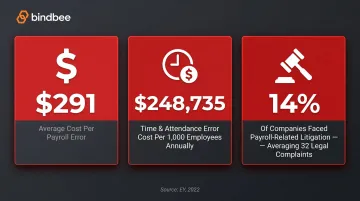
- Average cost per payroll error: $291 (EY, 2022), including direct correction costs and investigation time
- Time and attendance errors cost $248,735 per 1,000 employees annually
- 14% of companies experienced payroll-related litigation in the prior year, receiving an average of 32 legal complaints
Payroll errors also damage employee trust. Research from UKG found that 49% of American workers will start a job search after just two paycheck problems. Payroll errors also damage employee trust. Research from UKG found that 49% of American workers will start a job search after just two paycheck problems.
That number has context: 82 million U.S. workers — 54% of the workforce — have experienced paycheck errors at some point in their careers.
KPIs directly impacted:
- Payroll error rate
- Cost-per-payroll-run
- Employee dispute rate
- Time-to-process-payroll
Advantage 2: Stronger Compliance With Wage and Hour Laws
Wage and hour compliance failures almost always share the same root cause: someone had to manually identify and apply the right pay rule, and they either missed it or applied it incorrectly.
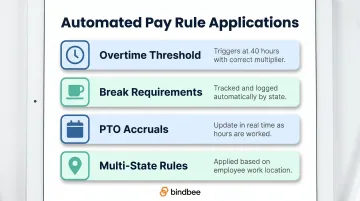
Integrated systems apply pay rules automatically at the point of calculation:
- Overtime kicks in when an employee crosses the 40-hour threshold, with the correct multiplier applied automatically
- State-specific break requirements are tracked and logged without manual intervention
- PTO accruals update in real time as hours are worked
- Multi-state rules are applied based on the employee's work location, not guesswork
The enforcement environment makes this urgent. The DOL's Wage and Hour Division recovered more than $259 million in back wages for 176,957 employees in fiscal year 2025 — the highest recovery since 2019. Civil money penalties for willful or repeated FLSA overtime violations are $2,515 per violation as of January 2025, and they compound fast across a large workforce.
Integration also generates a complete, timestamped audit trail. When a labor audit happens, the question isn't just whether you paid correctly: it's whether you can prove it. Connected systems produce that evidence automatically. Disconnected systems require manual reconstruction under pressure.
This advantage is especially critical for:
- Hourly and shift-based workforces
- Healthcare, construction, food service, and manufacturing
- Organizations operating across multiple states
KPIs directly impacted:
- Compliance violation rate
- Audit preparation time
- Overtime calculation accuracy
- Regulatory penalty exposure
Advantage 3: Operational Efficiency and Workforce Visibility
Every pay cycle, HR teams in disconnected environments follow the same loop: export time data, reformat it, review it for obvious errors, re-enter it into payroll, reconcile discrepancies, and process corrections. That loop consumes real hours, every period, with no end in sight.
SHRM data shows that automating administrative HR tasks saves staff over seven hours per week. For payroll teams processing time data manually, integration is one of the highest-leverage places to reclaim that time.
Speed is part of it — but the more meaningful shift is what HR teams can do with the time they recover:
- Managers approve time from a single interface rather than toggling between systems
- Payroll runs with fewer correction cycles because errors are caught at the source
- Labor cost variance is visible in real time, not discovered at month-end
When time data and payroll data share the same ecosystem, scheduling decisions improve too. Managers can track actual hours against budget, spot overtime creep before it happens, and adjust staffing based on patterns buried in separate reports.
KPIs directly impacted:
- HR administrative hours per pay period
- Time-to-process-payroll
- Labor cost variance
- Manager time spent on approvals
What Happens When Time Tracking and Payroll Aren't Connected
Running disconnected systems creates compounding problems that get harder to unwind as the organization grows:
- Error accumulation: Payroll mistakes from manual re-entry carry forward into future periods, requiring costly correction runs to fix
- Compliance blind spots: Overtime violations and break law breaches go undetected until an audit or employee complaint surfaces them. At that point, back wages and penalties are already accruing
- HR capacity drain: Teams spend meaningful time per period on data reconciliation that contributes nothing to workforce strategy
- Scaling penalty: Every new hire, location, or pay rule adds complexity that manual processes handle poorly — what works at 50 employees typically breaks well before 500
EY data puts a number on it: the average payroll accuracy rate sits at 80.15%, with time-punch failures ranking as the most common error source. That's not a rounding problem — it's a structural one baked into how disconnected systems share data.
How to Get the Most Value From Time Tracking and Payroll Integration
The integration delivers its full value when the data connection is reliable, real-time, and low-maintenance. A sync setup that works until it breaks under volume — or one that requires manual intervention every pay cycle — isn't solving the problem.
For teams operating the integration:
- Review sync logs regularly and treat anomalies as signals, not noise
- Establish clear ownership for exception handling: who resolves missed punches, who approves disputed time entries
- Don't treat integration as a one-time configuration; treat it as a process with defined checkpoints
For HR tech and payroll platforms building this capability, the challenge is different. Connecting to the broader ecosystem means managing dozens of APIs with different data models, authentication approaches, and update cadences. Building and maintaining each connection natively typically costs 4–8 weeks of engineering per integration, with ongoing maintenance on top.
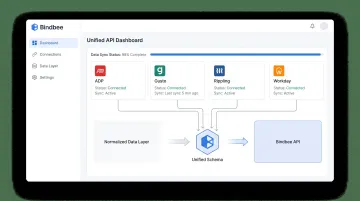
Platforms like Bindbee address this with a single unified API that normalizes data across 60+ HRIS and payroll systems — including ADP, Gusto, Rippling, Paychex, UKG, and Workday. Engineering teams connect once and get coverage across the full ecosystem. Bindbee's normalized data model covers the core fields required for time-to-payroll sync:
- Time sheet entries and hours worked
- Break times and PTO balances
- Compensation data and payroll deduction mapping
Papershift, a workforce management platform serving 250,000+ users, used Bindbee to power their time tracking to payroll integration workflow. Before the integration, each new HRIS connection required up to 3 months of custom development. After: integration deployment time dropped from 90 days to under 24 hours, with an 85% reduction in customer onboarding time and $200,000+ in annual development savings.
Conclusion
Integrating time tracking with payroll is an operational decision with measurable outcomes: fewer payroll errors, reduced compliance exposure, and HR teams with capacity for work beyond data reconciliation.
Those outcomes compound. Fewer errors build employee trust over time. Better compliance records reduce audit exposure before it becomes a problem. And HR hours recovered from manual reconciliation can go toward workforce decisions that actually need human judgment — hiring, retention, planning.
The manual handoff between time capture and payroll was never worth preserving. The organizations that move past it fastest tend to see the clearest returns.
Frequently Asked Questions
What are the benefits of integrating time tracking tools with payroll software?
Integration eliminates manual data re-entry between systems, which is the primary source of payroll errors. It automates the application of overtime rules and pay regulations, reduces HR administrative burden each pay period, and creates a timestamped audit trail that supports compliance without manual documentation.
How do you integrate time tracking with payroll software?
Integration is typically achieved through a direct API connection between the two systems, enabling automatic data sync after each time-capture event or on a scheduled cadence. Some organizations use unified HR platforms with both modules built in; others connect best-of-breed tools through middleware or a unified API layer.
Which payroll platforms offer integration with time tracking tools?
Most major payroll platforms have documented time tracking integration capabilities: ADP Workforce Now, Gusto, Rippling, QuickBooks Payroll, Paychex Flex, and UKG all offer either native time tracking modules or supported third-party connections. The depth and reliability of those integrations varies significantly by platform.
What is the best software for tracking employee time and attendance?
The right fit depends on workforce type (field vs. office-based), business size, and payroll system compatibility. Key features to evaluate include automated clock-in/out, overtime alerts, mobile access for distributed teams, and confirmed sync compatibility with your specific payroll platform.
Does integrating time tracking with payroll reduce compliance risk?
Integrated systems automatically apply wage and hour rules at the point of payroll calculation, flag overtime thresholds before they're breached, and generate timestamped records ready for audit. The result is compliance you can demonstrate, not just describe.
What data is typically synced between time tracking and payroll systems?
Core data fields include regular and overtime hours worked, PTO and leave balances, shift differentials, break times, employee pay rates, and department or cost center codes for labor allocation. More complete integrations also sync compensation changes, payroll deductions, and location-based pay rules.